Introduction
In 2023, a hoisting rope failure on the cargo ship Thorco Basilisk caused a wind turbine component to plummet, resulting in CAD $4-6.5 million in damages. The investigation revealed severe external wear and corrosion masked by grease—a stark reminder that abrasion resistance isn't just a technical specification, it's a safety imperative.
This incident illustrates the catastrophic consequences industrial buyers face in commercial marine, mining, utilities, and heavy rigging operations.
A Bureau of Safety and Environmental Enforcement (BSEE) investigation found that abrasion and corrosion reduced wire rope strength by up to 75% in an offshore platform failure that resulted in a fatality. Industry guidelines now explicitly prioritize abrasion resistance as the #1 selection criterion for ropes in demanding environments.
This guide examines the highest-performing abrasion-resistant ropes available today, backed by ISO testing data and real-world field performance across industrial applications.
Key Takeaways
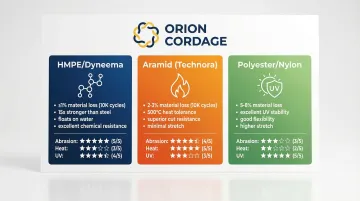
- HMPE ropes (Dyneema/UHMWPE) deliver ≤1% material loss after 10,000 ISO 4649 cycles—the industry's best abrasion performance
- Look for ISO 4649 or ASTM D3884 test documentation showing <2% material loss for demanding applications
- Match rope properties to your environment—high abrasion resistance means little if UV exposure or chemicals degrade the rope first
- Domestic manufacturers offer supply chain reliability, custom engineering, and faster turnaround for time-sensitive projects
- Larger diameter ropes provide significantly better abrasion resistance due to more material available to absorb wear
Overview of Abrasion Resistance in Industrial Rope Applications
What Abrasion Resistance Means
Abrasion resistance measures a rope's ability to withstand surface wear from friction against rough surfaces, edges, or itself under load.
Unlike cut resistance (which measures immediate severance from sharp edges), abrasion resistance measures gradual material loss over thousands of friction cycles.
Testing Standards That Matter
Two primary standards measure rope abrasion resistance:
| Testing Standard | Method | What It Measures | Best Used For |
|---|---|---|---|
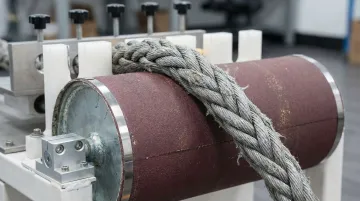
| ISO 4649 | Test piece slides over abrasive sheet on rotating drum | Volume loss in mm³ (lower = better) | Rubber, heavy-duty coatings, industrial rope jackets |
| ASTM D3884 | Specimen rubs against abrasive wheels | Cycles to failure or weight loss per 1,000 cycles | Textile fabrics and rope jackets |
Why This Matters in Extreme Conditions
These testing standards directly predict rope performance in the field. Abrasion is the leading cause of rope failure in industrial applications:
Offshore Mooring: Ropes endure constant cyclic abrasion against fairleads and chocks. OCIMF MEG4 guidelines identify abrasion as a primary degradation mechanism.
Mining Operations: Rock faces and embedded coal dust create internal fiber cutting in underground operations.
Utility Line Work: Pulling lines face repeated contact over rough surfaces during installation.
Heavy Towing & Rigging: High-friction scenarios generate heat that can melt synthetic fibers without adequate abrasion resistance.
Top 5 Most Abrasion Resistant Ropes for Extreme Conditions
These five rope types represent the highest-performing options based on ISO testing data, material science, and proven field performance across industrial applications.
DSM Dyneema® UHMWPE Ropes
DSM's Dyneema® fiber (ultra-high molecular weight polyethylene) sets the industry standard for strength-to-weight ratio and abrasion resistance. The SK78 and SK99 grades are widely adopted in commercial marine, offshore, and heavy industrial applications where failure is not an option.
Why Dyneema® Dominates Abrasion Testing
Dyneema® achieves exceptional performance through its molecular structure. The fiber demonstrates excellent abrasion resistance in yarn-on-yarn testing (ASTM D6611), with a low friction coefficient that minimizes internal abrasion between strands—a critical factor in cyclic bending applications.
| Performance Metric | Specification |
|---|---|
| Abrasion Performance | ≤1% material loss after 10,000 ISO 4649 cycles; superior to all conventional rope materials |
| Breaking Strength | Up to 20,871 kg (45,992 lbs) for 12mm diameter; 15x stronger than steel at same weight |
| Specific Gravity | 0.97 (floats on water); reduces drag and handling weight in marine environments |
| Chemical Resistance | Chemically inert; resists saltwater, acids, and industrial chemicals |
| UV Resistance | Very good; suitable for outdoor use with proper jacketing |
Best Applications
Offshore mooring lines, synthetic winch lines, crane slings, and heavy towing where weight reduction and maximum abrasion resistance are critical. Ideal for applications requiring minimal stretch (typically <3% elongation at working load).
However, prolonged sun exposure in tropical climates benefits from UV-protective jacketing to maximize service life.
Orion Cordage Industrial HMPE Rope
Orion Cordage has manufactured rope since 1856, bringing 168 years of expertise to their domestically-produced HMPE (high modulus polyethylene) ropes.
Their North American facilities serve industrial, marine, utility, and government sectors with thousands of SKUs designed for application-specific requirements.
The Domestic Manufacturing Advantage
Dyneema® fiber technology is widely available, but Orion Cordage stands out through supply chain reliability and custom engineering capabilities.
Their ISO 9001-certified facilities eliminate overseas shipping delays—critical for time-sensitive projects like emergency offshore repairs or scheduled utility maintenance windows.
| Performance Metric | Specification |
|---|---|
| Abrasion Performance | Comparable to DSM Dyneema® (≤1-2% loss after 10,000 cycles); enhanced with proprietary surface treatments for specific industrial environments |
| Customization Options | Available in custom diameters, colors, braiding patterns, and specialized coatings; OEM/ODM partnerships for unique applications |
| Supply Chain Advantage | Domestic manufacturing ensures consistent quality, rapid turnaround, and no overseas shipping delays for time-sensitive projects |
| Lead Times | Tight delivery schedules compared to imported alternatives |
Why Choose Orion Cordage
For buyers prioritizing domestic sourcing, custom engineering support, and reliable delivery schedules alongside top-tier abrasion performance, Orion Cordage offers a compelling value proposition.
Their engineering team provides technical consultation for selecting appropriate rope constructions for extreme abrasion environments—particularly valuable for complex industrial applications requiring specialized solutions.
Best Applications
Industrial rigging, commercial marine operations, utility pulling lines, government contracts, and any application where supply chain reliability and custom engineering support are as critical as material performance.
Marlow Ropes D12 Max (Aramid Core)
UK-based Marlow Ropes has specialized in high-performance marine and industrial cordage for over 200 years. Their D12 Max represents premium aramid-core construction engineered for extreme abrasion environments requiring near-zero stretch.
Aramid's Unique Performance Profile
HMPE excels in most abrasion scenarios, yet aramid fibers (specifically Technora®) offer superior heat resistance and cut resistance. Technora® decomposes at 500°C compared to ~150°C for HMPE, making it ideal for high-friction applications where heat generation is a concern.
In comparative testing of 8mm ropes, Technora-sheathed ropes performed "remarkably well," matching or exceeding the abrasion resistance of larger diameter (11mm) nylon ropes.
| Performance Metric | Specification |
|---|---|
| Abrasion Performance | 2-3% loss after 10,000 cycles (ASTM D3884); aramid fibers resist cutting and surface wear better than nylon or polyester |
| Stretch Characteristics | <3% elongation at working load; static performance ideal for precision rigging and lifting applications |
| Heat Resistance | Maintains integrity up to 500°C; suitable for high-friction winching scenarios |
| Breaking Strength (12mm) | 20,871 kg (45,992 lbs) average break load |
Best Applications
Offshore wind turbine maintenance, heavy crane operations, utility pole work, and applications requiring both exceptional abrasion resistance and minimal stretch. Particularly suited for precision lifting where load positioning is critical.
Note that aramid cores require UV-protective jacketing for outdoor use. The polyester jacket in D12 Max provides some protection, but prolonged UV exposure can degrade aramid fibers without proper covering.
Samson Rope AmSteel®-Blue
AmSteel®-Blue has become an industry standard since its introduction in the 1990s, particularly in arboriculture, rigging, and vehicle recovery applications. Its 12-strand single braid construction offers unique handling characteristics.
The Torque-Free Advantage
Unlike twisted or tightly braided constructions, AmSteel®-Blue's 12-strand design eliminates rope rotation under load—a critical feature for winching and rigging applications where rope spinning can cause dangerous situations or equipment damage.
Samthane Coating Technology
The proprietary Samthane urethane coating enhances abrasion resistance and provides excellent grip. In mining abrasion testing with limestone dust, coated HMPE ropes lasted 3 to 5 times longer than competitor ropes.
| Performance Metric | Specification |
|---|---|
| Abrasion Performance | 1-2% loss after 10,000 cycles with Samthane coating; coating adds 20-30% to abrasion life compared to uncoated HMPE |
| Handling Characteristics | Torque-free design prevents spinning; soft hand feel despite high strength; excellent for splicing and knot retention |
| Breaking Strength (1/2" / 12mm) | 30,600 lbs minimum, 34,000 lbs average |
| Splice Retention | 90%+ of rope strength maintained with proper 12-strand tuck bury splice |
Best Applications
Tree rigging, vehicle recovery winch lines, utility pulling lines, and applications where rope handling and abrasion resistance are equally important. Popular in arborist and off-road recovery markets.
Keep in mind that Samthane coating significantly extends abrasion life, but may wear in high-heat friction scenarios such as rapid winching. For extreme heat applications, consider aramid alternatives.
Yale Cordage Ultrex UHMWPE with Urethane Jacket
Yale Cordage specializes in arborist and industrial ropes, with Ultrex representing their premium UHMWPE construction enhanced with a urethane jacket for maximum abrasion protection in harsh environments.
360-Degree Abrasion Protection
Unlike surface coatings, Ultrex's Maxijacket High Performance urethane coating is applied at the fiber/strand level before braiding. This deep penetration provides superior abrasion resistance and extends wear life compared to surface-only treatments.
Cold Weather Performance
Ultrex maintains flexibility in freezing conditions—a critical advantage for winter utility work, cold-climate mining operations, and offshore applications in northern latitudes. The rope has zero water absorption, preventing weight gain and freezing in wet environments.
| Performance Metric | Specification |
|---|---|
| Abrasion Performance | <1% loss after 10,000 cycles (jacketed); urethane coating extends rope life 2-3x in high-friction scenarios |
| Flexibility & Handling | Maintains flexibility in cold temperatures; easier to grip and handle than bare HMPE fibers |
| Breaking Strength (1/2" / 12mm) | 37,400 lbs average spliced strength |
| Water Absorption | Zero; prevents freezing and weight gain in wet conditions |
Best Applications
Arborist rigging, mining hoist lines, industrial climbing, and any application with repeated contact over rough surfaces or sharp edges. Particularly suited for cold-weather operations where other ropes become stiff and difficult to handle.
Consider that the urethane jacket adds weight and reduces overall breaking strength by 10-15% compared to unjacketed HMPE. This trade-off favors abrasion protection over maximum strength—ideal when rope longevity in abrasive environments is the priority.
How We Chose the Best Abrasion Resistant Ropes
Common Buyer Mistakes
Focusing Solely on Breaking Strength: Many buyers select ropes based on maximum load capacity while ignoring abrasion testing data. A rope with 50,000 lbs breaking strength that loses 5% of its material after 5,000 cycles will fail faster than a 40,000 lbs rope with <1% loss under the same conditions.
Ignoring Internal Abrasion: External wear is visible, but internal abrasion from inter-strand friction during cyclic bending is a major failure mode. Friction generates heat that can degrade HMPE fibers internally without visible external damage.
Overlooking Hardware Condition: The condition of contact surfaces matters as much as rope quality. Corroded or seized fairleads, winches, and sheaves act as abrasive saws, dramatically shortening rope life regardless of material quality.
Failing to Account for Environmental Factors: UV exposure, chemical contact, and temperature extremes affect different rope materials differently. HMPE requires UV-protective jacketing for prolonged outdoor use, while aramid fibers need protection from moisture and acids.
Our Evaluation Criteria
ISO 4649/ASTM D3884 Test Results: We focused on ropes with documented testing showing <2% material loss after 10,000 cycles for demanding industrial applications.
Real-World Field Performance: Laboratory testing provides benchmarks, but real-world performance data from offshore, mining, and utility applications validates long-term durability.
Material Properties: HMPE offers the best overall abrasion resistance and chemical resistance; aramid excels in heat and cut resistance; jacketed constructions provide 360-degree protection.
Construction Type: 12-strand single braids flatten under load, distributing wear over larger surface areas. Double braids offer better handling but concentrate wear on the outer jacket.
Manufacturer Quality Standards: ISO 9001 certification, domestic manufacturing capabilities, and custom engineering support indicate reliable quality control and technical expertise.
Selection Framework for Industrial Buyers
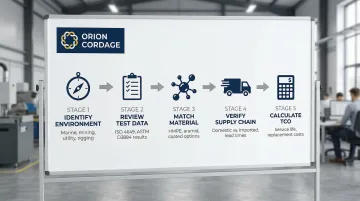
These evaluation criteria inform a practical framework you can apply when selecting rope for your specific application.
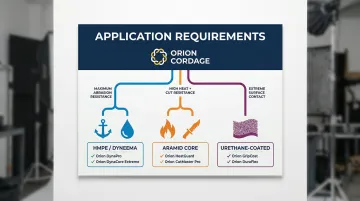
Match Material to Environment:
- HMPE for marine/chemical environments and maximum abrasion resistance
- Aramid for high-heat friction applications and cut resistance
- Urethane-coated for extreme abrasion with repeated surface contact
- Jacketed constructions for UV protection and 360-degree abrasion resistance
Verify Testing Documentation:
- Request ISO 4649 or ASTM D3884 test reports
- Look for <2% loss for critical applications
- Verify testing was performed on the actual rope construction, not just the fiber
Consider Supply Chain Reliability: Domestic manufacturing eliminates overseas shipping delays, while custom engineering support addresses application-specific requirements. Established manufacturer relationships provide ongoing technical consultation as your needs evolve.
Calculate Total Cost of Ownership:
- Higher upfront cost for superior abrasion resistance pays off through extended service life
- Rope failure costs include replacement material, labor, downtime, and potential safety incidents
- Document inspection schedules and retirement criteria based on manufacturer recommendations
Conclusion
Abrasion resistance is non-negotiable for extreme industrial conditions, but it must be balanced with UV stability, chemical resistance, flexibility, and application-specific requirements. HMPE ropes deliver the highest abrasion performance (≤1% material loss after 10,000 ISO 4649 cycles), while aramid cores excel in high-heat scenarios, and urethane jackets provide maximum surface protection.
Before committing to large orders, take these verification steps:
- Request ISO 4649 test data from manufacturers
- Review field performance case studies from similar applications
- Conduct pilot testing in your specific environment
- Document inspection procedures and establish clear retirement criteria based on visible wear indicators
This approach ensures the rope meets your operational demands.
For industrial applications requiring custom rope engineering and proven abrasion performance, contact Orion Cordage at 877-224-2673 or sales@orionropeworks.com.
With over 165 years of rope-making expertise and North American manufacturing facilities, they deliver thousands of SKUs designed for demanding conditions, plus the supply chain reliability and technical support critical for mission-critical applications.
Frequently Asked Questions
Which ropes are most resistant to abrasion and fatigue?
Dyneema/UHMWPE ropes offer the highest abrasion resistance (≤1% loss after 10,000 ISO 4649 cycles), followed by aramid-core ropes (2-3% loss). For fatigue resistance, 12-strand braids generally outperform double braids, while jacketed constructions protect against cyclic bending fatigue.
Is Dyneema rope abrasion resistant?
Yes, Dyneema (UHMWPE) is the most abrasion-resistant synthetic fiber available, with documented ≤1% material loss in ISO 4649 testing. Its low friction coefficient minimizes internal abrasion, making it ideal for high-friction industrial applications like offshore mooring and winch lines.
What abrasion testing standards should I look for when buying rope?
ISO 4649 and ASTM D3884 are the primary standards for measuring abrasion resistance. Look for <2% material loss after 10,000 cycles for demanding applications, and verify testing was performed on the actual rope construction, not just the fiber.
How does rope diameter affect abrasion resistance?
Larger diameter ropes offer significantly better abrasion resistance because more material is available to absorb wear—an 11mm rope lasts substantially longer than a 6mm rope under identical conditions. However, construction type and fiber material have greater impact than diameter alone.
Can abrasion-resistant rope also handle UV and chemical exposure?
HMPE ropes offer excellent chemical resistance and good UV resistance, though prolonged outdoor exposure benefits from UV-protective jacketing. Polyester provides superior UV resistance but lower abrasion performance. Hybrid constructions (HMPE core with polyester jacket) balance both requirements—ideal for outdoor industrial applications.
What's the difference between abrasion resistance and cut resistance?
Abrasion resistance measures surface wear from friction over time (volume or weight loss per cycle), while cut resistance measures a rope's ability to withstand immediate severance from sharp edge contact. Aramid fibers excel at cut resistance, while HMPE offers the best overall abrasion resistance. Some applications require both properties.