Introduction
Selecting rope for load-bearing applications hinges on one specification above all others: strength. For polypropylene rope, understanding strength ratings requires distinguishing between breaking strength and working load, accounting for construction differences, and recognizing that real-world performance rarely matches laboratory data.
A 1/2" polypropylene rope may show a breaking strength of 3,780 lbs in manufacturer specifications. However, that same rope faces multiple strength-reducing factors in actual use:
- Loses 40-60% capacity when knotted
- Degrades 10-20% annually under UV exposure
- Can fail catastrophically under shock loads that spike forces 2-5× beyond static weight
Many users struggle with interpreting strength ratings correctly. They assume all polypropylene rope of the same diameter performs identically, or they treat breaking strength as a safe working capacity. These misinterpretations lead to unsafe rigging, equipment failures, and preventable accidents.
This guide clarifies how polypropylene rope strength is measured, what factors reduce it in the field, and how to apply safety factors correctly across industrial, marine, and rigging applications.
Key Takeaways
- Breaking strength is maximum lab-tested load; working load limit is 1/5 to 1/12 of that capacity
- 8-strand plaited rope offers 10-15% higher strength than 3-strand twisted
- Knots reduce strength by 40-60%; properly executed splices retain 85-95% of original capacity
- UV exposure degrades polypropylene faster than nylon or polyester, causing 10-20% annual strength loss outdoors
- Polypropylene maintains 100% strength when wet but exhibits poor shock absorption compared to nylon
What Rope Strength Represents in Polypropylene Cordage
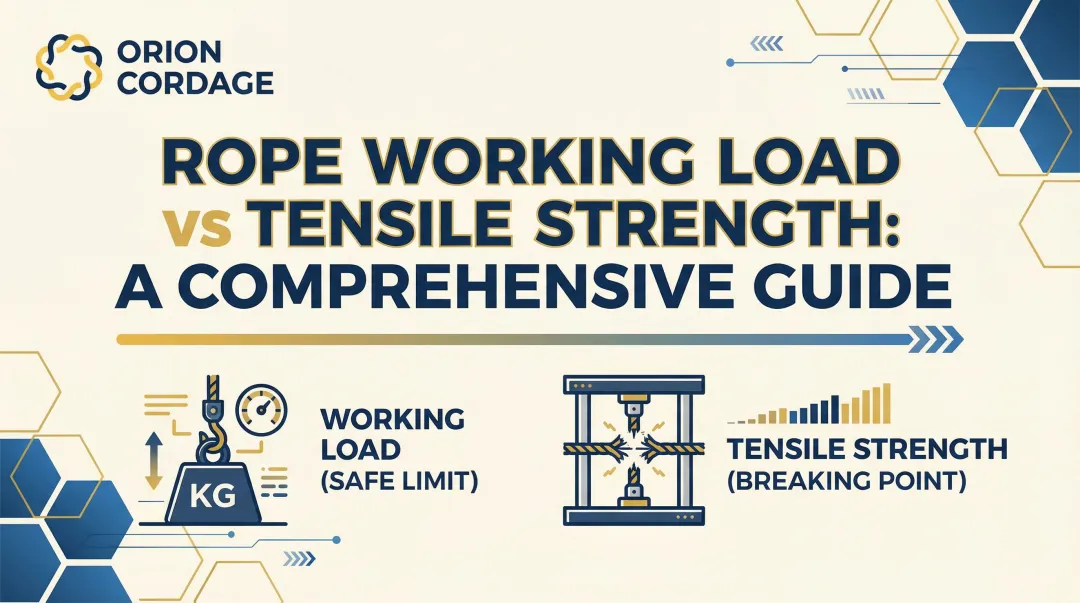
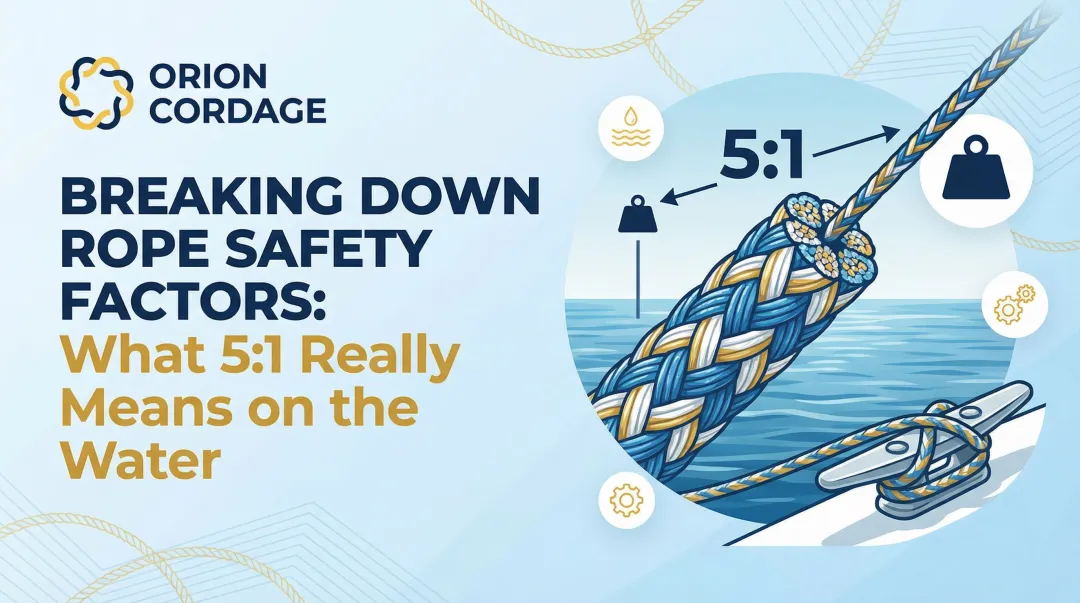
Rope strength is defined by two distinct measurements: breaking strength (also called tensile strength or minimum breaking strength) and working load limit. Breaking strength is the maximum force a new, unused rope can withstand under controlled laboratory conditions before failure—it represents the rope's absolute physical limit. Working load limit (WLL) is the maximum recommended load for safe operation, calculated by dividing breaking strength by a safety factor (typically 5:1 to 12:1 depending on application criticality).
This distinction matters because published strength ratings assume ideal conditions: new rope, no knots, no environmental degradation, and static loading. In the field, none of these conditions hold.
A rope subjected to UV exposure, tied with knots, and loaded dynamically may retain only 20-30% of its published breaking strength.
Material vs. Construction Strength
Polypropylene's base strength comes from its molecular structure—long thermoplastic polymer chains with a fiber tenacity of approximately 6.5 grams per denier (a measure of fiber strength), lower than nylon (7-9.5 g/den) or polyester but adequate for non-critical applications.
Rope strength isn't solely a material property, though. Construction type—how fibers are twisted, braided, or plaited—determines how effectively the rope translates fiber strength into load-bearing capacity.
Strength as a Governing Constraint
Unlike abrasion resistance or UV stability (which degrade gradually), exceeding rope strength results in immediate catastrophic failure. Fibers reach their breaking point simultaneously, and the rope parts without warning.
This makes strength the single most critical specification for any load-bearing application—there is no "close enough" margin when operating near capacity.
Strength Variations by Construction Type
Three-strand twisted rope typically exhibits the lowest strength-to-diameter ratio because the helical twist creates a "spring effect" that increases elongation but misaligns fibers relative to the load axis. Eight-strand plaited polypropylene offers 10-15% higher strength than 3-strand of the same diameter due to better load distribution across interwoven strands. Hollow braid construction sacrifices 30-50% of strength compared to solid 3-strand because it contains significantly less fiber material within the same diameter.
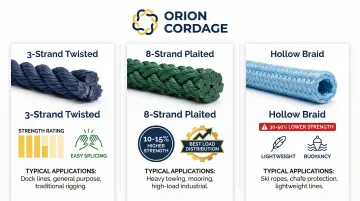
When to Select Each Construction:
- 3-strand twisted: General utility applications where moderate strength, easy splicing, and cost-effectiveness matter more than maximum capacity
- 8-strand plaited: Rigging and industrial applications requiring higher strength and better handling characteristics
- Hollow braid: Lightweight applications where buoyancy and flexibility outweigh strength requirements (swimming lane markers, decorative use)
Range of Polypropylene Rope Strength by Diameter and Construction
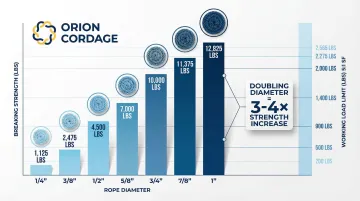
Polypropylene rope strength scales non-linearly with diameter—doubling the diameter roughly triples or quadruples breaking strength due to the increase in cross-sectional fiber mass.
Breaking strengths range from approximately 1,125 lbs for 1/4" rope to over 46,000 lbs for 2" diameter in 3-strand construction.
Typical Breaking Strength by Diameter (3-Strand Construction)
The table below presents minimum breaking strength values for standard 3-strand polypropylene rope, along with corresponding working load limits calculated using a conservative 5:1 safety factor:
| Diameter | Breaking Strength | Working Load (5:1 Safety Factor) |
|---|---|---|
| 1/4" (6 mm) | 1,125 lbs (510 kg) | 225 lbs (102 kg) |
| 5/16" (8 mm) | 1,710 lbs (776 kg) | 342 lbs (155 kg) |
| 3/8" (10 mm) | 2,430 lbs (1,102 kg) | 486 lbs (220 kg) |
| 1/2" (12 mm) | 3,780 lbs (1,715 kg) | 756 lbs (343 kg) |
| 5/8" (16 mm) | 5,580 lbs (2,531 kg) | 1,116 lbs (506 kg) |
| 3/4" (18 mm) | 7,650 lbs (3,470 kg) | 1,530 lbs (694 kg) |
| 1" (24 mm) | 12,825 lbs (5,817 kg) | 2,565 lbs (1,163 kg) |
These values represent minimum specifications for new rope tested under controlled conditions.
Actual strength may be higher depending on manufacturing quality—manufacturers like Orion Cordage, with over 165 years of domestic manufacturing experience, often exceed minimum industry standards through quality control and material selection.
Construction-Specific Strength Differences
Eight-strand plaited polypropylene distributes load more evenly across interwoven strands, resulting in approximately 10-15% higher breaking strength than 3-strand twisted rope of equivalent diameter. For example, a 1/2" 8-strand plaited rope might achieve 4,200-4,300 lbs breaking strength compared to 3,780 lbs for 3-strand.
Hollow braid construction, while offering excellent flexibility and buoyancy, contains 30-50% less fiber material than solid constructions. A 1/2" hollow braid polypropylene rope might have a breaking strength of only 2,200-2,600 lbs—insufficient for most industrial rigging applications but acceptable for lightweight utility tasks.
Safety Factors and Working Load Limits
Safety factors exist to account for variables that reduce rope strength in real-world use: knots, wear, UV degradation, dynamic loading, and manufacturing variations. Industry standards recommend:
- 5:1 (General Industrial): Standard for non-critical applications with predictable static loads
- 8:1-10:1 (Overhead Lifting): Required when loads are suspended overhead or failure presents property damage risk
- 12:1 (Life Safety): Mandatory for rescue operations, fall protection, or any application involving human safety
Never exceed working load limits. Approaching the WLL requires thorough inspection and engineering judgment.
Operating near capacity accelerates fatigue, increases creep (permanent stretching), and eliminates safety margin for unexpected shock loads or undetected degradation.
Factors That Influence Polypropylene Rope Strength in Real-World Operation
Published breaking strengths represent ideal laboratory conditions—new rope, no knots, controlled temperature, and static loading. Real-world strength is always lower, often dramatically so.
These degradation factors are cumulative. A rope with knots, UV exposure, and surface abrasion may retain only 20-30% of its original rated strength.
Knots and Splices
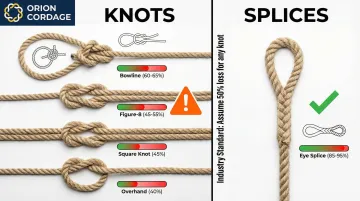
Knots create severe bends and compression points that concentrate stress and shear individual fibers. Different knots reduce strength by varying amounts:
- Bowline: ~60-65% strength retention (35-40% loss)
- Figure-8: ~45-55% retention (45-55% loss)
- Square knot: ~45% retention (55% loss)
- Overhand knot: ~40% retention (60% loss)
Industry guidelines recommend assuming 50% strength loss for any knotted rope unless specific knot data exists. The weak point in a knotted rope is always at the knot itself, not along the standing part.
Splices are far superior for permanent terminations. A properly executed eye splice retains 85-95% of the rope's original strength, making spliced terminations the preferred choice for critical rigging applications.
UV Degradation and Sunlight Exposure
Polypropylene is inherently susceptible to photo-oxidation—UV radiation breaks polymer chains, causing surface fibers to become brittle and powdery.
Untreated polypropylene can lose up to 30% of its strength within months of continuous outdoor exposure in high-UV environments.
UV-stabilized polypropylene treated with Hindered Amine Light Stabilizers (HALS) can retain approximately 90% of tensile strength after 2,000 hours of accelerated UV testing—significantly better than untreated rope but still inferior to polyester or nylon for long-term outdoor applications.
For outdoor applications:
- Specify UV-stabilized polypropylene for outdoor applications
- Inspect outdoor rope quarterly for surface chalking or discoloration
- Replace critical outdoor rope every 1-2 years regardless of visible condition
Abrasion and Surface Wear
Surface abrasion physically removes load-bearing fibers. Even minor surface fuzzing indicates strength loss.
Industry inspection guidelines state that visible abrasion reducing rope diameter by 10% may correspond to 20-30% strength loss, as surface damage often indicates deeper internal wear.
Rope should be retired when:
- 3-strand rope: Retire if any strand shows 10% diameter reduction
- Braided rope: Retire if 25% of sheath fibers are broken or worn
- Any construction: Retire immediately if glazing (heat-melted fibers) or stiff sections are present
Use chafe protection (sleeves, padding, or edge guards) at high-wear points such as corners, pulleys, or rough surfaces to extend rope service life.
Chemical Exposure and Environmental Factors
Polypropylene has excellent resistance to most acids, alkalis, and petroleum products, making it suitable for industrial environments where chemical exposure is common. However, strong oxidizers (chlorine, concentrated bleach) and certain solvents can degrade the polymer.
Temperature significantly impacts rope performance:
- Below -20°C (-4°F): Polypropylene becomes brittle; shock loads may cause sudden failure
- Above 50-65°C (122-150°F): Strength begins to decline; prolonged exposure accelerates degradation
- Melting point: ~165°C (330°F)
Unlike natural fibers (manila, sisal), polypropylene maintains 100% of its dry strength when wet because it absorbs virtually no water. This makes it reliable for marine applications where consistent performance in wet conditions is essential.
Age and Storage Conditions
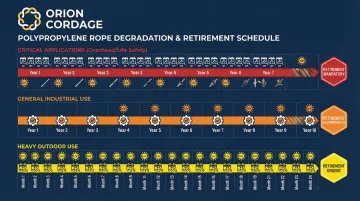
Even properly stored polypropylene rope degrades over time due to oxidation and polymer chain breakdown. Recommended retirement schedules vary by application:
- Critical applications (overhead lifting, life safety): 5-7 years maximum, regardless of use frequency
- General industrial use: Replace when visible degradation appears or after 7-10 years
- Heavy outdoor use: 1-2 years for UV-exposed rope in critical applications
Proper storage extends rope life:
- Cool, dry environment away from direct sunlight
- Store away from chemicals, solvents, or battery acid
- Avoid prolonged storage under tension
- Keep rope clean and dry between uses
Key Technical Properties of Polypropylene Rope Strength
Polypropylene's strength characteristics are defined by material properties, load-response behavior, and performance under stress. Understanding these properties helps predict how the rope will perform under specific operating conditions.
Tensile Strength and Fiber Tenacity
Polypropylene fiber has a breaking tenacity of approximately 6.5 grams per denier, placing it in the moderate strength range for synthetic fibers. This translates to a good strength-to-weight ratio for non-critical applications.
Nylon and polyester offer higher absolute strength per unit weight, but polypropylene excels in cost-effectiveness for general utility work.
Elongation and Shock Load Absorption
Polypropylene elongates 12-22% at break, providing moderate elasticity.
Nylon (18-28% elongation) absorbs shock loads more effectively, while low-stretch fibers like polyester or Spectra elongate less than polypropylene.
Practical effects:
- Polypropylene provides adequate shock absorption for general utility applications
- Not recommended for high-shock environments such as anchor lines, climbing rope, or dynamic fall arrest systems
- Dynamic shock loads can generate forces 2-5× the static load, easily exceeding breaking strength if safety factors are insufficient
Strength Retention When Wet
Polypropylene's hydrophobic nature means it absorbs essentially no water. Polypropylene maintains 100% of its dry strength rating in wet conditions.
Nylon may gain 10-15% strength when wet, while manila loses strength. This makes polypropylene strength ratings reliable for marine and wet environments without adjustment.
How Polypropylene Rope Strength Is Specified, Measured, and Validated
Understanding how manufacturers determine and verify rope strength helps buyers evaluate product quality and reliability. Reputable manufacturers test samples against industry standards and publish minimum breaking strength values that meet or exceed specifications.
Specification Standards and Documentation
Rope strength testing is governed by industry standards including:
- Cordage Institute (CI) Specifications: US-based standards defining test methods and minimum performance requirements
- ISO 2307: International standard for determining physical and mechanical properties of fiber ropes
- ASTM D4268: Test methods for fiber rope diameter, circumference, and breaking force
Manufacturers test rope samples to verify they meet or exceed these minimum standards. Orion Cordage, with manufacturing facilities across the USA and Canada, conducts rigorous testing to ensure consistent quality.
Specifications should reference minimum breaking strength, not average values, to ensure consistent performance across production batches.
Testing Methods and Breaking Strength Determination
Standard tensile testing involves mounting rope samples in a testing machine and applying force at a controlled rate until failure. Multiple samples are tested to establish statistical minimum breaking strength.
Testing is performed on new rope without knots under controlled laboratory conditions (typically 20°C, 65% relative humidity).
Key testing parameters:
- Samples are conditioned to standard atmosphere before testing
- Pull rate is controlled to ensure consistent failure data
- Most manufacturer data is based on spliced samples rather than bollard wraps, reflecting real-world usage
Field Inspection and Strength Assessment
Laboratory testing establishes initial strength, but field conditions require different assessment methods. There is no practical field test to measure remaining strength of used rope.
Inspection relies on visual and tactile assessment using these retirement criteria:
- Visible fiber damage or broken strands
- Stiffness or loss of flexibility
- Discoloration indicating UV or chemical damage
- Surface chalking or powdery texture
- Known shock load history or overload events
- Reaching manufacturer's recommended service life
When in doubt, retire the rope. The cost of replacement is trivial compared to the consequences of failure—equipment damage, injury, or death in critical applications.
Implications of Operating Outside the Recommended Strength Range
Exceeding working load limits or ignoring degradation factors creates immediate safety risks and accelerates rope failure. Understanding these implications is essential for safe rigging practices.
Overloading and Catastrophic Failure
Rope failure under overload is sudden and without warning. When breaking strength is exceeded, fibers reach their limit simultaneously and the rope parts instantly.
Dynamic shock loads from sudden jerks or drops can generate forces 2-5× the static load, easily exceeding breaking strength even when static weight appears safe.
Consequences of failure:
- Load drops with no warning
- Equipment damage or destruction
- Potential injury or death in lifting/rigging applications
- Liability exposure for operators and employers
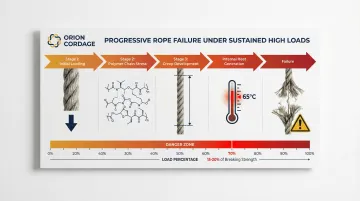
Accelerated Degradation from Sustained High Loads
Beyond catastrophic overload, operating near the upper limits causes gradual but serious damage. Polypropylene exhibits creep—permanent stretching under sustained loads near the working limit.
Continuous loading should not exceed 15-20% of breaking strength to prevent creep failure. In creep failure, polymer chains slowly slide past one another until rupture occurs.
Effects of sustained high loads:
- Repeated loading cycles accelerate fatigue and reduce service life
- Each cycle generates internal heat within the rope structure
- Polypropylene's low critical temperature (65°C) makes it vulnerable to internal melting
- Damage accumulates even when breaking strength is never reached
Common Misinterpretations of Polypropylene Rope Strength in Practice
Several dangerous misconceptions about rope strength persist in the field, putting workers and equipment at risk:
Treating breaking strength as working load This is the most dangerous error. It eliminates all safety margin for knots (40-60% loss), wear, dynamic loading, and environmental degradation. A rope rated at 3,780 lbs breaking strength has a safe working load of only 378-756 lbs depending on application—not 3,780 lbs.
Assuming all polypropylene rope of the same diameter has identical strength This ignores construction type (3-strand vs. 8-strand vs. hollow braid), manufacturer quality, and fiber grade. These variables create significant performance differences even at identical diameters.
Believing "it hasn't broken yet" means the rope is still safe This overlooks invisible strength degradation. UV damage, internal abrasion, and polymer chain breakdown occur gradually over months or years.
A rope may appear intact while retaining only 30-40% of its original strength, then fail catastrophically under a load it previously handled routinely.
Applying indoor/lab strength ratings directly to outdoor UV-exposed applications Without accounting for degradation, this leads to unsafe loading. A rope rated for 3,780 lbs breaking strength may have only 2,600-3,000 lbs effective strength after one year of outdoor UV exposure.
Conclusion
Polypropylene rope strength is not a passive specification to be noted and forgotten. It's the governing parameter that determines safe load capacity, application suitability, and service life.
Understanding the critical difference between breaking strength and working load is essential for reliable operation. Account for real-world degradation factors including knots, UV exposure, abrasion, and age, then follow proper inspection and retirement protocols.
Engineering judgment matters as much as published strength tables. Manufacturers with established quality standards, like Orion Cordage (manufacturing since 1856), provide consistent products that meet or exceed industry specifications.
Even the highest-quality rope degrades under field conditions. Maintain safe operation throughout the rope's service life by:
- Conducting regular visual and tactile inspections
- Applying conservative safety factors (minimum 5:1 for overhead loads)
- Retiring rope at the first sign of significant wear or damage
- Keeping detailed usage and inspection records
Frequently Asked Questions
How much weight can polypropylene rope hold?
Capacity depends on diameter and construction. Working load is typically 1/5 to 1/12 of breaking strength depending on application. For example, 1/2" 3-strand polypropylene with 3,780 lbs breaking strength has a working load of 315-756 lbs. Always consult manufacturer specifications like those provided by Orion Cordage for your specific rope.
What is the difference between breaking strength and working load limit?
Breaking strength is the maximum force before failure under ideal lab conditions. Working load limit is the safe operating load with a safety factor (typically 5:1 to 12:1) that accounts for knots, wear, dynamic loading, and environmental degradation. Never exceed working load limits.
Does polypropylene rope lose strength when wet?
No. Polypropylene maintains 100% of its dry strength when wet because it absorbs virtually no water. This makes it reliable for marine applications where consistent performance in wet conditions is essential, unlike natural fibers which lose strength when wet.
How does UV exposure affect polypropylene rope strength?
UV radiation degrades polypropylene faster than nylon or polyester, causing approximately 10-20% annual strength loss under continuous outdoor exposure. UV-stabilized rope performs better but still requires regular inspection and replacement every 1-2 years for critical outdoor applications.
What is the typical safety factor for polypropylene rope?
Standard safety factors are 5:1 for general industrial use, 8:1-10:1 for overhead lifting or property damage risk scenarios, and 12:1 for life safety applications like rescue operations. These factors account for knots, wear, dynamic loads, and aging.
Does rope construction (3-strand vs 8-strand) affect strength?
Yes. Eight-strand plaited rope typically has 10-15% higher strength than 3-strand of the same diameter due to better load distribution across interwoven strands. Hollow braid has significantly lower strength (30-50% less) than solid constructions due to reduced fiber content.