Introduction
Polyester and nylon dominate the synthetic rope market, accounting for the majority of industrial, marine, and commercial applications worldwide. The global synthetic rope market was valued at $1.02 billion in 2023 and is projected to reach $1.80 billion by 2030, driven largely by these two materials.
Choosing the wrong rope material carries serious consequences. Industry data reveals that up to 30% of rope failures stem from environmental deterioration rather than mechanical overload—failures directly linked to improper material selection.
The wrong choice leads to:
- Premature rope failure and replacement costs
- Equipment damage from unexpected breaks
- Safety incidents putting workers at risk
- Increased operational downtime
Understanding the fundamental differences between polyester and nylon rope is critical for anyone specifying rope for industrial rigging, marine operations, utility work, or commercial applications where performance and safety are non-negotiable.
Key Takeaways
- Polyester: 10-15% stretch, 100% wet strength retention, superior UV resistance—ideal for static loads and marine rigging
- Nylon: 20-30% stretch with excellent shock absorption. Best for towing, anchoring, and dynamic load applications
- Neither material is universally superior—selection depends on whether your application prioritizes dimensional stability (polyester) or shock absorption (nylon)
- Construction type (3-strand, double braid, 12-strand) significantly affects performance within each material category
Polyester vs Nylon Rope: Quick Comparison
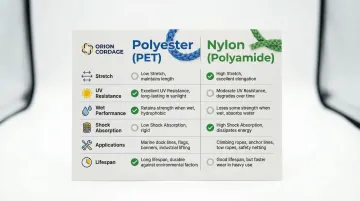
| Feature | Polyester (PET) | Nylon (Polyamide) |
|---|---|---|
| Stretch Characteristics | Low stretch, 10-15% elongation | High stretch, up to 30% elongation |
| Shock Absorption | Minimal—maintains tension | Excellent—absorbs dynamic loads |
| UV Resistance | Excellent (retains ~70% strength after 12 months) | Good (loses 50-60% strength after 36 months) |
| Wet Performance | Retains 100% strength when wet | Loses 10-15% strength when wet |
| Water Absorption | <0.5% (hydrophobic) | 3-7% (hydrophilic) |
| Abrasion Resistance | Excellent | Very good (dry) / Poor (wet) |
| Specific Gravity | 1.38 (sinks) | 1.14 (sinks) |
| Melting Point | ~260°C (500°F) | ~215-260°C (420-500°F) |
| Best Applications | Winch lines, static rigging, halyards, arborist work, utility pulling | Dock lines, anchor lines, towing, recovery, fall protection, mooring |
What is Polyester Rope?
Polyester rope is constructed from polyethylene terephthalate (PET) fibers, the same polymer used in high-performance textiles and industrial applications.
Its defining characteristic is dimensional stability—the ability to maintain consistent working length under sustained loads.
Core Benefits
Low stretch maintains working length: With only 10-15% elongation at break (and just 3-6% at working loads), polyester rope stays dimensionally stable. This makes it essential for applications where maintaining precise tension is critical.
Superior UV resistance extends service life: Polyester retains approximately 70% of its strength after 12 months of outdoor UV exposure, then stabilizes. This dramatically outperforms nylon in outdoor installations.
Excellent wet performance: Unlike nylon, polyester is hydrophobic, absorbing less than 0.5% water by weight. Crucially, it retains 100% of its dry breaking strength when wet—a critical advantage in marine environments.
High abrasion resistance: Polyester's fiber structure provides excellent resistance to wear in pulley systems and hardware contact points, reducing replacement frequency.
These benefits vary depending on how the rope is constructed. Understanding construction types helps match the right rope to your application.
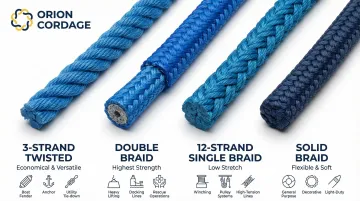
Common Construction Types
- 3-strand twisted: Traditional construction, economical, easy to splice. Prone to rotation under load
- Double braid: Braided core with braided cover. Highest strength-to-weight ratio, excellent for splicing, protects core from UV and abrasion
- 12-strand single braid: Extremely low stretch, non-rotational, preferred for arborist and precision rigging work
- Solid braid: Flexible and smooth, suitable for light-duty applications
Performance Characteristics
Key performance specifications include:
- Heat resistance: Melting point of approximately 480°F provides good thermal performance
- Specific gravity: 1.38 (sinks in water)—important for underwater applications but a consideration for water rescue
- Low creep: Minimal permanent elongation under sustained load means lines don't sag over time in static installations
Limitations
Polyester's low stretch is a disadvantage when shock absorption is needed. It offers slightly lower breaking strength than equivalent-diameter nylon, and some constructions can be stiffer and less flexible than nylon alternatives.
Use Cases of Polyester Rope
Marine Running Rigging
Polyester is the industry standard for sailboat halyards, sheets, and running rigging. Its low elongation ensures sails remain properly trimmed without constant adjustment as wind loads change.
Marine equipment manufacturers universally recommend polyester over nylon for these applications.
Static Rigging and Arborist Work
In arboriculture, construction rigging, and utility installations, polyester's dimensional stability prevents dangerous slack from developing. Climbers and riggers depend on consistent rope length for safety and precision.
Permanent Outdoor Installations
Where safety-critical installations face prolonged exposure, durability becomes paramount. For antenna guys, utility support lines, and permanent moorings where UV exposure is constant, polyester's superior UV stability makes it the reliable long-term choice.
Key advantages for outdoor installations:
- Lifecycle costs favor polyester despite comparable initial pricing
- Resists UV degradation far longer than nylon alternatives
- Maintains strength and dimensional stability over years of exposure
Offshore Mooring
Research on floating wind turbines demonstrates that polyester mooring lines achieve a fatigue life exceeding 10 years in deepwater installations. Standard nylon constructions last approximately 2.5 years under the same conditions.
This 4x longevity advantage makes polyester the economical choice for permanent offshore systems.
What is Nylon Rope?
Nylon rope is manufactured from polyamide fibers (typically Nylon 6 or Nylon 6.6), designed for elasticity and energy absorption. Its defining characteristic is high stretch—the ability to elongate significantly under load and return to original length.
Core Benefits
- Offers the highest breaking strength among common synthetic ropes, providing maximum safety margins in critical applications
- Acts as a built-in shock absorber with 20-30% elongation, protecting equipment during towing, anchoring, or fall arrest
- Easy to handle, knot, and coil due to its flexible fiber structure
- Provides very good abrasion resistance when dry, though this decreases when wet
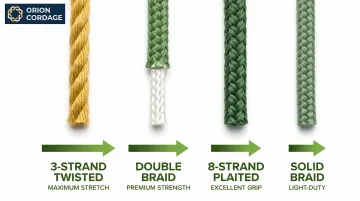
Common Construction Types
- 3-strand twisted: Most elastic construction, affordable and easy to splice
- Double braid: Premium strength with slightly less stretch than 3-strand
- 8-strand plaited: Very flexible with excellent grip for heavy mooring
- Solid braid: Smooth construction for light-duty applications
Performance Characteristics
Key performance specifications:
- Stretches 20-30% under working loads (up to 45% when wet)
- Melting point: 420-500°F depending on formulation
- Specific gravity: 1.14 (sinks in water)
Critical Limitation: Water Absorption
These performance characteristics come with one important trade-off. Nylon is hydrophilic, absorbing 3-7% of its weight in water. This absorption causes a 10-15% reduction in tensile strength when wet—a critical factor that must be accounted for when sizing lines for marine applications. Wet nylon also experiences reduced abrasion resistance.
UV Degradation
While nylon offers good UV resistance with proper marine finishes, it degrades faster than polyester. Uncoated nylon can lose 50-60% of its strength after 36 months of outdoor exposure, compared to polyester's 30% loss that then stabilizes.
Use Cases of Nylon Rope
Dock Lines and Mooring
Nylon is the standard recommendation for dock lines and temporary mooring because its elasticity absorbs critical shock loads:
- Wave surge and wind gusts
- Boat movement and wake impacts
- Protects cleats, deck hardware, and vessel structure from damaging peak loads
Anchoring
For anchor rodes, nylon's stretch is essential. It acts as a shock absorber, preventing the anchor from being jerked out of the seabed during surge conditions. Marine standards consistently recommend nylon (typically 3-strand or 8-plait) for this application.
Beyond marine applications, nylon's shock-absorbing properties make it ideal for high-stress land-based recovery work.
Towing and Recovery
Nylon is the material of choice for tow straps and kinetic recovery ropes:
- Stretches 20-30% to store kinetic energy
- Smooths out violent "snatch" forces during vehicle recovery
- Protects both towed and towing equipment from shock damage
Fall Protection
In fall arrest systems, limiting impact force on the human body is critical. Nylon's high energy absorption makes it suitable for dynamic climbing ropes and lanyards where it cushions falls.
Real-World Performance Data
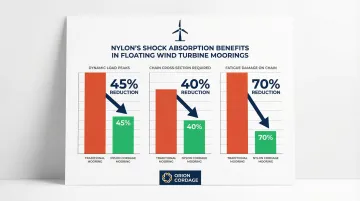
Field testing confirms nylon's shock-absorption advantage. Research on floating wind turbine moorings showed nylon mooring lines deliver measurable benefits:
- 45% reduction in dynamic load peaks vs. polyester
- 40% reduction in required chain cross-section
- 70% lower fatigue damage on chain segments
These results validate why nylon remains the preferred choice for applications where shock loads threaten equipment integrity.
Polyester vs Nylon: Which is Better?
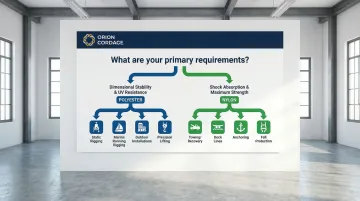
Neither material is universally superior—the right choice depends entirely on your application requirements, environmental conditions, and performance priorities.
Choose Polyester If You Need:
- Minimal stretch and dimensional stability for static rigging, precision lifting, or maintaining consistent length
- Maximum UV resistance for permanent outdoor installations and extended service life in sunlight
- Consistent wet/dry performance where strength cannot vary with moisture (ideal for marine running rigging)
- Low creep characteristics that prevent sagging over time in guy lines, support cables, and permanent installations
Choose Nylon If You Prioritize:
- Superior shock absorption for towing, anchoring, or mooring applications
- Maximum tensile strength where absolute breaking strength is the primary safety consideration
- Energy absorption in applications involving movement, impact, or cyclic loading
- Fall protection systems that dissipate impact forces and reduce peak loads
Construction Matters as Much as Material
Beyond material selection, rope construction significantly affects performance. A 3-strand nylon rope offers maximum stretch, while a double-braid nylon has less elongation but higher strength. A 12-strand polyester provides even lower stretch than double-braid polyester. Always specify both material and construction based on your application.
Key Decision Factors
- Application type: Static loads favor polyester; dynamic loads favor nylon
- Environmental conditions: Outdoor UV exposure favors polyester; applications where wet strength loss is acceptable favor nylon
- Performance requirements: Dimensional stability needs favor polyester; shock absorption needs favor nylon
- Safety considerations: Account for nylon's wet strength loss and snap-back energy storage when sizing lines
Real World Examples
Offshore Wind Mooring: Material Choice Impacts Lifecycle Economics
Floating offshore wind installations face a critical decision: which rope material provides the best long-term value? A 2023 study examined this question by comparing chain-nylon-chain versus chain-polyester-chain mooring configurations in demanding offshore environments.
The situation: Offshore wind installations require mooring systems that can withstand dynamic wave loads for 20+ year service lives. Initial designs used nylon for its shock absorption, but operators questioned whether the material choice was optimal for long-term reliability. Engineers tested both materials under identical environmental conditions, evaluating dynamic load response, fatigue life, and component sizing implications.
Measurable Outcomes:
- Nylon reduced dynamic load peaks by 45%, allowing for 40% reduction in chain cross-section area
- However, standard braided nylon showed fatigue life of only ~5 years versus polyester's >10 years
- To make nylon viable long-term, specialized "long-lay" parallel sub-rope constructions were required to reduce internal abrasion
- Polyester systems, while experiencing higher dynamic loads, provided superior lifecycle economics due to extended service life
Key Takeaway: Material selection must balance immediate performance (shock absorption) against lifecycle durability. For permanent installations, polyester's longevity often outweighs nylon's dynamic performance advantages unless specialized nylon constructions are specified.
UV Degradation in Lifting Applications
UV exposure affects the two materials differently, with measurable safety implications. The Web Sling & Tie-Down Association conducted long-term testing from 1981-2004, directly comparing polyester and nylon performance in outdoor lifting applications.
Boat lifting slings and outdoor rigging equipment experience constant UV exposure, raising questions about safe service intervals and material selection. The results were clear:
- Polyester slings lost approximately 30% strength in the first 12 months, then stabilized
- Nylon slings showed progressive degradation, reaching 50-60% strength loss after 36 months
- Based on this data, manufacturers like Unirope discontinued nylon for boat lifting slings in favor of polyester
Key Takeaway: For outdoor applications with extended UV exposure, polyester's superior stability provides measurable safety and economic advantages through extended replacement intervals and predictable degradation patterns.
Orion Cordage manufactures both premium polyester and nylon ropes at facilities in the USA and Canada, with thousands of SKUs designed and tested for demanding industrial, marine, utility, and rigging applications. Contact the team at 877-224-2673 or sales@orionropeworks.com to discuss your specific requirements.
Conclusion
The polyester versus nylon decision is not about which material is "better"—it's about which material is right for your specific application. Polyester excels where dimensional stability, UV resistance, and consistent wet/dry performance are priorities. Nylon dominates where shock absorption, maximum tensile strength, and dynamic load management are critical.
Selecting the right rope material directly impacts safety outcomes, equipment longevity, operational efficiency, and total cost of ownership.
A polyester halyard that maintains sail trim, a nylon dock line that protects cleats from shock loads, or a polyester utility guy that doesn't sag over years of service—these aren't minor details. They're critical decisions that separate reliable operations from preventable failures.
Make your decision based on:
- Load characteristics: Static versus dynamic forces
- Environmental conditions: UV exposure, moisture levels
- Performance requirements: Stretch tolerance, strength needs
- Construction options: Lay type, core structure, coatings
The right choice, properly specified, delivers years of reliable service. The wrong choice leads to premature replacement, operational issues, or worse—safety incidents. Whether you're rigging a commercial vessel, securing industrial loads, or setting up fall protection systems, matching rope material to application is fundamental to safe, efficient operations.
Frequently Asked Questions
Which is better, nylon or polyester rope?
Neither is universally better—it depends on your application. Nylon excels in dynamic, shock-load situations like towing and mooring (20-30% stretch). Polyester is superior for static loads and UV exposure, retaining 70% strength after 12 months outdoors versus nylon's 40-50% loss.
Is polyester or nylon rope better for swings?
Polyester is best for outdoor swings due to superior UV resistance and minimal stretch, maintaining consistent height without sagging. Nylon works for indoor or shaded swings where shock absorption helps, but degrades faster in sunlight.
Does nylon rope stretch more than polyester?
Yes, significantly. Nylon stretches 20-30% under load (up to 45% when wet), making it ideal for shock absorption. Polyester stretches only 10-15% at break and just 3-6% at working loads, making it better for maintaining consistent length under load.
What rope is best for marine applications?
Polyester is best for running rigging and halyards due to UV resistance and wet performance (retains 100% strength when wet). Nylon is preferred for dock lines and mooring due to shock absorption that protects hardware from dynamic loads.
Which rope lasts longer outdoors?
Polyester lasts longer outdoors, retaining 70% strength after 12 months of UV exposure before stabilizing. Nylon degrades progressively, losing 50-60% strength after 36 months, though proper maintenance extends both materials' lifespans.
How do I choose between nylon and polyester for rigging?
Choose polyester for static rigging requiring low stretch and dimensional stability (guy lines, utility support, precision lifting). Choose nylon for dynamic loads requiring shock absorption or maximum tensile strength without needing dimensional stability.
Does rope construction matter as much as material?
Yes. Construction (3-strand, double braid, 12-strand) significantly affects strength, flexibility, stretch, and spliceability. For example, 12-strand polyester has lower stretch than double-braid polyester. Construction choice is often as important as material selection.