While "linear foot" sounds straightforward, many people confuse it with square feet or struggle with practical measurement techniques. These mistakes lead to ordering errors, budget overruns, and project delays. Whether you're measuring rope for a marine application, trim for a room renovation, or fencing for your property, understanding linear footage measurement is a fundamental skill.
This guide explains what linear footage is, provides step-by-step measurement instructions, covers essential tools, highlights common mistakes, and clarifies how linear feet differ from other measurements.
Key Takeaways
- Linear footage measures length in a straight line—12 inches equals one linear foot
- Basic tools needed: measuring tape (25-foot minimum), marking tool, and notepad
- Measure in straight segments and add them together for total length
- Extra material needed: 5-10% beyond measured length for cutting waste and errors
- Linear feet measure length only; square feet measure area, cubic feet measure volume
What is Linear Footage?
Linear footage measures length in a straight line. One linear foot equals exactly 12 inches or 0.3048 meters, according to NIST Handbook 44, the authoritative U.S. measurement standard.
The term "linear" emphasizes the one-dimensional nature of this measurement—it accounts for length only, not width, height, area, or volume. A linear foot and a "regular" foot are the same measurement (12 inches), but "linear" specifies you're measuring distance in a straight line.
Materials Sold by Linear Foot
Materials with a uniform cross-section where length is the primary variable are typically sold by the linear foot:
- Rope and cordage - Marine lines, industrial rigging rope, utility cord
- Lumber - Dimensional boards, trim, and surfaced lumber
- Fencing - Chain link fabric, posts, rails, and wire
- Trim and molding - Baseboards, crown molding, chair rails
- Piping and wire - Plumbing pipes, electrical wire, cable
When ordering rope from manufacturers such as Orion Cordage for industrial or marine applications, you specify the total length needed in linear feet.
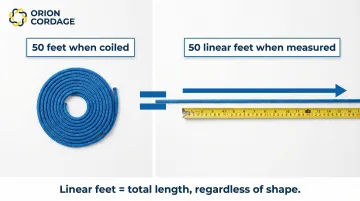
Real-world example: A 50-foot length of rope is 50 linear feet regardless of its diameter or how it's coiled for storage. You're measuring its total stretched-out length, not the space it occupies when coiled.
Step-by-Step Guide to Measuring Linear Footage
Step 1: Gather Your Measuring Tools
Essential tools:
- Measuring tape (25-foot minimum for most projects)
- Marking tool (pencil, chalk, or stakes)
- Notepad or smartphone for recording measurements
Optional tools for larger projects:
- Measuring wheel for distances over 100 feet
- Laser distance measurer for hard-to-reach areas
- Helper to hold tape ends and ensure accuracy
Tool choice depends on project scale. A standard measuring tape works for most DIY projects like trim installation or rope cutting. Measuring wheels suit large perimeters like fencing layouts.
Step 2: Identify What You're Measuring
Determine the start and end points of your measurement:
- Fencing: Corner posts or property boundaries
- Rope or cordage: Total length needed for your specific application
- Trim: Wall-to-wall measurements around room perimeters
Break complex measurements into straight segments. If your path has corners or turns, measure each straight section separately rather than trying to measure around corners in one continuous run.
Mark key points with stakes, chalk, or tape to maintain accuracy and avoid re-measuring the same sections.
Step 3: Measure Each Straight Segment
Extend your measuring tape along the ground, wall, or surface in a straight line from start point to end point. Keep the tape taut and level—sagging adds extra length and creates inaccurate measurements.
Record each measurement in feet and inches (example: 15 feet 7 inches). Note which segment you measured to avoid confusion when adding totals later.
Pro tip: For long measurements, have a helper hold one end of the tape to keep it straight and prevent it from moving.
Step 4: Convert Inches to Decimal Feet (If Needed)
If you measured 15 feet 6 inches, convert the 6 inches to 0.5 feet for easier addition (15.5 linear feet total).
Quick conversion reference:
- 3 inches = 0.25 feet
- 6 inches = 0.5 feet
- 9 inches = 0.75 feet
Many projects allow rounding to the nearest foot, especially when ordering materials with standard lengths. However, for precision work or expensive materials, maintain decimal accuracy.
Step 5: Add All Segments Together
Sum all your individual measurements to get total linear footage. This is your baseline measurement before adding waste allowance.
Example calculation:
- Wall 1: 12.5 feet
- Wall 2: 10.75 feet
- Wall 3: 12.5 feet
- Wall 4: 10.75 feet
- Total: 46.5 linear feet
Double-check your math, especially for large projects where small errors add up quickly.
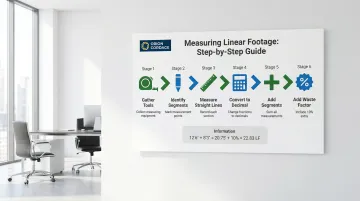
Step 6: Add Waste Factor
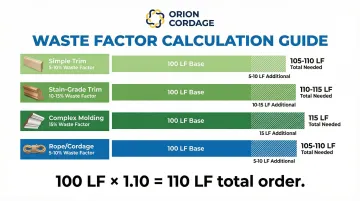
Most projects require 5-10% extra material to account for cutting waste, mistakes, and material defects. Industry standards recommend specific allowances based on material type and project complexity.
Calculation example:
If your total measurement is 100 linear feet, order 105-110 linear feet to ensure adequate supply (100 × 1.05 = 105 or 100 × 1.10 = 110).
Recommended waste factors:
- Simple paint-grade trim: 5-10%
- Stain-grade trim with grain matching: 10-15%
- Complex molding installations: 15%
- Rope and cordage: 5-10% depending on splicing requirements (industrial rope manufacturers like Orion Cordage often provide guidance on waste allowances for specific applications)
When Should You Measure in Linear Feet?
Linear feet measurement applies to any material purchased by length rather than area or volume. This straightforward measurement method works for items sold in continuous runs, making ordering and cost calculations simple.
Use linear feet for these common materials:
Construction and home improvement:
- Lumber, trim, moulding, and baseboards
- Crown moulding and chair rails
- Siding and decking boards
Fencing and outdoor:
- Chain link fabric and posts
- Wire fencing and rails
- Property boundary measurements
Marine and industrial:
- Rope and cordage for rigging, mooring, or utility work (manufacturers like Orion Cordage sell industrial rope by linear footage for accurate load calculations)
- Chain and cable
- Industrial webbing
Utilities:
- Electrical wire and cable
- Plumbing pipes
- Conduit and tubing
Understanding when to use linear feet helps you avoid common measurement mistakes. However, some projects require different units entirely.
When NOT to Use Linear Feet
Don't use linear feet for:
- Floor space - Use square feet (length × width)
- Storage capacity - Use cubic feet (length × width × height)
- Paint coverage - Use square feet for wall area
- Mulch or concrete - Use cubic yards for volume
What You Need to Measure Linear Feet
Essential Measuring Tools
Start with these basic items for most linear measurement tasks:
- Measuring tape: 25-foot or longer for most projects
- Marking tools: Chalk, stakes, or pencil
- Recording method: Notepad or smartphone app
For larger or more complex projects, consider these optional tools:
- Measuring wheel for distances over 100 feet
- Laser distance measurer for solo work or hard-to-reach areas
- Smartphone apps with built-in calculators
Preparation Steps
Once you've gathered your tools, follow these steps to set up for accurate measurements:
- Clear the path by removing obstacles and debris that could affect accuracy
- Mark endpoints by identifying all measurement segments and marking start/end points
- Get help from someone to hold the tape end for measurements longer than 10 feet
- Check conditions to ensure adequate lighting and stable footing
Common Mistakes When Measuring Linear Footage
Measurement errors cost time and money. Research shows measurement errors contribute to 4% of construction rework costs, whether you're cutting lumber, ordering rope, or planning a deck. Avoid these frequent errors:
Measuring curved paths as straight lines
- Always follow the actual path
- Break curves into short straight segments
- Add segments together for total length
Not accounting for corners and turns
- Measure each wall or segment separately
- Add measurements together rather than measuring around corners
- Mark corner points clearly
Forgetting waste factor
- Ordering exactly the measured amount leaves no room for cuts, errors, or damaged sections
- Always add 5-10% minimum for waste
Confusing linear feet with square feet
- Linear feet = length only (one dimension)
- Square feet = area (length × width, two dimensions)
- Check material specifications carefully
Letting measuring tape sag
- Sagging adds extra length to measurements
- Keep tape taut and level
- Use support points every 10-15 feet for long runs
Linear Feet vs. Square Feet vs. Cubic Feet
Understanding the difference between these measurements prevents costly ordering mistakes.
Key Differences
| Measurement Type | Dimensions | Formula | Common Uses |
|---|---|---|---|
| Linear Feet | 1D (length) | Length only | Rope, trim, lumber, fencing, pipe |
| Square Feet | 2D (area) | Length × Width | Flooring, drywall, paint, roofing |
| Cubic Feet | 3D (volume) | Length × Width × Height | Concrete, soil, insulation, storage |
Practical Examples
These real-world scenarios show how each measurement applies to actual projects.
Linear feet: A 10-foot board = 10 linear feet (regardless of width or thickness)
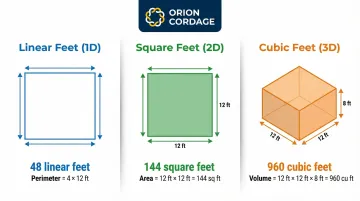
Square feet: A 10-foot × 12-foot room = 120 square feet of floor area
Cubic feet: A 10-foot × 12-foot × 8-foot room = 960 cubic feet of interior space
Conversion scenario: If you're installing baseboard trim around a 12-foot × 12-foot room:
- The room's floor area is 144 square feet (12 × 12)
- The perimeter requiring trim is 48 linear feet (12 + 12 + 12 + 12)
- You would order trim by linear feet, not square feet
Frequently Asked Questions
How many linear feet is a 12×12 room?
A 12×12 room has 144 square feet of floor area. The perimeter (for baseboard or trim) is 48 linear feet (12+12+12+12).
What is the difference between linear feet and square feet?
Linear feet measure length in one direction (12 inches = 1 linear foot), while square feet measure area (12 inches × 12 inches = 1 square foot). Use linear feet for materials sold by length like rope or trim; use square feet for materials covering area.
How do you convert inches to linear feet?
Divide total inches by 12 to get linear feet. Example: 156 inches ÷ 12 = 13 linear feet. For mixed measurements like 15 feet 6 inches, convert just the inches (6 ÷ 12 = 0.5) and add to the feet (15 + 0.5 = 15.5 linear feet).
What tools do I need to measure linear feet?
Basic tools include a measuring tape (25-foot minimum), marking tool (chalk, pencil, or stakes), and notepad. For larger projects, consider a measuring wheel or laser distance measurer. A helper is useful for measurements longer than 10 feet.
Do I need to account for waste when ordering materials by linear foot?
Yes, always add 5-10% extra to cover cutting waste, mistakes, and material defects. Industry standards recommend 10-15% for complex installations requiring precise matching.
Can you measure linear feet around corners?
Measure each straight segment separately and add them together. Measuring around corners in one continuous measurement creates inaccuracy because the tape bends and doesn't follow a true straight line along each wall surface.