Introduction
Lost fish at the last second. Line that tests strong but fails when it counts. For most anglers using braided line, the problem isn't the line itself—it's the knot. Testing shows that improper knots with braid can result in 50% or more loss of line strength, turning premium line into an unreliable weak point.
Braided line's unique properties—ultra-low stretch, thin diameter, and slippery polyethylene coating—demand specialized knot-tying techniques that differ from monofilament or fluorocarbon.
The slick surface of braid means traditional knots that work perfectly on mono often slip and fail under loads far below the line's rated strength.
This guide covers the five most reliable knots for braided line, backed by independent testing and professional angler recommendations, and critical techniques to ensure your connections hold when it matters most.
Key Takeaways
- Braided line needs extra wraps for friction-based grip
- Best knots: Palomar (96% strength, terminal tackle), FG (90-100%, braid-to-leader), Double Uni (85-90%, versatile), Alberto (90-95%, faster)
- Heavy cover demands simple strength (Palomar); finesse fishing requires slim profiles (FG)
- Wet before tightening and add 25-50% more wraps to prevent slippage
Why Braided Line Requires Special Knots
Braided fishing lines are constructed from Ultra-High Molecular Weight Polyethylene (UHMWPE) microfibers—materials like Spectra or Dyneema that deliver exceptional strength but create unique challenges for knot security.
The Slippage Problem
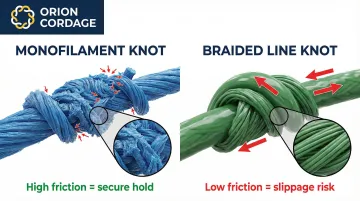
The smooth, coated surface of braid has an extremely low coefficient of friction compared to monofilament. Traditional knots rely on line biting into itself to create holding power, but braid's slick surface prevents this mechanism from working effectively. The primary failure mode isn't line breakage—it's slippage, where the tag end pulls back through the knot structure under loads significantly lower than the line's rated strength.
Zero Stretch Amplifies Weak Knots
Monofilament can stretch up to 25% to absorb shock loads during hook sets and fish runs. Braided line has near-zero stretch, transferring shock directly to the knot without any cushioning effect. This lack of elasticity means your knot must be mechanically superior—there's no stretch to compensate for weak knot construction.
These structural challenges make knot selection critical for braided line performance.
Proper Knots Retain Strength
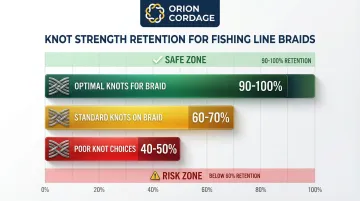
The difference between proper and improper knots is dramatic:
- Optimal knots retain 90-100% of line strength
- Poor knot choices drop retention to 40-50%
- Wrong knot = losing fish and lures
Top 5 Fishing Knots for Braided Line
Independent labs and professional anglers have tested these knots extensively, confirming they maintain maximum strength with braided line across various fishing applications.
Palomar Knot
For tying braided line directly to hooks, lures, and swivels, the Palomar Knot delivers unmatched reliability. Its doubled-line construction creates inherent security that prevents the slippage issues plaguing other terminal knots.
Best Applications:
- Direct connections to terminal tackle
- Heavy cover bass fishing where maximum strength is critical
- Saltwater applications requiring absolute reliability
- Any scenario where you need 95%+ knot strength
How to Tie:
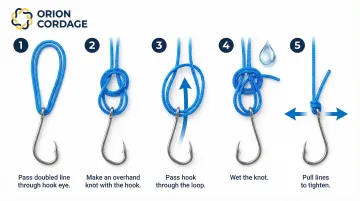
- Double 6 inches of line and pass the loop through the hook eye
- Tie an overhand knot with the doubled line, leaving the hook hanging
- Pass the hook completely through the loop
- Wet the knot thoroughly with saliva or water
- Pull both the tag end and standing line to tighten, ensuring the knot seats evenly
| Attribute | Details |
|---|---|
| Knot Strength Retention | 96% of line strength with proper tying; testing shows breaks at 18.36 lbs on 10 lb braid |
| Best Applications | Terminal tackle connections, heavy cover, saltwater fishing, maximum strength scenarios |
| Difficulty Level | Easy—can be tied in low-light conditions or on the water with minimal practice |
FG Knot
When you need to connect braid to a leader, the FG (Fine Grip) Knot is the top choice among tournament anglers. It creates an ultra-slim profile that passes through rod guides with virtually no resistance while maintaining near-perfect line strength.
Why It's Superior:
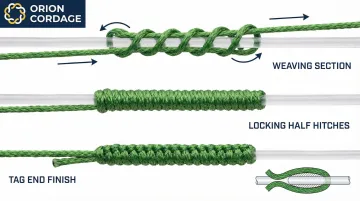
Professional tournament anglers overwhelmingly prefer the FG Knot for its unique construction. Rather than forming a traditional knot structure, the FG weaves braid around the leader in a "finger trap" configuration. This design grips through friction without cutting into the leader material, resulting in the slimmest possible connection and the highest strength retention of any braid-to-leader knot.
How to Tie:
- Hold the leader taut between your hands or knees
- Weave the braid over and under the leader in alternating passes for 15-20 wraps
- Maintain tension throughout the weaving process
- Lock the weave with a series of half hitches around the leader
- Finish with a final securing knot on the tag end
- Trim both tag ends close (this knot allows very close trimming)
This knot demands practice to master. Once learned, it rewards you with superior casting distance and connection reliability.
| Attribute | Details |
|---|---|
| Knot Strength Retention | 90-100% strength retention; often breaks the line before the knot fails |
| Best Applications | Long-distance casting, finesse fishing, tournament bass fishing, offshore applications, any scenario requiring leader material |
| Difficulty Level | Advanced—requires dedicated practice but delivers unmatched performance once mastered |
Double Uni Knot (Uni-to-Uni)
If you want a reliable braid-to-leader connection without the complexity of the FG Knot, the Double Uni offers the best compromise between strength, versatility, and tying speed. While it doesn't match the FG Knot's slim profile, it's significantly easier to tie and maintains excellent reliability.
Key Advantages:
- Works effectively with lines of significantly different diameters
- Reliable in both freshwater and saltwater environments
- Can be tied on the water without tools or complex hand positions
- Serves as an excellent backup when conditions make FG Knot tying difficult
How to Tie:
- Overlap braid and leader by 6-8 inches
- Form a loop with the braid and wrap the tag end around both lines 6-8 times
- Pull the braid tag end to tighten the first uni knot (don't cinch completely yet)
- Form a loop with the leader and wrap its tag end around both lines 4-5 times
- Pull the leader tag end to tighten the second uni knot
- Wet both knots thoroughly
- Pull the standing lines in opposite directions to slide the knots together
| Attribute | Details |
|---|---|
| Knot Strength Retention | 85-90% depending on line diameter differences; tests show approximately 30% weaker than FG Knot |
| Best Applications | Versatile for most fishing situations, ideal for significantly different line diameters, excellent backup knot option |
| Difficulty Level | Moderate—requires understanding of uni knot mechanics but learnable in one session |
Alberto Knot (Crazy Alberto)
The Alberto Knot—also called Crazy Alberto or Modified Albright—creates a compact, strong braid-to-leader connection that's