Introduction
When specifying rope for critical applications, you'll encounter terms like Dyneema, HMPE, Spectra, and UHMWPE—often used interchangeably, but they're not the same. Many buyers face a common dilemma: specify premium Dyneema and pay more, or choose generic HMPE and risk inconsistent performance in demanding conditions like offshore mooring or heavy lifting.
The decision between brand-name Dyneema and generic HMPE directly affects operational safety, cost predictability, and equipment lifespan.
Understanding these differences helps you select the right rope for your requirements—balancing performance consistency, durability, and budget without compromising on what matters most for your operation.
Key Takeaways
- Dyneema and Spectra are premium brands of HMPE—the generic term for ultra-high molecular weight polyethylene fiber
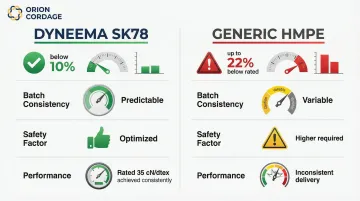
- Strength consistency varies dramatically: generic HMPE shows up to 22% variation while Dyneema maintains less than 10%
- Premium grades last 4× longer under abrasion and resist creep 2-4× better than generic alternatives
- Generic HMPE offers cost-effective performance for non-critical applications where extreme consistency isn't required
- Safety-critical applications justify Dyneema's 15-30% premium through superior total cost of ownership
Dyneema vs HMPE: Quick Comparison
Strength Consistency
Dyneema: Manufacturing quality control ensures batch-to-batch strength variation remains below 10%, delivering predictable performance across production runs. Dyneema SK78 consistently achieves its rated 35 cN/dtex tenacity, allowing engineers to design with leaner safety factors.
Generic HMPE: Independent testing reveals strength variations up to 22% below claimed ratings in generic HMPE products. This inconsistency forces higher safety factors, effectively derating the rope and eliminating cost savings.
Abrasion Resistance
Dyneema: In controlled fairlead abrasion testing, Dyneema SK78 ropes lasted 4× longer than generic HMPE equivalents under identical load cycles.
Superior performance stems from:
- High molecular weight fibers
- Optimized surface properties
- Enhanced resistance at contact points
Generic HMPE: Lower fiber quality and less stringent manufacturing standards compromise abrasion performance. Generic ropes show accelerated wear at contact points, requiring more frequent inspection and earlier replacement.
Creep Performance
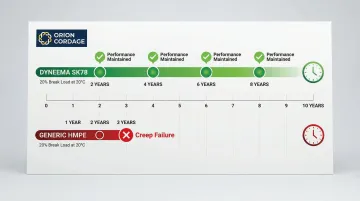
Dyneema: Engineered for stability, Dyneema SK78 maintains performance for 8 years under continuous 20% break load at 20°C. For permanent installations, Dyneema DM20 exhibits virtually zero creep, outlasting most asset operational lifespans.
Generic HMPE: Under identical loading conditions, generic HMPE typically fails due to creep in under 3 years. Higher creep rates require more frequent replacement in static load applications like permanent moorings.
Cost
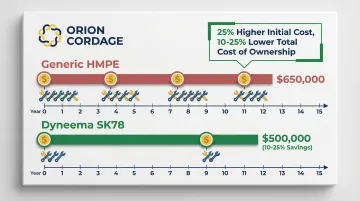
Dyneema: Commands a 15-30% price premium over generic alternatives, but delivers lower total cost of ownership:
- 10-25% cost savings over 15-year project horizons
- Extended service life reduces replacement frequency
- Better suited for critical, long-term installations
Generic HMPE: Offers economical entry point for non-critical applications where:
- Projects have shorter operational timelines
- Frequent scheduled replacement is already planned
- Upfront budget constraints outweigh lifecycle costs
Manufacturing Quality Control
Dyneema: Avient Protective Materials (formerly DSM Dyneema) maintains rigorous production standards with filament diameter variation below 10%. This ensures uniform load distribution throughout the rope structure, preventing premature strand failure.
Generic HMPE: Quality varies widely among manufacturers. Less stringent standards result in greater filament irregularity, leading to uneven loading where some strands break prematurely and cascade into total failure.
Orion Cordage has manufactured high-performance ropes for over 150 years, giving our team direct experience with how material quality translates to real-world performance in demanding industrial and marine applications.
What is HMPE (UHMWPE)?
HMPE (High Modulus Polyethylene), also called UHMWPE (Ultra-High Molecular Weight Polyethylene), is a synthetic fiber with exceptional strength-to-weight characteristics.
Its molecular structure consists of extremely long polyethylene chains aligned parallel through a gel-spinning process, achieving over 95% parallel alignment and more than 85% crystallinity.
Key Performance Characteristics
HMPE delivers the highest strength-to-weight ratio of any industrial fiber:
- 15× stronger than steel at equal weight
- 5× stronger than polyester at equal diameter
- Density of 0.97 g/cm³ - floats in water, unlike steel (7.85 g/cm³) or polyester (1.38 g/cm³)
- Melting point 144-152°C with continuous operating range up to 70°C
- Tenacity of 3.5-4.5 cN/dtex compared to 0.2 cN/dtex for steel wire
Chemical and Environmental Resistance
HMPE maintains performance across extreme conditions:
- Chemical resistance: Highly resistant to acids, alkalis, and most solvents; does not swell or break down in seawater
- Hydrophobic properties: Repels water, preventing moisture-related degradation
- Temperature range: Maintains strength from -150°C to +70°C operational limits
- UV resistance: Retains high residual strength after long-term UV exposure, outperforming aramid fibers that degrade rapidly without protective jackets
Industrial Applications
Beyond marine use, HMPE serves diverse sectors:
- Lifting slings and crane ropes for weight-critical operations
- Tow ropes and recovery lines
- Fall protection systems where minimal stretch limits fall clearance
- Utility line work for electrical transmission stringing (non-conductive when dry)
- Architectural tension structures requiring permanent dimensional stability
Adoption in offshore wind and deepwater operations surges as operators recognize HMPE's neutral buoyancy and handling advantages over steel wire.
Use Cases of HMPE
HMPE fits applications where weight reduction improves safety and efficiency:
- Mooring lines for vessels and barges
- Ship-assist lines and offshore rigging
- Crane applications with weight-critical requirements
The lighter weight reduces handling injuries and allows smaller winches.
Commercial marine, offshore energy, commercial fishing, and industrial rigging have rapidly adopted HMPE. In offshore wind installation, the fiber's neutral buoyancy simplifies subsea operations that would be impractical with heavy steel wire.
When replacing steel wire with HMPE in crane applications, operators typically achieve 2-3× service life extension due to immunity from corrosion and fatigue. Hook block weight drops significantly, increasing effective lifting capacity.
Orion Cordage manufactures HMPE ropes for North American industrial and marine applications, including crane rigging, fall protection, and utility line work.
What is Dyneema?
Dyneema is the premium HMPE fiber brand manufactured exclusively by Avient Protective Materials (formerly DSM Dyneema), positioned as the global reference standard for high-performance polyethylene fibers.
While chemically identical to generic HMPE, Dyneema represents HMPE with rigorously controlled and consistent quality, offering predictable performance across all production batches.
The Quality Differentiator
Dyneema distinguishes itself through verified consistency. Avient's manufacturing process emphasizes tight tolerances and batch-to-batch uniformity, allowing engineers to design systems with confidence in the fiber's performance characteristics.
Quality control extends to filament diameter, tenacity, and long-term behavior under load.
Dyneema Grade System
| Grade | Tenacity (cN/dtex) | Key Characteristic | Primary Application |
|---|---|---|---|
| SK75 | ~35 | High strength, standard creep | General rigging, fishing |
| SK78 | ~35 | Low creep, high fatigue life | Mooring, offshore, heavy lifting |
| SK99 | 42.5 | Highest strength (20% > SK78) | Performance yachting, critical lift |
| DM20 | ~32 | Ultra-low creep (near zero) | Permanent deepwater mooring |
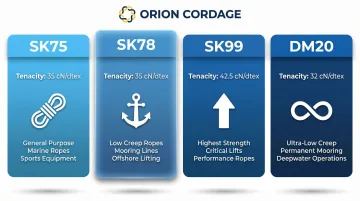
SK78 is the most specified grade for demanding industrial applications, balancing strength with exceptional creep resistance. SK99 serves extreme conditions where maximum strength justifies higher cost.
Certifications
Dyneema SK78 holds type approvals from major classification societies—ABS, DNV, Bureau Veritas, and ClassNK—verifying compliance with specific performance criteria for creep, fatigue, and strength required in safety-critical marine systems.
Use Cases of Dyneema
Safety-Critical Operations:
- Mooring lines for large vessels
- Critical rigging components on offshore platforms
- Fall protection systems
- Industrial safety equipment where failure is not an option
- Applications requiring tighter operational planning through verified consistency
Preferred Industries:
- Offshore oil and gas
- Commercial shipping
- Mega-yacht rigging
- Industrial safety equipment
- Operations where regulatory requirements demand certified performance
Many offshore energy operators require Dyneema SK78 by specification due to its proven track record.
Performance Case Study: BW Fleet Management replaced jacketed generic HMPE lines with Dyneema SK78-based ropes after experiencing multiple failures. The new lines operated for over 1,500 hours without incident, improving safety while allowing easier visual inspection of the rope's condition.
HMPE vs Dyneema: What is Better?
Key Selection Factors
Choosing between Dyneema and generic HMPE requires evaluating:
- Criticality of the application and consequences of failure
- Load requirements and duty cycles
- Environmental conditions (abrasion, UV, temperature)
- How often you'll need to replace the rope and ease of maintenance access
- Total cost of ownership over asset life
- Regulatory or certification requirements
Performance Consistency Impact
Dyneema's manufacturing quality control delivers predictable performance critical for safety and operational planning.
Generic HMPE's variability requires more conservative safety factors (effectively derating the rope) and more frequent inspection to catch batch-related weaknesses before failure.
For permanent moorings or long-service applications, this consistency translates directly to reduced risk and extended replacement intervals.
Situational Recommendations
Choose Dyneema SK78 or SK99 for:
- Safety-critical applications where failure causes injury, environmental damage, or major financial loss
- Continuous high-load scenarios exceeding 15% of minimum breaking load
- Harsh environmental conditions with significant abrasion or cyclic loading
- Situations where downtime costs exceed material cost premiums
- Applications requiring classification society approval
Choose quality generic HMPE for:
- Cost-sensitive projects with acceptable performance margins
- Lower duty cycles with loads typically below 10% of breaking strength
- Applications with frequent scheduled replacement (annual or biennial)
- Non-critical backup or secondary systems
- Projects where budget constraints outweigh performance optimization
Industry Standards
Certain industries require certified materials. Offshore energy operations often need DNV or ABS-approved synthetic ropes, effectively specifying Dyneema SK78.
Fall protection equipment must meet ANSI or CSA standards that reference specific fiber performance characteristics. Commercial marine operations following OCIMF MEG4 guidelines benefit from Dyneema's fully documented compliance pathway.
Generic HMPE may be acceptable in less-regulated applications, but verify that your specific use case doesn't trigger certification requirements.
Total Cost Analysis Framework
Calculate total cost of ownership by considering:
- Initial acquisition cost - rope purchase price
- Expected service life - years or load cycles to retirement
- Replacement labour costs - installation time and vessel/equipment rental
- Downtime costs - lost productivity during replacement
- Inspection frequency - monitoring costs over rope life
Example: A mooring line requiring replacement every 4 years (generic HMPE) will need 3 replacements over 15 years, while Dyneema lasting 10 years needs only 1 replacement. Even with Dyneema's 25% higher purchase price, the reduced replacement labour and downtime typically delivers 10-25% lower total cost.
Real-World Examples
Offshore Mooring Challenge
The Jubilee FPSO project needed a mooring solution for both permanent installation and riser pull-in operations. Traditional steel wire created handling challenges: excessive weight, heavy-duty winch requirements, and significant deck load.
The Solution: Project engineers specified Dyneema SK78 for both mooring and operational rigging. The switch eliminated corrosion concerns while reducing weight by roughly 85%.
Key Results:
- Reduced deck load enabled more compact winch installations
- Flexible rope simplified handling and storage versus rigid steel wire
- Corrosion immunity removed ongoing maintenance requirements in harsh offshore conditions
- Weight reduction of 85% streamlined deck load management
Operational Impact: The project proved high-performance synthetic ropes can meet demanding offshore oil and gas requirements while offering significant handling advantages over traditional materials.
Projects like these highlight why industrial and marine operations increasingly specify HMPE-based solutions. For applications requiring reliable high-performance cordage, Orion Cordage manufactures both premium Dyneema and quality HMPE options backed by over 150 years of rope manufacturing experience. Contact us at 877-224-2673 to discuss your specific requirements.
Conclusion
Dyneema and HMPE are fundamentally the same material, but quality, consistency, and performance vary significantly between premium branded fiber and generic alternatives.
Dyneema offers superior consistency (strength variation below 10%), exceptional abrasion resistance (4× longer life), and extended creep performance (8 years versus under 3 years at 20% load), justifying its use in safety-critical and high-value applications. Quality generic HMPE provides excellent performance for cost-sensitive projects where extreme consistency is not required.
Your choice depends on several key factors:
- Application requirements and safety criticality
- Risk tolerance and liability exposure
- Total cost of ownership (purchase price + replacement frequency)
- Performance consistency requirements
For industrial and marine operations, selecting the right high-performance rope affects safety, operational efficiency, and long-term costs. Orion Cordage manufactures both premium Dyneema and quality HMPE ropes at facilities in the USA and Canada, supporting North American operations with domestic production, thousands of SKUs, and tight lead times since 1856.
Frequently Asked Questions
Is Dyneema the same as HMPE?
Dyneema is a brand name for HMPE fibre, similar to how Kleenex became synonymous with facial tissue. All Dyneema is HMPE, but not all HMPE is Dyneema—the difference lies in manufacturing quality control, consistency, and performance verification that distinguish premium branded fibre from generic alternatives.
Which is stronger: Dyneema or generic HMPE?
Premium Dyneema consistently meets claimed strength ratings with less than 10% variation, while generic HMPE can vary up to 22% below specifications. Strength consistency matters more than peak strength for critical applications.
What are the different grades of Dyneema?
SK75 offers entry-level performance, SK78 is most popular for demanding applications with superior creep resistance, and SK99 provides 15-20% higher strength for extreme conditions. DM20 offers ultra-low creep for permanent installations.
Can HMPE rope replace steel wire in industrial applications?
Yes, HMPE ropes increasingly replace steel wire due to comparable strength at a fraction of the weight, easier handling, and corrosion resistance. Marine rigging, crane operations, and lifting applications deliver 2-3× longer service life.
How long do HMPE/Dyneema ropes last?
Service life depends on application conditions, load cycles, and abrasion exposure. Premium Dyneema lasts 2-4× longer than generic HMPE—for example, 8 years versus under 3 years for permanent moorings.
What industries commonly use HMPE ropes?
Commercial marine, offshore energy, industrial manufacturing, utility work, commercial fishing, and architectural applications all rely on HMPE ropes. Adoption continues growing as industries recognize performance and safety benefits over steel wire and polyester.