Introduction
Mooring line failures account for numerous maritime accidents each year, with snap-back incidents causing fatalities and serious injuries across commercial shipping operations. The stakes are high: a single line failure can result in vessel drift, terminal damage, and crew casualties.
The maritime industry has decisively shifted from traditional steel wire and natural fiber ropes to synthetic alternatives—a transition driven by weight reduction needs, corrosion resistance, and enhanced safety protocols mandated by OCIMF MEG4.
Modern synthetic mooring lines offer strength comparable to steel at a fraction of the weight, with some materials like HMPE delivering 15 times the strength-to-weight ratio of steel wire.
This guide covers what maritime professionals need to know about synthetic mooring lines:
- Material types and performance characteristics
- Regulatory compliance requirements
- Selection criteria for vessel applications
- Maintenance protocols that extend service life and ensure crew safety
TLDR:
- Synthetic lines offer superior strength-to-weight ratios and corrosion resistance versus steel and natural fiber
- OCIMF MEG4 mandates Line Design Break Force (LDBF) at 100-105% of Ship Design MBL
- Material selection depends on application: HMPE for high-strength/low-stretch needs, polyester for permanent moorings, nylon for shock absorption
- Proper inspection protocols and retirement at 75% residual strength are critical for safety
- D/d bend ratios of at least 15:1 are required to prevent premature fatigue failure
What Are Synthetic Mooring Lines?
Synthetic mooring lines are rope systems made from man-made polymer fibers that secure vessels to berths or offshore structures. These lines absorb dynamic forces from wind, waves, and currents through controlled elongation rather than rigid resistance.
How They Work
Synthetic lines transfer loads from vessels to anchoring points through a combination of tensile strength and controlled stretch. When environmental forces act on a moored vessel, the lines elongate to absorb shock loads, then recover to maintain position.
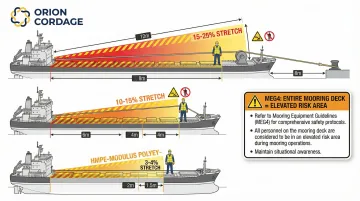
This dynamic response varies significantly by material—nylon can stretch 15-25%, while HMPE stretches only 3-4%.
Evolution from Traditional Materials
The maritime industry's transition away from traditional mooring solutions addresses critical operational challenges:
Steel Wire Rope Limitations:
- Extreme weight creates handling hazards and requires heavy deck equipment
- Corrosion in saltwater environments demands frequent replacement
- Stores dangerous energy under tension with severe snap-back risks
- Provides no shock absorption, transmitting full dynamic loads to vessel and terminal
Natural Fiber Obsolescence:
- Manila and sisal ropes offered shock absorption but lacked durability
- UV degradation and rot limited service life to months rather than years
- Insufficient strength for modern vessel sizes and mooring loads
- Water absorption caused significant strength loss and weight increase
Key Advantages of Synthetic Lines:
- Eliminate corrosion entirely
- Reduce weight by up to 85%
- Provide predictable performance across environmental conditions
- Deliver consistent strength throughout service life
Construction Elements
Modern synthetic mooring lines consist of three primary components:
Core Fibers: The load-bearing element, made from nylon, polyester, polypropylene, or HMPE depending on performance requirements
Rope Construction: Available in multiple configurations:
- 3-strand twisted construction for traditional applications
- 8-strand plaited designs offering balanced torque
- Double-braided (core and cover) for maximum strength retention
- 12-strand single braid for ultra-high-performance applications
Protective Jackets: Optional outer layers that shield core fibers from UV exposure, abrasion, and contamination while maintaining flexibility
Regulatory Framework
Understanding these construction elements is essential because modern maritime regulations now specify exact performance requirements for mooring line materials and design.
OCIMF's Mooring Equipment Guidelines, Fourth Edition (MEG4) released in 2018 fundamentally changed mooring line specification and management. Key requirements include:
Line Design Break Force (LDBF): Minimum breaking force for new, dry, spliced lines, set at 100-105% of the Ship Design Minimum Breaking Load (SDMBL)
Working Load Limit (WLL): Set at 50% of SDMBL for synthetic lines to maintain safety margins during normal operations
Line Management Plans (LMP): Mandatory documentation tracking installation, inspection, maintenance, and retirement of all mooring lines
SIRE 2.0 inspection standards now explicitly verify MEG4 compliance, making proper line specification and documentation essential for vessel operations at major terminals worldwide.
Types of Synthetic Mooring Lines
Choosing the right synthetic mooring material requires understanding how each fiber type performs under load. The five primary options—nylon, polyester, polypropylene, HMPE, and steel wire—each excel in specific applications.
Nylon (Polyamide)
Nylon delivers exceptional shock absorption through high elongation characteristics, stretching 15-25% under load. This elasticity makes it ideal for vessels experiencing dynamic loads from wave action, tidal changes, or vessel traffic wake.
Key Properties:
- High elongation provides excellent energy absorption
- Approximately twice as elastic as polyester
- Stores significant energy when stretched—creating larger snap-back zones
- Good UV resistance when treated
Critical Limitation: Nylon absorbs water, causing approximately 10% strength loss when wet. This strength recovers upon drying, but wet strength must be factored into LDBF calculations per MEG4 requirements.
Best Applications: Shock-absorbing tails, exposed berths with significant swell, vessels requiring cushioning against dynamic loads
Key Properties:
- Ultra-high strength-to-weight ratio (15x stronger than steel by weight)
- Minimal elongation (3-4% at break)—similar to steel wire
- Near-zero water absorption
- Excellent UV resistance when jacketed
- Floats in water (specific gravity 0.98)
Limitations: HMPE is subject to creep—irreversible elongation under sustained load. If not properly managed, creep can lead to rupture, making it less suitable for some permanent mooring applications than polyester.
Best Applications: LNG carriers, large container vessels, offshore platforms requiring high strength with minimal stretch, deepwater moorings where weight savings are critical
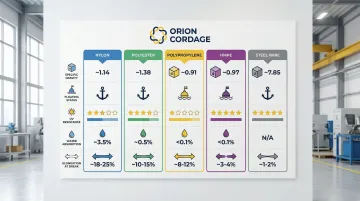
Material Comparison Table
| Material | Specific Gravity | Floats? | UV Resistance | Water Absorption | Elongation at Break |
|---|---|---|---|---|---|
| Nylon | 1.14 | No | Good (treated) | 3-5% | 15-25% |
| Polyester | 1.38 | No | Excellent | <0.1% | 10-15% |
| Polypropylene | 0.91 | Yes | Poor | 0% | 10-15% |
| HMPE | 0.98 | Yes | Excellent | 0% | 3-4% |
| Steel Wire | 7.85 | No | N/A | N/A | <2% |
Performance Characteristics Compared
Strength-to-Weight Ratio
HMPE delivers the most dramatic advantage in strength-to-weight performance, weighing 85% less than steel wire while providing equivalent breaking strength. This weight reduction transforms handling safety and operational efficiency.
Practical Impact:
- Reduced crew fatigue during line handling operations
- Lower risk of musculoskeletal injuries
- Smaller winches and deck equipment requirements
- Faster deployment and recovery operations
- Reduced deck space requirements for line storage
For reference, a typical 64mm HMPE line provides similar breaking strength to a 44mm steel wire rope while weighing approximately 15% as much—dramatically changing what crew members can handle safely.
Elongation and Elasticity
Stretch characteristics vary significantly by material type and directly influence vessel movement, mooring precision, and shock absorption capacity. Selecting the right elongation profile depends on your berth conditions and operational requirements.
High Elongation Materials (Nylon):
- Absorb shock loads effectively, reducing peak forces on bollards and vessel fittings
- Allow greater vessel movement, increasing swing radius
- Store more energy, creating larger snap-back danger zones
- Ideal for exposed berths with significant wave action
Low Elongation Materials (HMPE):
- Maintain precise vessel positioning similar to steel wire
- Transmit dynamic loads with minimal cushioning
- Store less energy, reducing snap-back danger zones
- Often require nylon tails for shock absorption in exposed conditions
- 22m nylon tails are common in exposed ports to reduce peak loads
Moderate Elongation Materials (Polyester):
- Balance positioning precision with shock absorption
- Suitable for most commercial applications
- Predictable behavior across load ranges
Durability Factors
Material durability varies significantly across synthetic rope types:
- Abrasion Resistance: Polyester and HMPE offer excellent resistance to surface wear from contact with fairleads, bollards, and rough surfaces. HMPE often includes protective jackets for additional protection.
- UV Degradation: Polyester ranks highest (5/5) for UV resistance, followed by treated nylon and jacketed HMPE. Polypropylene degrades rapidly without protective covering.
- Chemical Resistance: Synthetic fibers generally resist saltwater, oils, and most marine chemicals. Polyester excels in acidic environments; nylon performs better in alkaline conditions.
Expected Service Life:
- Polyester: 5-7 years in typical commercial applications
- HMPE: Designed lifetime of approximately 8,000 mooring hours, potentially exceeding 10 years with proper maintenance
- Nylon: 3-5 years depending on UV exposure and load cycles
Safety Considerations
All synthetic lines store energy when stretched, creating snap-back hazards when lines part. However, risk levels vary significantly:
Snap-Back Energy: Nylon stores the most energy due to high elongation, creating the largest danger zones. HMPE stores less energy but still presents serious risks due to high strength and low mass. MEG4 advises that the entire mooring deck should be considered an area of elevated risk, as snap-back zones cannot be accurately calculated for all failure scenarios.
Failure Mode: Unlike steel wire which may show visible broken strands or produce audible signals before parting, synthetic lines break suddenly without warning. This makes regular inspection and adherence to retirement criteria absolutely critical.
Recoil Characteristics: Low-stretch materials like HMPE significantly reduce snap-back distance compared to high-stretch nylon, though all materials present serious hazards when lines fail under load.
Applications and Use Cases
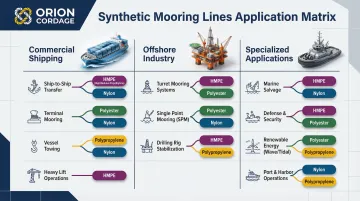
Commercial Shipping
Commercial vessels rely on different synthetic rope configurations based on operational demands:
- LNG Carriers specify HMPE lines for exceptional strength-to-weight ratio and ease of handling. However, failures have been observed in exposed ports, leading operators to add 22m nylon tails that reduce peak loads through shock absorption.
- Container Ships use a mix of polyester for general mooring and HMPE for high-load applications. Rapid turnaround requirements favor lighter synthetic lines that crews can handle more efficiently than steel wire.
- Bulk Carriers use polyester or polyester/polypropylene composite lines for cost-effective mooring with adequate durability for frequent port calls.
Offshore Industry
Oil Platforms and Floating Production Facilities: Polyester is widely used for deepwater taut-leg mooring systems because its lower stiffness induces less tension during storm conditions compared to HMPE or steel. Corrosion resistance dramatically extends service life in harsh marine environments.
Deepwater Moorings: Weight savings become critical as water depth increases. Synthetic lines eliminate the massive weight penalties associated with steel chain and wire systems, making permanent moorings economically viable in ultra-deep water.
Renewable Energy: Synthetic ropes are considered an enabling technology for floating wind and wave energy deployments, where weight reduction and corrosion resistance are essential for long-term reliability.
Specialized Applications
Beyond standard mooring, synthetic lines serve critical specialized roles:
- Towing Operations — HMPE's high strength and low weight make it ideal for emergency towing equipment and long-distance towing where line weight becomes a limiting factor
- Tension-Leg Moorings — Low-stretch materials like HMPE maintain precise platform positioning with minimal vertical movement, critical for drilling operations and process equipment
- Fast Water Moorings — Rivers and areas with strong currents require materials that resist abrasion while maintaining strength. Polyester excels in these applications due to superior abrasion resistance and fatigue life.
Selection Criteria for Synthetic Mooring Lines
Vessel Requirements Assessment
Proper line selection begins with understanding your vessel's specifications and operating profile:
Ship Design MBL: The foundation of all mooring calculations. LDBF must be 100-105% of Ship Design MBL per MEG4 requirements.
Vessel Size and Displacement: Larger vessels require higher-strength lines with greater diameter to achieve required LDBF values.
Operating Conditions:
- Water depth and tidal range affect line length and catenary requirements
- Current velocity influences drag forces and required holding capacity
- Wave action determines need for shock-absorbing characteristics
- Wind exposure affects lateral loads on moored vessels
Environmental Factors
Once you've assessed vessel requirements, environmental conditions shape material selection:
UV Exposure: Vessels operating in tropical or high-altitude regions require materials with excellent UV resistance. Polyester and jacketed HMPE perform best, while polypropylene degrades rapidly without protection.
Water Temperature: Extreme cold can affect line flexibility and handling characteristics. Consult manufacturer specifications for temperature performance ranges.
Chemical Exposure: Vessels loading or discharging chemicals should check line compatibility with specific substances. Most synthetics resist common marine chemicals, but concentrated acids or solvents may require specialized materials.
Service Duration Considerations:
- Temporary moorings: Lower-cost materials like polypropylene provide adequate performance
- Permanent installations: Premium materials (polyester, HMPE) deliver extended service life and better ROI
- Seasonal operations: Match material selection to expected exposure period
Operational Considerations
Your shipboard systems and procedures directly impact which synthetic lines will work best:
Mooring Configuration:
- Catenary moorings rely on line weight for restoring force—synthetics are generally too light unless weighted
- Taut-leg moorings rely on line elasticity—polyester's specific stiffness characteristics make it ideal
Deck Equipment Compatibility: MEG4 requires D/d bend ratios of at least 15 (fairlead diameter to rope diameter). Existing fairleads, winches, and capstans must handle synthetic line diameters or require modification.
Crew Handling Capabilities: Lighter synthetic lines reduce crew fatigue and injury risk, but require different handling techniques than steel wire. Training programs should address synthetic-specific procedures.
Regulatory Compliance: Check that lines meet classification society requirements and port-specific regulations. SIRE 2.0 inspections explicitly verify MEG4 compliance including proper LDBF documentation.
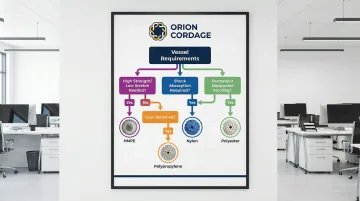
Selection Decision Matrix
| Requirement | Recommended Material | Rationale |
|---|---|---|
| High strength, low stretch | HMPE | Minimal elongation with maximum strength-to-weight ratio |
| Shock absorption needed | Nylon or nylon tails | High elongation absorbs dynamic loads effectively |
| Permanent deepwater mooring | Polyester | Excellent fatigue life without creep rupture concerns |
| Cost-sensitive temporary mooring | Polypropylene | Lowest cost option for light-duty applications |
| Exposed berth with swell | Nylon tails + HMPE main | Combines positioning precision with shock absorption |
The right selection requires balancing technical requirements against operational realities. For North American maritime operators, partnering with experienced manufacturers like Orion Cordage—manufacturing rope and cordage since 1856—provides the technical support and product availability needed to match mooring lines precisely to your vessel's specifications and operating conditions.
Installation, Handling, and Maintenance
Proper Termination Methods
Line terminations represent critical failure points. Professional splices can retain 100% of rope strength, while improper knots reduce strength by 50% or more.
Splicing Techniques:
- Eye splices with thimbles for permanent terminations
- Soft eyes for applications requiring flexibility
- Taper splices for joining different line types
- All splices should be performed by certified riggers following manufacturer specifications
Hardware Requirements:
- Connecting shackles must have Safe Working Load (SWL) equal to or greater than the line's Working Load Limit
- Thimbles protect eye splices from deformation under load
- Soft shackles offer lightweight alternatives for some applications
Deployment and Recovery Procedures
Preventing installation damage starts with proper site preparation:
- Inspect fairleads and remove sharp edges that could damage synthetic fibers
- Avoid dragging lines across rough surfaces during deployment
- Use protective sleeves in high-wear areas
- Never allow lines to contact hot surfaces or running machinery
Winch operation requires careful attention to prevent damage:
- Maintain proper tension during spooling to prevent line burial on drums
- Control payout speed to prevent heat buildup from friction
- Use capstan bars or rope riders to reduce friction on drum surfaces
- Monitor line temperature during high-load operations
Friction between synthetic lines and fairleads or winch drums generates heat that can melt fibers. Glazed or melted fibers indicate heat damage requiring immediate retirement.
Inspection Protocols
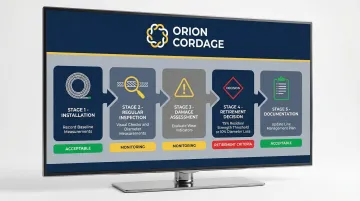
Proper deployment practices protect your investment, but regular inspections ensure long-term safety. Establish inspection schedules based on usage intensity and environmental exposure:
Visual Inspection Indicators:
- Surface abrasion or fiber wear
- Cut or broken strands
- Glazed fibers indicating heat damage
- Compression or flattening of rope structure
- UV degradation (discoloration, brittleness)
- Contamination with chemicals or debris
Measurement Criteria:
- Record diameter at multiple points along line length
- Compare measurements to baseline values from installation
- Document any diameter reduction or inconsistencies
Lines should be retired when residual strength reaches 75% of Ship Design MBL, which typically corresponds to:
- 10% diameter loss for most synthetic materials
- Visible damage to more than 10% of cross-section
- Any evidence of heat damage (fused fibers)
- Compression damage from overloading
Maintain Line Management Plans per MEG4 and SIRE 2.0 requirements, recording:
- Installation date and initial specifications
- Inspection dates and findings
- Maintenance performed
- Retirement date and reason
Frequently Asked Questions
What are synthetic mooring lines?
Synthetic mooring lines are engineered ropes made from man-made polymer fibers (nylon, polyester, polypropylene, or HMPE) designed to secure vessels to berths or offshore structures. They offer superior strength-to-weight ratio, corrosion resistance, and handling safety compared to traditional steel wire and natural fiber ropes.
Are synthetic mooring lines better than natural fiber ropes?
Yes, synthetic lines vastly outperform natural fiber ropes in strength, durability, UV resistance, and service life. Natural fiber ropes (manila, sisal) are now obsolete for commercial mooring, unable to meet modern vessel requirements or regulatory standards like OCIMF MEG4.
What is the difference between HMPE and polyester mooring lines?
HMPE offers superior strength-to-weight ratio (15x stronger than steel) and minimal stretch (3-4%), ideal for high-performance applications. Polyester provides moderate stretch (10-15%), excellent fatigue life, and lower cost, making it preferred for permanent deepwater moorings where elasticity is beneficial.
How long do synthetic mooring lines last?
Polyester typically lasts 5-7 years in commercial applications, while HMPE can exceed 10 years with proper maintenance. Lines must be retired when residual strength reaches 75% of Ship Design MBL, regardless of age.
What safety precautions are needed when handling synthetic mooring lines?
Key safety measures include maintaining clear snap-back zones (treat the entire mooring deck as high-risk), using proper PPE, ensuring correct winch operation to prevent heat damage, avoiding standing in bights or near tensioned lines, and following proper storage to prevent UV degradation.
Do synthetic mooring lines require special equipment?
Optimal performance requires properly sized fairleads (minimum 15:1 D/d ratio per MEG4), rope-compatible winches with adequate grip, and termination hardware rated for the line's working load. Existing steel wire equipment may require modification or replacement.