For recreational and commercial boaters alike, this decision involves balancing performance characteristics against practical considerations like budget, docking environment, and how often you handle your lines.
Key Takeaways
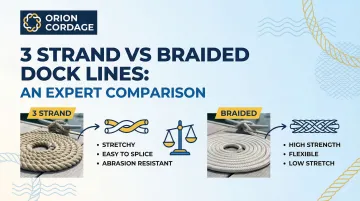
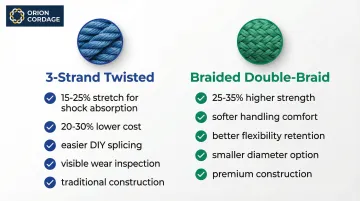
- 3-strand offers superior stretch (15-25%) for shock absorption and costs 20-30% less
- Braided provides 25-35% higher strength, softer handling, and better flexibility retention
- Choose 3-strand for maximum elasticity, budget value, and exposed docking with wave action
- Choose braided for handling comfort, long-term durability, and smaller diameter with equal strength
- Both use nylon for excellent UV and rot resistance in marine environments
3 Strand vs Braided Dock Lines: Quick Comparison
- 3-strand costs 20-30% less upfront but braided offers better long-term value through extended service life
- 3-strand provides up to 16% stretch for superior shock absorption; braided offers half that for tighter position control
- Braided is 25-35% stronger than 3-strand at the same diameter but 3-strand maintains partial strength if one strand fails
- Braided stays soft and flexible longer; 3-strand is easier to inspect for wear and splice without special tools
- 3-strand splicing requires only tape and a knife while braided demands specialized fids and advanced skills
What is 3 Strand Twisted Dock Line?
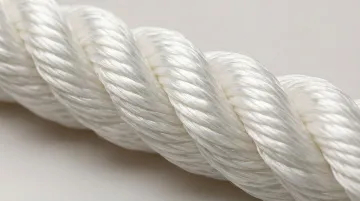
3-strand dock line features three individual bundles of nylon fibers twisted together in a right-hand spiral. This construction creates a rope with inherent elasticity and a distinctive appearance that's been trusted by mariners for generations.
Construction & Performance
The twisted design allows significant elongation under load—the strands untwist slightly before the fibers themselves stretch.
This characteristic makes 3-strand the "shock absorber" of dock lines, stretching up to 16% when loaded to 15% of breaking strength.
Key benefits for docking:
- Cost-effectiveness reduces initial investment by 20-30%
- High stretch protects cleats, deck hardware, and dock infrastructure from shock loads
- Field repair capability allows DIY splicing with minimal tools
- Visible wear inspection allows easy inspection of internal wear
This performance stems from the material quality. The twisted construction uses premium nylon (polyamide), often heat-stabilized to reduce shrinkage and improve handling.
A standard 1/2" 3-strand nylon line has an average breaking strength of 5,750-6,400 lbs.
One consideration: nylon loses approximately 15% of its strength when wet, which must be factored into sizing for storm conditions.
Use Cases of 3 Strand Dock Lines
3-strand dock lines work best where maximum shock absorption is needed and budget matters. Their natural elasticity makes them particularly valuable for boats up to 45 feet in conditions where protecting hardware matters more than raw tensile strength.
Optimal applications:
- Permanent slip docking in areas with significant wave action or tidal movement
- Recreational powerboats and sailboats 20-50 feet
- Commercial fishing vessels requiring durable, economical lines
- Exposed marinas where boats experience regular surge loads
- Custom splicing applications where marinas or boat owners need specific lengths
Performance in Challenging Conditions
In exposed anchorages or marinas with significant wave action, 3-strand's superior stretch can prevent cleats from being ripped out of the deck. Post-storm analyses reveal that boaters sometimes switch back to 3-strand from braided lines specifically to gain this elasticity after experiencing hardware failures.
This same durability extends to long-term maintenance. The visible construction lets you inspect the rope thoroughly:
- See inside strands to detect internal wear before failure
- Identify chafe damage through simple visual inspection
- Spot UV degradation or chemical damage early
- Check splice integrity without specialized tools
What is Braided Dock Line?
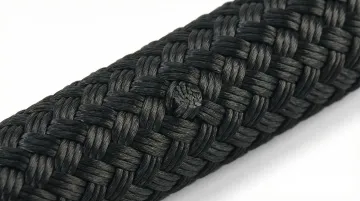
Braided dock lines typically feature double-braid construction: a braided core enclosed within a braided cover, both made of nylon. This "rope within a rope" design creates superior strength-to-diameter ratio and exceptionally soft handling.
Construction & Strength Advantages
The braided construction distributes loads evenly throughout the rope structure, with both the core and cover absorbing stress (percentages vary by manufacturer). This load-sharing design is torque-balanced, meaning it won't twist or kink under load—a significant handling advantage.
Core benefits for marine docking:
- Higher strength allows smaller diameter lines (less storage space, less weight)
- Soft handling reduces hand fatigue during frequent adjustments
- Resistance to stiffening extends service life in saltwater environments
- Professional appearance appeals to yacht owners and marinas
Braided construction is 25-35% stronger than 3-strand of the same diameter. The tightly woven cover protects the load-bearing core from external abrasion, though cover damage significantly reduces strength.
Within the braided category, several construction variations serve different needs:
- Single braid: Simpler construction, different handling characteristics
- Mega braid: 12-strand construction for boats 40+ feet, offering high strength and flexibility
- Core-to-cover ratios: Vary by manufacturer and intended application
Use Cases of Braided Dock Lines
Braided dock lines are preferred for boats requiring frequent line handling, vessels where deck space is limited, and situations where consistent performance over time is critical.
Optimal applications:
- Larger yachts and cruisers (35+ feet) requiring maximum strength in minimal diameter
- Compact storage situations where smaller diameter at equal strength saves space
- Marinas with minimal wave action where extreme stretch isn't necessary
- Frequent line handlers who value comfort and sustained flexibility
- Professional operations where appearance and consistent performance matter
These applications take advantage of braided line's handling and longevity characteristics.
Handling & Longevity Advantages
Braided lines offer distinct performance benefits:
Torque-free handling:
- Coil easily without kinking or "hockling" (the twists that plague 3-strand)
- Softer on hands during adjustment
- Remain supple through repeated use
Long-term flexibility:
- Retain suppleness longer than 3-strand
- Resist becoming stiff and "wiry" with age
- Maintain consistent handling even after multiple seasons of saltwater exposure
3-strand tends to stiffen as it absorbs salt, while double braid construction preserves flexibility throughout the rope's service life.
3 Strand vs Braided: What is Better?
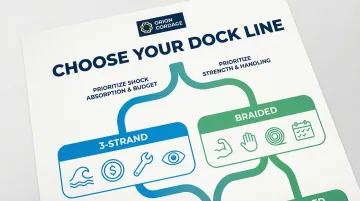
Neither construction is universally "better"—the right choice depends on your specific docking environment, boat characteristics, and priorities.
Decision Framework
Choose 3-strand if you prioritize:
- Maximum shock absorption for exposed slips with wave action or significant tidal range
- Budget efficiency with 20-30% lower initial cost
- DIY splicing capability for custom lengths or field repairs
- Visible wear inspection to monitor rope condition
Choose braided if you prioritize:
- Superior strength-to-diameter ratio for smaller, lighter lines with equal holding power
- Handling comfort with soft, flexible rope that's easy on hands
- Long-term flexibility retention in saltwater environments
- Professional appearance and consistent performance over multiple seasons
Total Cost of Ownership
While 3-strand costs 30-50% less initially, braided lines may last longer due to better UV protection (the cover protects the core) and flexibility retention. Over a 5-10 year period, the higher upfront cost may be balanced out by reduced replacement frequency.
Practical Considerations
Diameter and weight savings: Because braided is 25-35% stronger, you can often use a smaller diameter line to achieve the same strength as a larger 3-strand line. This saves deck space and weight—a 1/2" braided line can replace a 5/8" 3-strand line in many applications.
Durability in challenging environments: In areas with rough pilings, 3-strand's knobby surface can snag, whereas double braid's smooth cover slides more easily. However, 3-strand has more "sacrificial" material before the core is compromised, making it more forgiving of abrasion over time.
Splicing requirements: 3-strand is easily spliced with no special tools—a critical advantage for DIY boaters or remote locations. Double braid requires tubular fids, pushers, and careful measurement. Improper splicing can severely weaken the line, making professional splicing or pre-spliced lengths a safer choice for braided dock lines.
Real World Examples
Real-world testing reveals critical differences between these constructions under stress. An MIT study following Hurricane Gloria found that many nylon lines failed internally due to heat buildup from friction during repeated stretching—not from external chafe as expected.
The Challenge
During the hurricane, dock lines experienced cyclic loading as boats surged repeatedly against their moorings. The constant stretching and relaxing generated internal friction and heat—nylon starts to deteriorate at 300°F and loses half its strength at 350°F.
Non-breathable chafe guards (like PVC) trapped this heat, causing internal melting while exteriors appeared intact. This hidden failure mode proved more dangerous than visible external wear.
Beyond storm conditions, age affects both constructions similarly.
Performance Metrics
Testing on aged 3-strand lines (10-12 years old) revealed critical strength degradation:
- Retained only 25-50% of original breaking strength
- Showed no visible external damage despite internal deterioration
- Demonstrated that age impacts all construction types
Termination methods also significantly affected performance:
- Knots (bowlines) reduced breaking strength to ~50% of rated capacity
- Splices retained significantly more strength
- Proper termination proves as critical as construction choice
Practical Takeaway
Choose dock line construction based on your specific conditions. For exposed locations with surge, 3-strand's higher stretch (20-25%) absorbs shock better. For tight slips with limited movement, braided lines' lower stretch (15-18%) prevents excessive range while maintaining adequate shock absorption.
Both constructions require proper ventilation around chafe points and regular inspection for internal heat damage—especially after storm events.