For operations spanning marine, utility, towing, and rigging applications, the choice between synthetic rope and steel cable directly impacts operational safety, equipment lifespan, and total cost of ownership. This comparison matters because the right rope reduces worker injuries, minimizes downtime, extends replacement intervals, and ultimately improves your bottom line. The wrong choice leads to premature failure, increased maintenance costs, and unnecessary safety risks.
Key Takeaways
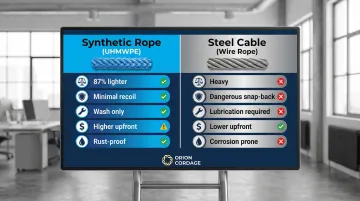
- Synthetic rope weighs up to 87% less than steel, reducing fatigue and handling time
- Steel cable excels in abrasive, high-heat environments where durability outweighs handling convenience
- Synthetic rope virtually eliminates dangerous snap-back recoil if it breaks under load
- Maintenance differs: steel needs lubrication and rust checks; synthetic requires UV and abrasion protection
- Total cost of ownership often favors synthetic despite higher upfront costs due to reduced labor and maintenance expenses
Synthetic Rope vs Steel Cable: Quick Comparison Table
| Feature | Synthetic Rope (UHMWPE) | Steel Cable (6×19 IWRC) |
|---|---|---|
| Weight (per 100 ft, 1/2" diameter) | 5.9 lbs | 46.0 lbs |
| Breaking Strength (1/2" diameter) | 30,600 lbs | 26,600 lbs |
| Abrasion Resistance | Moderate (requires chafe protection) | Excellent |
| UV/Chemical Resistance | Good (coating recommended) | Excellent (impervious to UV) |
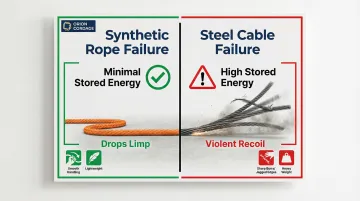
| Safety (recoil risk) | Minimal stored energy, drops limp | High stored energy, dangerous snap-back |
| Maintenance Requirements | Inspect for UV damage, fraying, contamination; wash periodically | Lubricate regularly, monitor for rust and broken wires |
| Initial Cost | Higher | Lower |
| Typical Lifespan | 3-5 years (with proper UV protection) | 5-10+ years (in non-corrosive environments) |
| Best Applications | Off-road recovery, marine operations, frequent handling | Construction cranes, mining, abrasive conditions, high-heat environments |
| Key Limitations | Susceptible to abrasion and cutting; requires hawse fairleads | Heavy, prone to rust, dangerous burrs, requires lubrication |
What is Synthetic Rope?
Synthetic rope refers to high-performance cordage made from ultra-high molecular weight polyethylene (UHMWPE) or similar advanced polymers. Originally developed for maritime and aerospace applications, these ropes deliver exceptional strength-to-weight ratios that often exceed steel at equivalent diameters.
Core benefits include:
- Weighs approximately 1/7th the weight of steel wire rope at the same diameter while delivering comparable or greater breaking strength
- Resists saltwater, acids, and alkalis with no rust or corrosion
- Stores minimal kinetic energy—drops to the ground if it breaks rather than whipping back violently
- Allows bare-handed handling without heavy gloves, reducing operator fatigue
- Floats in water, making it ideal for marine applications
Types and Variations
Synthetic rope comes in several configurations:
- Standard UHMWPE: 12-strand braided construction for maximum strength
- Coated synthetic: Urethane or polyester coating adds abrasion and UV protection
- Heat-resistant variants: Specialized formulations for elevated temperature applications
- Diameter options: Available from 3/8" to 5/8" and beyond, with breaking strengths ranging from 17,600 lbs to 47,500+ lbs
Use Cases of Synthetic Rope
Synthetic rope excels in operations requiring frequent handling, weight reduction, and enhanced safety:
Common applications:
- Off-road vehicle recovery and winching
- Marine and boat operations (mooring lines, tow lines, anchor lines)
- Helicopter external load operations
- Utility work requiring lightweight portability
- Maritime and commercial fishing
- Aerospace ground operations
- Power transmission and utility line work
Real-World Performance Examples
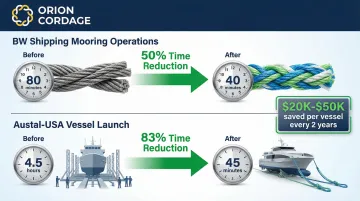
BW Shipping replaced wire mooring lines with synthetic rope and reduced mooring operations time by 50%—from 80 minutes down to 40 minutes per vessel. They also saved $20,000 to $50,000 per vessel every two years in maintenance costs by eliminating lubrication requirements and rust-related replacements.
Austal-USA shipyard switched to synthetic winch lines for vessel launches and cut pre-launch rigging time from 4.5 hours to just 45 minutes—an 83% reduction due to ease of handling.
What is Steel Cable?
Steel cable, also known as wire rope, consists of multiple steel wire strands twisted together around a central core.
This construction—typically featuring a fibre core (FC) or independent wire rope core (IWRC)—has provided reliable performance in heavy-duty applications for over a century.
Core benefits include:
- Superior abrasion resistance: Steel withstands rough surfaces, sharp edges, and abrasive materials better than bare synthetic fibres
- Excellent heat resistance: Stainless steel wire rope can withstand temperatures up to 900°F (480°C)
- UV immunity: Unaffected by ultraviolet degradation
- Chemical resistance: Unaffected by most industrial chemicals
- Proven track record: Over 100 years of documented performance in demanding applications
- Lower initial cost: Often less expensive upfront than equivalent synthetic alternatives
Types and Variations
Steel cable comes in multiple configurations:
- Galvanized vs. stainless steel: Galvanized offers corrosion protection at lower cost; stainless provides superior corrosion resistance and heat tolerance
- Strand configurations: 6×19 (flexible, general-purpose), 6×37 (greater fatigue resistance), and specialized designs
- Rotation-resistant designs: Minimize twisting under load
- Compacted strand options: Increased surface contact and abrasion resistance
Use Cases of Steel Cable
Steel cable remains the standard for heavy industrial lifting and abrasive environments:
Primary applications:
- Construction cranes and overhead lifting systems
- Heavy industrial lifting and material handling
- Long-term fixed installations (guy wires, suspension bridges)
- Abrasive environments (rock, sand, mud, concrete)
- High-temperature applications (foundries, steel mills)
These applications span multiple industries where durability and heat resistance are non-negotiable:
Key industries:
- Construction and heavy equipment operations
- Mining and quarrying
- Oil and gas drilling
- Tower and utility pole installation
- Logging and forestry
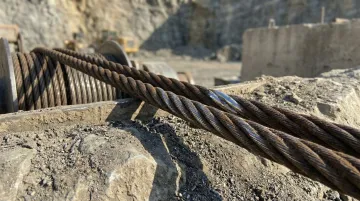
In abrasive conditions where rock, sand, and sharp edges constantly contact the rope, steel wire rope can outlast synthetic alternatives by 2-3 times.
The rigid structure of steel strands resists cutting and surface damage that would quickly degrade synthetic fibres.
Synthetic Rope vs Steel Cable: Which Should You Choose?
The right choice depends on matching rope characteristics to your specific operational requirements, environmental conditions, and safety priorities.
Decision Framework
Choose synthetic rope if you:
- Prioritize worker safety and want to eliminate snap-back hazards
- Need frequent rope handling and want to reduce operator fatigue
- Operate in marine or wet environments where rust is a concern
- Require weight reduction for portability or equipment capacity
- Want to minimize maintenance labor (no lubrication required)
Choose steel cable if you:
- Face abrasive conditions with constant contact against rock, concrete, or metal
- Need maximum durability with minimal maintenance in controlled environments
- Have long-term fixed installations where weight isn't a concern
- Operate in high-heat environments exceeding 180°F
- Want lower initial purchase cost and proven long-term performance
Total Cost of Ownership
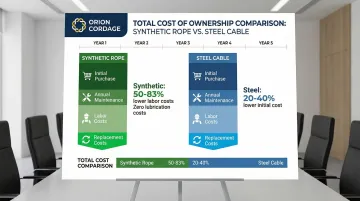
While steel cable often costs less initially, total cost of ownership tells a different story:
- Initial purchase price: Steel cable typically costs 20-40% less than equivalent synthetic rope
- Expected lifespan: Steel lasts 5-10+ years in non-corrosive environments; synthetic lasts 3-5 years with proper UV protection (but in marine or corrosive conditions, synthetic can outlast steel by 2-3 times)
- Maintenance costs: Steel requires regular lubrication, rust prevention, and monitoring for broken wires (neglecting lubrication can reduce lifespan by 40%); synthetic needs only periodic washing and visual inspection
- Labor costs: Synthetic's 87% weight reduction translates to faster rigging times and reduced crew size—operations report 50-83% reductions in handling time
- Replacement frequency: In corrosive environments, synthetic's rust immunity reduces replacement frequency despite shorter absolute lifespan
Maintenance Considerations
Synthetic rope maintenance:
- Regular visual and tactile inspection for UV damage, fraying, and chemical exposure
- Check for pulled strands, glazing (heat damage), and internal abrasion from dirt/grit
- Wash periodically with fresh water and mild soap to remove contaminants
- Store out of direct sunlight when not in use
- No lubrication required
Steel cable maintenance:
- Regular lubrication to prevent internal corrosion and reduce friction
- Monitor for rust, broken wires (burrs), and diameter reduction
- Discard criteria: 6 broken wires in one lay or 3 in one strand (OSHA standard)
- Inspect for diameter reduction exceeding 5-7% of nominal size
- Proper storage to prevent moisture accumulation
Safety Considerations
Synthetic rope safety advantages:
- Minimal stored energy means no dangerous recoil if rope breaks
- No sharp burrs or "fishhooks" that cause lacerations
- Lighter weight reduces ergonomic strain and handling injuries
Steel cable safety hazards:
- Stores significant potential energy under tension; failure results in violent snap-back that can cause severe injury or death
- Broken wires form sharp burrs that pose severe laceration hazards
- Heavy weight increases risk of crush injuries and ergonomic strain
Both rope types require proper protective equipment and procedures. However, synthetic rope's inherent safety characteristics significantly reduce the most dangerous failure modes.
Real-World Performance: Marine Operations Case Study
BW Shipping, a commercial maritime operator, faced mounting costs and operational delays with traditional wire mooring lines. Rust and corrosion required frequent replacements.
The weight and handling difficulty of steel cable slowed mooring operations and increased crew fatigue.
The Decision Process
BW Shipping evaluated their performance requirements:
- Reduce mooring time to improve vessel turnaround
- Lower maintenance costs associated with rust and lubrication
- Improve crew safety and reduce handling injuries
- Maintain or exceed breaking strength requirements
After consulting with rope manufacturers, they selected UHMWPE synthetic mooring lines based on superior strength-to-weight ratio, corrosion immunity, and ease of handling.
Measurable Outcomes
Within six months of switching to synthetic rope, BW Shipping achieved:
- 50% reduction in mooring operations time: From 80 minutes to 40 minutes per vessel
- $20,000-$50,000 savings per vessel every two years: Elimination of lubrication and rust-related maintenance
- Zero safety incidents related to rope handling during the test period
- Extended service life in saltwater environment compared to previous wire rope
The Role of Quality Manufacturing
These results depended on choosing a manufacturer with proven track records. BW Shipping selected suppliers who could deliver consistent performance in demanding saltwater conditions.
Companies like Orion Cordage bring critical advantages to marine operations:
- 168 years of manufacturing experience (since 1856)
- Thousands of SKUs designed, manufactured, and tested in-house
- Facilities in the USA and Canada ensuring quality control
- Proven performance across industrial, marine, and utility applications
Practical Takeaway
Evaluate your operation's specific pain points—not just breaking strength. If handling time, crew fatigue, or corrosion drives your replacement costs, synthetic rope may deliver better total value despite higher upfront cost. If abrasion is your primary concern and weight isn't an issue, steel cable's proven durability may be the better choice.
Conclusion
Neither synthetic rope nor steel cable is universally "better." The right choice depends on matching rope characteristics to your specific operational requirements, environmental conditions, and safety priorities.
Evaluate your applications based on the factors covered:
- Abrasion exposure levels in your environment
- Handling frequency and operator safety considerations
- Weight constraints for portable operations
- Maintenance capabilities and downtime tolerance
- Budget for initial purchase and long-term ownership
Many operations benefit from using both types for different applications—synthetic rope for frequently handled operations and marine environments, steel cable for fixed installations and abrasive conditions.
Whether you choose one type or both, making an informed decision requires evaluating total cost of ownership, not just initial purchase price. Consider labour costs, maintenance requirements, replacement frequency, and safety implications alongside breaking strength specifications.
Orion Cordage manufactures both synthetic rope and steel cable solutions for industrial and marine applications. Our team can help you select the right rope type based on your specific operational conditions and performance requirements.
Frequently Asked Questions
Is synthetic rope better than steel?
It depends on your application. Synthetic rope excels in weight (87% lighter), handling safety, and marine use, while steel cable wins in abrasion resistance, heat tolerance (up to 900°F for stainless), and durability in harsh, abrasive conditions like mining and construction.
Why can't you use a roller fairlead with synthetic rope?
The low friction of UHMWPE causes rollers to jam rather than rotate, creating heat and abrasion that damages fibers. Synthetic rope requires hawse fairleads or closed chocks with smooth, rounded edges to prevent premature failure.
How long does synthetic rope last compared to steel cable?
Synthetic rope typically lasts 3-5 years with proper care, while steel cable lasts 5-10+ years in non-corrosive environments. In marine conditions, synthetic can outlast steel by 2-3 times due to rust immunity.
What maintenance does each type require?
Synthetic rope needs visual inspection for UV damage and fraying, plus periodic washing with mild soap—no lubrication required. Steel cable requires regular lubrication (neglect reduces lifespan by 40%), rust prevention, and monitoring for broken strands.
Can synthetic rope and steel cable be used interchangeably on the same winch?
Yes, but you must change the fairlead (hawse for synthetic, roller for steel) and adjust drum capacity calculations. For example, 1/2" synthetic (30,600 lbs) is stronger than 1/2" steel (26,600 lbs) but has different diameter requirements.
Which is more cost-effective in the long run?
Steel has lower initial cost, but synthetic reduces total ownership cost through lower labour (50-83% faster rigging), no lubrication expenses, and extended lifespan in corrosive environments. The better value depends on priorities—handling efficiency favours synthetic, abrasive conditions favour steel.