Introduction
Industrial rope buyers, marine professionals, and rigging specialists ask the same question constantly: "Are UHMWPE and Dyneema the same thing, or is one better?" Suppliers blur the lines—some treat the terms interchangeably, others position Dyneema as a premium upgrade worth paying extra for.
Understanding the relationship between UHMWPE and Dyneema directly impacts your purchasing decisions and cost considerations. You need the right rope for your application without overpaying for a brand name when a quality alternative performs equally well.
The distinction matters. Price differences can reach 30-40%, yet the material science tells a more nuanced story than most sales pitches suggest.
Key Takeaways
- UHMWPE (Ultra High Molecular Weight Polyethylene) is the material; Dyneema is DSM's premium brand name for UHMWPE fiber
- They are chemically identical—all Dyneema is UHMWPE, but not all UHMWPE is Dyneema
- Other quality UHMWPE brands include Spectra (Honeywell) and domestic manufacturers with rigorous quality control
- Brand reputation and testing certifications matter for critical applications
- Certified UHMWPE from trusted manufacturers delivers excellent value for industrial utility uses
UHMWPE vs Dyneema: Quick Comparison
| Feature | UHMWPE | Dyneema |
|---|---|---|
| Chemical Composition | Ultra High Molecular Weight Polyethylene | Ultra High Molecular Weight Polyethylene (identical) |
| Manufacturing Origin | Multiple manufacturers globally | DSM (Netherlands), now owned by Avient Corporation |
| Cost Range | Varies by producer; generally lower | Premium pricing (20-40% higher than generic) |
| Quality Assurance | Varies by manufacturer | ISO 10325 certified with rigorous testing |
| Typical Applications | Wide range of industrial, marine, utility applications | High-performance marine, aerospace, defense, offshore |
The comparison reveals a key insight: chemically, these are identical materials. The differences lie entirely in manufacturing quality control and brand reputation.
Your choice comes down to three factors:
- Budget constraints: Generic UHMWPE costs 20-40% less than Dyneema-branded rope
- Application criticality: Life-safety and high-stakes operations benefit from ISO-certified consistency
- Performance requirements: Both offer the same baseline strength-to-weight ratio; Dyneema provides tighter manufacturing tolerances
The decision isn't about choosing a different substance. It's about determining which quality level and manufacturer reputation your specific application requires.
What is UHMWPE?
Ultra High Molecular Weight Polyethylene (UHMWPE) is a thermoplastic polymer with extremely long molecular chains that deliver exceptional strength-to-weight performance. These chains transfer load efficiently to the polymer backbone, creating a material with outstanding toughness and tensile strength.
Core Material Properties
UHMWPE changed rope manufacturing by outperforming steel cable in several critical areas. The material properties make it ideal for demanding applications:
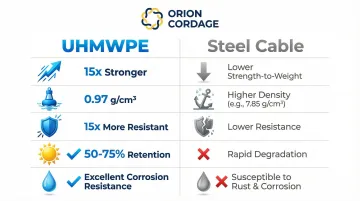
- Strength-to-weight ratio: UHMWPE is 15 times stronger than steel on a weight-for-weight basis, with axial tensile strengths up to 3.6 GPa
- Density: At approximately 0.97 g/cm³, UHMWPE floats on water—a critical advantage for marine handling compared to steel
- Abrasion resistance: Up to 15 times more resistant to abrasion than carbon steel
- UV resistance: Retains 50-75% of tensile strength after 5 years of continuous sun exposure
- Chemical resistance: Excellent resistance to acids, alkalis, and most organic solvents
- Moisture resistance: Hydrophobic material that doesn't absorb water; mechanical properties remain unchanged when wet
Manufacturing Process
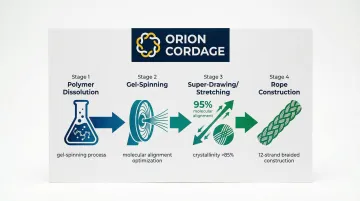
UHMWPE fibers are created through a specialized gel-spinning process. The polymer is dissolved in a solvent and spun into filaments, then stretched (super-drawing) to align molecular chains to over 95% orientation. This stretching increases crystallinity beyond 85%.
The molecular alignment is what gives the fiber its extreme tensile strength.
These fibers are then woven or braided into rope using various construction methods:
- 12-strand single braid: Torque-free, maximum strength-to-weight ratio, easy to splice
- 8-strand braid: Good balance of strength and flexibility
- Double-braid: Core-and-cover construction offering maximum protection against external abrasion and UV
Use Cases of UHMWPE Rope
Marine Applications
The marine industry was among the first to adopt UHMWPE for critical operations:
- Mooring lines for LNG carriers and tankers—UHMWPE is less than one-seventh the weight of steel wire of equivalent strength
- Reduced weight lowers crew fatigue and handling risks in towing bridles
- Anchor lines become weightless when submerged, allowing winches to use full capacity for payload rather than cable weight
Industrial Rigging
UHMWPE transforms lifting and rigging operations by reducing weight without sacrificing strength:
- Lifting slings that are 80-90% lighter than equivalent steel wire rope slings
- Crane lines improve safety and reduce equipment strain through weight reduction
- Load-bearing applications eliminate hand injuries from broken wire "fishhooks"
Utility and Telecom
Power utility and telecommunications rely on UHMWPE for infrastructure support:
- Low coefficient of friction makes cable pulling lines highly effective with excellent abrasion resistance
- Guy lines for towers and poles deliver long-term durability in outdoor environments
- Dielectric properties prevent conductivity in energized environments, critical for safety
What is Dyneema?
DSM developed Dyneema as its proprietary UHMWPE fiber brand in the Netherlands during the 1960s. Avient Corporation now owns the brand following a September 2022 acquisition.
Marketed as "The World's Strongest Fiber™," Dyneema distinguishes itself through strict quality controls and specialized fiber grades.
Dyneema's Distinctive Characteristics
DSM's refined gel-spinning process and performance-specific fiber grades separate Dyneema from generic UHMWPE:
Dyneema Fiber Grades:
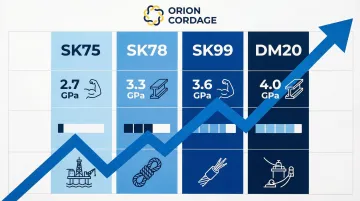
- SK75: Original standard grade with high strength (2.5-3.4 GPa) but higher creep than newer grades
- SK78: Offers 3x better creep resistance than SK75 with similar strength; the only HMPE fiber type-approved by classification societies like ABS for offshore mooring
- SK99: Highest tenacity grade, delivering 20% more strength than SK78 with similar creep properties
- DM20: "Zero creep" technology showing virtually no permanent elongation under static load
Quality Control and Certifications
Dyneema ropes typically meet or exceed ISO 10325 standards, which specify requirements for HMPE braided and covered ropes.
The brand emphasizes supply chain traceability and performance consistency. Tests have shown generic HMPE fibers can vary in strength by up to 22%, whereas Dyneema SK78 consistently matches its rated strength of 35 cN/dtex.
Premium Pricing Justification
Dyneema commands a 20-40% price premium over generic HMPE. This premium reflects several key advantages:
- Guaranteed specifications with minimal batch-to-batch variation
- Four times better abrasion resistance than generic HMPE in demanding tug applications
- Type approvals from classification societies for critical marine applications
- Complete documentation and certification for liability-critical uses
Use Cases of Dyneema Rope
High-Stakes Marine Operations
Commercial shipping mooring lines rely on Dyneema where rope failure could cause significant safety or financial consequences. Offshore oil and gas operations use it for classification society-approved applications, while tugboat operators benefit from increased bollard pull forces without weight penalties.
Defense and Aerospace
Military applications demand Dyneema's consistent performance under extreme conditions. The fiber appears in parachute lines, aviation cargo nets, and ballistic protection where weight savings translate directly to extended range or payload capacity.
Performance Sailing and Racing
Competitive sailors use Dyneema SK99 for running rigging—halyards and sheets—where its high modulus ensures precise sail shape control. Every pound saved affects competitive performance in weight-critical racing applications.
UHMWPE Brands: Beyond Dyneema
While Dyneema dominates marketing mindshare, other manufacturers produce high-quality UHMWPE fibers and ropes that deliver comparable performance at different price points.
Spectra (Honeywell)
Honeywell produces Spectra using a gel-spinning process similar to Dyneema's. Chemically, the two fibers are identical.
Spectra comes in grades like S900 (standard) and S1000 (high tenacity). S1000 offers tenacity of 34-45 g/denier—competitive with Dyneema SK75/78. Spectra is widely used in industrial cordage, fishing lines, and ballistic materials, with strong presence in North American markets.
AmSteel (Samson Ropes)
Samson Ropes produces AmSteel-Blue using 100% Dyneema fiber with a proprietary Samthane urethane coating. This coating greatly improves external abrasion resistance and prevents contaminants from entering the rope structure.
The product is marketed as a direct wire rope replacement, offering the same strength at 1/7th the weight with torque-free construction.
Quality Generic UHMWPE
Beyond the major brands, reputable manufacturers produce quality UHMWPE ropes that meet rigorous standards without the brand premium. Orion Cordage, with over 165 years of manufacturing expertise and domestic facilities in the USA and Canada, manufactures quality UHMWPE solutions for North American markets.
Orion's Dynaplex 12 Strand HMPE rope features maximum break forces up to 189,000 lbs and is engineered for demanding applications across marine, industrial, and utility sectors.
When Brand Matters vs. When It Doesn't
Choose branded UHMWPE (Dyneema/Spectra) when:
- Applications involve high liability (fall protection, heavy lifting, commercial marine towing)
- Classification society approvals are required (ABS, DNV, Bureau Veritas)
- Long-term static loads demand engineered creep resistance
- Insurance or regulatory compliance requires documented pedigree
Quality generic UHMWPE from certified manufacturers works well for:
- General industrial rigging and material handling
- Utility cable pulling and guy lines
- Non-critical marine applications
- Budget-conscious projects where specifications, not brand names, drive decisions
Choosing the Right UHMWPE Rope: What Really Matters
Choosing between Dyneema and generic UHMWPE isn't just about the fiber brand. Construction method, diameter, working load limit, and manufacturer quality control often matter more than the fiber name on the label.
Application Requirements
Match rope specifications to your use case by considering:
- Static vs. dynamic loads, maximum expected forces, and required safety factors
- UV intensity, chemical exposure, temperature range, and storage conditions
- Contact with rough surfaces and running through blocks or fairleads
- Industry standards like ISO 10325, Cordage Institute standards (CI 1500, CI 1906/1907), and OSHA 1910.184 for synthetic rope slings
Quality Indicators Beyond Brand
Look for these verification points regardless of brand:
- ISO certifications: ISO 10325 compliance for HMPE ropes
- Published breaking strengths: Detailed specification sheets with testing data
- Manufacturer testing documentation: Evidence of quality control processes
- Warranty terms: Manufacturer confidence in product longevity
- Domestic manufacturing: Quality control advantages from USA/Canada facilities
Construction Considerations
12-Strand Single Braid:
- Maximum strength-to-weight ratio (entire rope bears load)
- Torque-free, won't kink or rotate under load
- Easy to splice in the field
- Best for: Winch lines, direct wire rope replacement, maximum strength applications
Double-Braid:
- Protective cover over load-bearing core
- Superior UV and external abrasion protection
- Slightly heavier than single braid
- Best for: Permanent outdoor installations, ropes dragging over rough surfaces
Cost-Benefit Framework
Invest in premium brands when:
- Rope failure could cause injury or death
- Regulatory compliance requires classification society approval
- Application involves permanent static loads requiring engineered creep resistance
- Total cost of ownership favors longevity over initial price
Choose quality generic UHMWPE when:
- Specifications and certifications meet application requirements
- Manufacturer maintains documented quality control (domestic facilities preferred)
- Budget constraints exist without compromising safety
- Application doesn't require brand certification for insurance or regulatory purposes

Real World Applications and Selection Examples
Scenario 1: Commercial Marine Towing
A tugboat operator needs reliable towing hawsers for harbor operations handling vessels up to 50,000 tons. The US Coast Guard and classification societies like ABS require specific testing for creep and fatigue.
Rope failure could result in vessel damage, environmental incidents, or crew injury.
Recommendation: Dyneema SK78 or Spectra S1000 from established manufacturers.
The premium cost (approximately 30-40% higher than generic UHMWPE) delivers:
- Classification society approvals and liability protection
- Documented creep resistance preventing permanent elongation
- Type approvals satisfying insurance requirements
Scenario 2: Industrial Rigging in Manufacturing
A manufacturing facility needs lifting slings for overhead crane operations moving equipment weighing 5-15 tons. OSHA 1910.184 governs synthetic rope sling use, requiring removal from service if abrasive wear, cuts, or heat damage appear.
The facility prioritizes worker safety while managing equipment budgets across multiple facilities.
Recommendation: Quality UHMWPE from certified domestic manufacturers like Orion Cordage.
Their Dynaplex 12 Strand HMPE rope balances performance and cost effectively:
- Maximum break forces up to 189,000 lbs
- Domestic quality control meeting OSHA requirements
- 80-90% weight reduction vs. steel slings (reduces rigger fatigue)
- Substantial cost savings compared to premium brands
Scenario 3: Utility Line Work
A utility company needs guy lines for transmission towers and cable pulling rope for underground conduit installations.
Applications require dielectric properties near energized lines and outdoor durability, but don't involve the liability profile of lifting personnel or marine towing.
Recommendation: Generic UHMWPE meeting ASTM F1701 dielectric standards from reputable manufacturers.
The material's dielectric properties, combined with proper specifications for UV resistance and abrasion, meet utility requirements effectively. Focus on documented specifications and domestic manufacturing quality control rather than brand premiums that don't add functional value here.
Need help selecting the right UHMWPE rope for your application? Orion Cordage's team brings over 165 years of rope manufacturing expertise to help you make the right choice. Contact us at 877-224-2673 or sales@orionropeworks.com for personalized recommendations based on your specific requirements.
Conclusion
UHMWPE and Dyneema are the same material—Dyneema is simply DSM's premium brand name for their UHMWPE fiber. The decision isn't about "which is better" but rather "which quality level and brand reputation does my application require?"
Critical, high-liability applications demand premium brands. When rope failure in commercial marine towing, fall protection, or heavy lifting could cause injury or significant financial loss, established brands like Dyneema or Spectra are worth the investment.
The premium cost delivers documented performance, classification society approvals, engineered features like creep resistance, and the liability protection that comes with regulatory compliance and performance guarantees.
Industrial rigging, utility, and general material handling applications benefit from a different approach. When quality matters but brand premium isn't justified, focus on manufacturers with proven track records—like Orion's 150+ years of domestic manufacturing with rigorous testing standards.
What matters most:
- Detailed specifications and certifications
- Manufacturing consistency and quality control
- Testing documentation and performance data
- Manufacturer reputation and accountability
The material science is identical across UHMWPE products. What varies is manufacturing consistency, testing rigor, and whether you're paying for brand recognition or proven performance.
Frequently Asked Questions
Is Dyneema the same as UHMWPE rope?
Yes, they are chemically identical. Dyneema is DSM's brand name for their UHMWPE fiber, similar to how Kleenex is a brand of facial tissue. All Dyneema is UHMWPE, but not all UHMWPE is Dyneema.
What's the difference between Dyneema and Spectra rope?
Both are premium UHMWPE brands with similar performance—Dyneema from DSM (Netherlands) and Spectra from Honeywell (USA). Differences lie in specific fiber processing techniques, but both deliver comparable strength and durability.
Is UHMWPE rope stronger than steel cable?
Yes, UHMWPE has 15 times the strength-to-weight ratio of steel cable. It also floats, resists corrosion, and reduces snap-back hazards compared to steel.
How long does UHMWPE rope last?
Properly maintained UHMWPE rope can last 10+ years in marine applications and longer in protected industrial uses. UV-protective covers extend outdoor service life.
Can UHMWPE rope be used in marine applications?
Absolutely. UHMWPE is excellent for marine use—it floats, resists saltwater and UV degradation, and won't rust. It's widely used for mooring lines, towing bridles, and anchor lines, with weight advantages reducing crew fatigue and handling risks.
Does brand matter when buying UHMWPE rope?
Brand matters most for critical applications requiring documented performance and liability protection—commercial marine towing, fall protection, or offshore operations. For general industrial use, focus on manufacturer quality standards, domestic production, and certifications.