Introduction
In 2017, the UK Marine Accident Investigation Branch documented a fatal mooring line failure aboard the vessel Zarga. The investigation revealed a critical finding: the mooring system lacked sufficient elasticity to absorb dynamic loads, contributing directly to the catastrophic failure. The line snapped under conditions well below its rated breaking strength—not because the rope was weak, but because operators had selected the wrong material for the application.
For industrial buyers, marine operators, and construction professionals, choosing between nylon and polypropylene rope isn't just a purchasing decision—it's a safety calculation. The wrong choice can lead to equipment failure, operational downtime, increased replacement costs, and serious safety incidents.
The right choice optimises performance, extends service life, and protects both personnel and assets.
Understanding these stakes, this guide breaks down the critical differences between these two synthetic rope materials, helping you make informed decisions based on load requirements, environmental conditions, and total cost of ownership.
Key Takeaways
- Nylon wins for strength: 2.5x stronger than manila with 30-35% stretch for shock absorption in mooring, towing, and anchor lines
- Polypropylene floats and costs less: Lightweight with 15-20% stretch, ideal for water sports, pools, and budget applications
- Cost reality: Polypropylene costs 30-40% less initially, but nylon typically lasts 3-7 years outdoors versus 1-3 years for polypropylene
- Safety consideration: Material selection directly impacts line failure risk—always consult manufacturer specifications for critical applications
Nylon vs Polypropylene: Quick Comparison
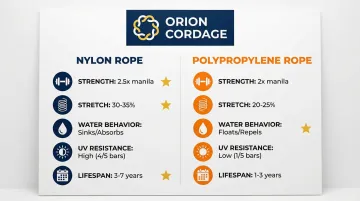
| Feature | Nylon Rope | Polypropylene Rope |
|---|---|---|
| Tensile Strength | High: ~2.5x stronger than manila | Moderate: ~2x stronger than manila |
| Elongation | 30-35% at break | 15-20% at break |
| Shock Absorption | Excellent—absorbs dynamic loads | Good—less elastic than nylon |
| Specific Gravity | 1.14 (sinks) | 0.91 (floats) |
| Water Absorption | High: up to 15% by weight | None: does not absorb water |
| Wet Strength | Loses 10-15% when wet | Retains 100% of dry strength |
| Melting Point | ~480°F (250°C) | ~330°F (165°C) |
| UV Resistance | Good—better inherent resistance | Poor—degrades rapidly without stabilizers |
| Abrasion Resistance | Excellent—durable in high friction | Good—less durable than nylon |
| Typical Outdoor Lifespan | 3-7 years | 1-3 years |
| Relative Cost | Higher (baseline +50%) | Lower (baseline) |
Beyond the specs, two practical factors significantly impact day-to-day rope use: weight characteristics and maintenance demands.
Weight and Handling
Polypropylene's specific gravity of 0.91 makes it the lightest synthetic rope available—lighter than water itself. This translates to easier handling, reduced shipping costs, and less strain on workers during deployment.
Nylon's higher density (1.14) means it's heavier to handle. But this weight provides better control in high-wind conditions and won't blow around on deck.
Maintenance Requirements
| Maintenance Task | Nylon | Polypropylene |
|---|---|---|
| Inspection Focus | Powdered fiber between strands; discoloration or stiffness | Surface fuzzing or brittleness |
| Storage Requirements | Store dry when possible to prevent mildew | Store out of direct sunlight (critical for UV protection) |
| Cleaning Needs | Clean with fresh water after saltwater exposure | Minimal—water and dirt don't affect performance |
| Replacement Frequency | 3-7 years typical outdoor lifespan | 1-3 years; replace more frequently |
What is Nylon Rope?
Nylon (polyamide) became a commercial reality when DuPont introduced it in the late 1930s. Today, it's the preferred choice for applications requiring maximum strength combined with exceptional elasticity.
Core Strengths for Demanding Applications
Nylon delivers approximately 2.5 times the strength of manila rope at the same diameter. This strength advantage translates directly to safety margins in critical applications.
Key performance characteristics:
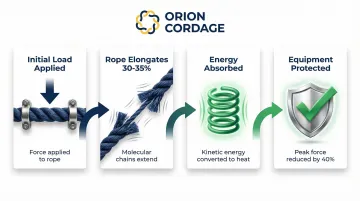
- Superior shock absorption: 30-35% elongation acts as a built-in shock absorber, protecting equipment and structures from peak loads
- Excellent wet/dry performance: Loses only 10-15% strength when wet (still stronger than most alternatives)
- Outstanding abrasion resistance: Withstands high-friction environments that would quickly destroy natural fiber ropes
- Chemical resistance: Very good resistance to oils, alkalis, and most industrial chemicals
- Extended lifespan: Typically lasts 4-5 times longer than natural fiber ropes under similar conditions
Understanding Nylon's Limitations
Despite these strengths, nylon does have trade-offs worth considering. The material absorbs up to 15% of its weight in water, becoming heavier and slightly weaker when wet—a factor you should account for in safety calculations.
The material also sinks, which can be either an advantage (keeping lines away from propellers) or a disadvantage (propeller fouling risk) depending on your application.
Cost is another consideration. Nylon typically commands a 50% price premium over polypropylene. This higher upfront cost is often offset by longer service life and superior performance in demanding conditions.
Use Cases of Nylon Rope
Marine Applications
Nylon's elasticity makes it indispensable for marine applications where dynamic loads are constant:
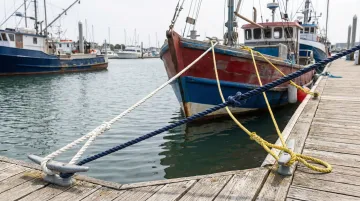
- Mooring lines: The 30-35% stretch dampens wave action and wind gusts, preventing shock loading on cleats and dock hardware
- Anchor lines: Elasticity absorbs the energy of a vessel rising and falling with waves, reducing strain on ground tackle
- Towing operations: Critical shock absorption protects both vessels during towing in varying sea states
- Dock lines: Prevents sudden jerks that could damage cleats or pull dock hardware loose