Introduction
One wrong load calculation can mean the difference between a routine lift and a workplace fatality. Analysis of industrial rigging failures reveals that inadequate material specification causes more accidents than inherent material defects—six of twelve documented synthetic sling failures stemmed from insufficient edge protection, three from no protection at all.
That's why understanding rope strength data matters.
Hemp and nylon strength charts aren't just reference sheets—they're your blueprint for compliance, efficiency, and worker safety. Both materials fit different industrial uses, and their load-bearing capabilities differ significantly.
Hemp delivers natural fiber strength with excellent grip. Nylon provides 30-40% higher tensile capacity with superior shock absorption. Choosing between them means understanding Working Load Limits, environmental impacts, and how factors like knots and moisture affect real-world performance.
Key Takeaways
- Hemp tensile strength: 540-8,100 lb (0.25"-1.0"); excellent grip but loses 10% strength when wet and degrades under UV
- Nylon offers 1,650-25,000 lb strength (0.25"-1.0")—30-40% stronger with 18-25% elongation for shock absorption
- Hemp excels in controlled environments; nylon dominates marine, industrial, and high-load applications
- Working Load Limit equals Breaking Strength ÷ 5 (standard safety factor); knots reduce strength by 30-50% regardless of material
Nylon vs Hemp: Quick Comparison
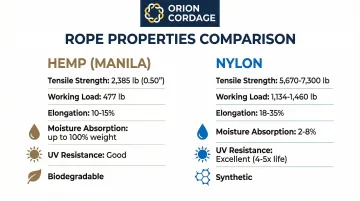
Understanding the fundamental differences between nylon and hemp rope helps you make informed decisions for specific applications. Here's how these materials compare across critical performance factors:
| Property | Hemp (Manila) | Nylon |
|---|---|---|
| Tensile Strength (0.50") | 2,385 lb | 5,670-7,300 lb (construction-dependent) |
| Working Load Limit (0.50") | 477 lb | 1,134-1,460 lb |
| Elongation at Break | 10-15% | 18-35% |
| UV Resistance | Good (lignin breaks down) | Good to Excellent (4-5x longer life) |
| Moisture Impact | Absorbs up to 100% weight, ~10% strength loss | Absorbs 2-8%, 10-15% strength loss |
| Shock Absorption | Poor (low stretch) | Excellent (high stretch) |
| Biodegradability | 100% natural, fully biodegradable | Non-biodegradable synthetic |
| Service Life | Shorter (rot/mildew susceptible) | 4-5x longer than natural fiber |
These performance differences stem from each material's distinct construction characteristics.
Material Construction Advantages
Nylon's synthetic polyamide construction delivers:
- 30-40% higher breaking strength than hemp across comparable diameters
- Fiber breaking tenacity of 7.0-9.5 grams/denier (vs. hemp's 5.0-6.0 range)
- Superior load capacity per unit of material
- Resistance to rot, mildew, and most chemicals
Hemp offers natural performance benefits:
- Better grip due to natural fiber texture and tight fiber twist
- Zero synthetic content with full biodegradability
- Excellent handling characteristics for traditional applications
- Lower initial cost per foot
While nylon costs more initially, its 4-5x longer service life typically delivers better long-term value in demanding industrial conditions. Hemp remains the preferred choice for applications where biodegradability and natural aesthetics matter most.
Understanding Hemp Rope Strength Charts
Reading hemp rope strength charts correctly is essential for safe rigging and compliance. Here's how to interpret the data and apply it to real-world applications.
How to Read Hemp Strength Charts
Follow these steps when consulting a hemp rope strength chart:
- Locate the diameter in inches or millimeters in the left column
- Find the tensile/breaking strength (measured in pounds or kilonewtons) in the adjacent column
- Calculate Working Load Limit by dividing breaking strength by 5 (the standard safety factor)
- Account for conditions like knots, moisture, and wear that further reduce capacity
Hemp Rope Strength by Diameter
| Diameter | Tensile Strength (MBS) | Working Load Limit (5:1) |
|---|---|---|
| 0.25" (6mm) | 540 lb | 108 lb |
| 0.50" (13mm) | 2,385 lb | 477 lb |
| 1.0" (25mm) | 8,100 lb | 1,620 lb |
These specifications align with US Federal Specification TR-605B and ISO 1181, the authoritative standards for Manila rope manufacturing. Understanding these standards helps explain why hemp's natural fiber structure creates both advantages and limitations.
Natural Fiber Composition Effects
Hemp's unique properties stem from its organic composition:
Grip and handling advantages:
- Tight fiber twist provides superior grip characteristics
- Natural texture prevents slipping better than smooth synthetics
- Ideal for hand-holding applications or friction-critical uses
Moisture vulnerability:
- Absorbs up to 100% of its weight in water (hemp is water-loving by nature)
- Most technical references indicate ~10% strength loss when saturated
- Wet hemp shrinks and stiffens, making handling difficult
UV degradation:
- Sunlight breaks down lignin in hemp fibers. This causes gradual strength loss and brittleness.
- Unlike synthetic ropes with UV stabilizers, hemp has no photodegradation protection.
Knot Impact on Hemp Strength
Knots create stress concentration points that dramatically reduce rope capacity. For hemp rope:
- Figure-eight knots: Retain 66-80% of original strength (30-34% loss)
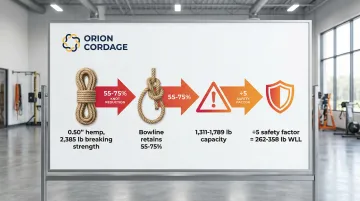
- Bowline knots: Retain 55-75% of original strength (25-45% loss)
- Overhand knots: Retain 58-65% of original strength (35-42% loss)
Critical calculation: A 0.50" hemp rope with 2,385 lb breaking strength and a bowline knot retains only 1,311-1,789 lb capacity. Dividing by the 5:1 safety factor yields a WLL of just 262-358 lb—dramatically lower than the unknotted WLL of 477 lb.
Typical Hemp Rope Applications
Hemp excels in specific applications where its natural properties provide advantages:
- Historic ship rigging and museum restoration (authentic materials)
- Decorative applications (landscaping, barriers, rustic aesthetics)
- Grip-critical uses (tug-of-war, climbing training, fitness equipment)
- Low-cost utility work in dry, controlled environments
- Applications where non-melting characteristics matter (around hot equipment)
Understanding Nylon Rope Strength Charts
Nylon rope strength charts are more complex than hemp charts because strength varies significantly by construction type. Understanding these differences is critical for proper specification.
How to Read Nylon Strength Charts
When consulting nylon rope specifications:
- Identify construction type (3-strand twisted, double-braid, 12-strand)
- Locate diameter in the appropriate construction section
- Find tensile strength (breaking strength) for that combination
- Calculate Working Load Limit using the 5:1 safety factor
- Adjust for conditions including wet use, knots, and dynamic loading
Nylon Rope Strength by Construction (0.50" Diameter)
| Construction Type | Tensile Strength (MBS) | Working Load Limit (5:1) |
|---|---|---|
| 3-Strand Twisted | 5,670-6,400 lb | 1,134-1,280 lb |
| Double-Braid | 7,300-7,400 lb | 1,460-1,480 lb |
| 12-Strand | 8,000 lb | 1,600 lb |
Double-braid constructions typically offer the highest tensile strength for a given diameter because the braided core and braided cover distribute loads more evenly than twisted constructions.
Nylon's Superior Tensile Capacity
Nylon fibers achieve 7.0-9.5 grams/denier breaking tenacity, significantly higher than hemp's 5.0-6.0 range. High-tenacity industrial nylon variants exceed 7.5 g/denier, providing maximum strength per unit of material.
Nylon's 18-25% elongation at break (with some double-braid specs reaching 30-35%) provides excellent energy absorption during dynamic loading. This makes nylon ideal for applications involving sudden loads:
- Mooring lines absorbing wave action
- Towing operations with jerking forces
- Fall arrest systems dissipating energy
- Anchor rodes accommodating tidal changes
Wet Strength and Environmental Factors
Unlike hemp's variable wet performance, nylon consistently loses 10-15% strength when saturated. The molecular structure absorbs 2-8% water, which disrupts hydrogen bonding between polymer chains.
For example, a 0.50" double-braid nylon rope with 7,300 lb dry strength retains approximately 6,205-6,570 lb when wet. With a 5:1 safety factor, the wet WLL drops to 1,241-1,314 lb compared to the dry WLL of 1,460 lb.
Even with superior base strength, nylon still loses 30-50% capacity from common knots, requiring the same careful calculation as hemp.
UV Resistance and Longevity
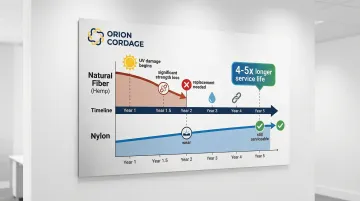
Nylon maintains strength 4-5 times longer than natural fiber ropes in outdoor applications. Key durability advantages include:
- UV stabilizers protecting against sun damage
- Complete resistance to rot and mildew
- Excellent resistance to oils and alkalis
- Minimal strength loss from abrasion
These durability features make nylon the preferred choice for marine environments, industrial rigging, and any application where rope remains exposed to weather over extended periods.
Key Factors That Impact Rope Strength and Durability
Understanding how various factors degrade rope strength helps you maintain safety margins and predict when replacement is necessary.
Diameter and Construction Effects
Cross-sectional area determines capacity: Rope strength scales roughly with the square of diameter. Doubling diameter increases cross-sectional area by four times, approximately quadrupling load capacity.
A 1.0" rope isn't twice as strong as a 0.50" rope—it's nearly four times stronger.
Construction distributes load: Braided constructions distribute stress more evenly across fibers than twisted strands, typically delivering 15-25% higher breaking strength for the same diameter and material.
The braided core and cover work together, while twisted ropes concentrate stress on outer strands.
Beyond diameter and construction, environmental conditions significantly impact how rope performs over its service life.
Environmental Degradation Factors
UV exposure:
- Hemp becomes brittle as UV breaks down natural fiber bonds
- Nylon polymer chains crack despite UV stabilizers
- High-altitude and tropical environments accelerate damage
- Surface fibers weaken before visible signs appear
Moisture effects:
- Hemp absorbs up to 100% of its weight, causing ~10% strength loss
- Nylon absorbs 2-8% water, reducing capacity by 10-15%
- Freeze-thaw cycles damage saturated fibers
- Mildew affects hemp but not nylon
Chemical exposure:
- Acids severely degrade both materials
- Alkalis damage hemp; nylon resists them
- Petroleum products weaken hemp but not nylon
- Mild chemical contact accelerates other degradation
Temperature extremes:
- Hemp chars at 177°C (350°F) but doesn't melt
- Nylon melts at 216-249°C (420-480°F), losing all strength
- Cold makes both materials stiffer and more brittle
- Thermal cycling causes progressive fiber fatigue
Knots and Splices: Strength Reduction
Knots create sharp bends that concentrate stress on individual fibers, dramatically reducing rope capacity:
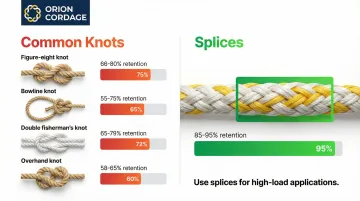
Common knot efficiency:
- Figure-eight: 66-80% retention (20-34% loss)
- Bowline: 55-75% retention (25-45% loss)
- Double fisherman's: 65-79% retention (21-35% loss)
- Overhand: 58-65% retention (35-42% loss)
Splices preserve more strength: Properly executed splices typically retain 85-95% of original rope strength. They distribute load over a longer transition zone rather than creating sharp stress points.
Practical guidance: When working loads approach 50% of the unknotted WLL, consider using splices instead of knots or selecting the next larger diameter to maintain adequate safety margins.
Creep: Long-Term Elongation
Creep is the gradual, permanent elongation that occurs under sustained load, even below rated capacity:
- Nylon: Extended static loads cause progressive elongation—problematic for guy lines or installations requiring dimensional stability
- Hemp: Natural fibers resist permanent elongation, making hemp ideal for static applications where maintaining exact length matters
Maintenance Best Practices
Preserve rated strength through proper care:
Storage requirements:
- Store dry and off the ground to prevent moisture absorption and contamination
- Keep away from direct sunlight and UV sources
- Maintain moderate temperatures (avoid extreme heat or freezing)
- Coil loosely to prevent kinks and permanent deformation
- Separate from chemicals, solvents, and petroleum products
Regular inspection criteria:
- Check for surface abrasion, fuzzing, or broken fibers
- Inspect for cuts, snags, or impact damage
- Look for discoloration indicating UV damage or chemical exposure
- Feel for stiff sections suggesting internal damage
- Examine areas near knots and attachment points closely
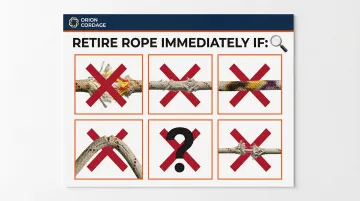
Retirement criteria:
- Any visible core damage in braided rope
- Abrasion affecting more than 10% of rope diameter
- Chemical contamination or severe discoloration
- Stiffness, brittleness, or glazing
- Unknown load history or age exceeding manufacturer recommendations
- Any use in life-safety applications after significant loading events
Nylon vs Hemp: Which Rope is Right for Your Application?
Choosing between nylon and hemp rope depends on your load requirements, environmental conditions, and performance priorities. Each material excels in distinct applications, and understanding these differences ensures optimal safety and cost-effectiveness.
Choose Hemp When You Need:
Natural fiber properties:
- 100% biodegradable material for environmentally sensitive applications
- Traditional appearance for historic restoration or decorative use
- Non-melting characteristics around hot equipment or friction points
Grip-critical applications:
- Better hand grip for tug-of-war or manual handling
- High friction for training ropes and climbing applications
- Natural texture that prevents slipping better than smooth synthetics
Minimal stretch requirements:
- Static applications where dimensional stability matters
- Situations where elasticity would be problematic
- Very low creep for long-term installations
Controlled environment conditions:
- Indoor or covered storage protecting from UV and moisture
- Moderate loads within hemp's capacity range
- Applications where cost sensitivity outweighs longevity concerns
Hemp performs best indoors with moderate loads. For demanding outdoor or dynamic applications, nylon delivers superior performance.
Choose Nylon When You Need:
Maximum strength and durability:
- 30-40% higher tensile capacity than hemp for the same diameter
- Better abrasion resistance extending service life 4-5x
Dynamic load applications:
- 18-25% elongation provides excellent shock absorption
- Ideal for mooring lines, towing ropes, and anchor rodes
- Critical for fall arrest and safety systems requiring energy dissipation
Environmental resistance:
- UV stabilizers protect against sun damage
- Resists rot, mildew, and biological degradation
- Performs consistently in marine and industrial environments
- Superior chemical resistance (except acids)
Regulatory compliance:
- OSHA 29 CFR 1926.104(c) requires lifelines with minimum 5,400 lb breaking strength
- Standard 3/4" Manila rope (4,860 lb MBS) fails this requirement
- Nylon's higher strength meets safety-critical specifications
Cost-Effectiveness Considerations
Initial cost vs. lifecycle value:
Hemp typically costs 30-50% less upfront, making it attractive for budget-conscious projects. However, nylon's 4-5x longer service life often delivers better ROI in demanding conditions.
Total cost of ownership factors:
- Replacement frequency based on environmental exposure
- Inspection and maintenance labor
- Downtime costs for rope failure or scheduled replacement
- Safety incident risk and associated liability
Custom Solutions for Specialized Requirements
Standard rope products don't always match unique operational requirements. Applications requiring specific strength specifications, unusual diameters, or custom constructions may need engineered solutions.
Manufacturers like Orion Cordage, with over 168 years of North American rope manufacturing experience, design custom ropes to meet exact load, material, and compliance specifications. These engineered solutions optimize performance for applications where off-the-shelf products fall short.
Frequently Asked Questions
Which type of rope is strongest?
Synthetic nylon provides 30-40% higher breaking strength than hemp across comparable diameters, making it the strongest of these two materials. For example, 0.50" nylon achieves ~7,300 lb breaking strength versus ~2,385 lb for hemp at the same diameter.
What rope can hold 200 pounds?
Hemp rope 0.25" diameter or larger (108+ lb WLL) and nylon rope 0.25" diameter or larger (330+ lb WLL) can safely hold 200 pounds. Since common knots reduce capacity by 30-50%, use 0.50" diameter or larger when knots are necessary to maintain proper safety margins.
What is the minimum breaking strength of a rope?
Minimum Breaking Strength (MBS) is the guaranteed minimum load at which new, unused rope will fail under laboratory testing. The Cordage Institute defines MBS as three standard deviations below the mean breaking force of tested specimens, with Working Load Limit calculated by dividing MBS by the design factor (typically 5:1 for fiber ropes).
How do you calculate working load limit from breaking strength?
Apply the standard 5:1 safety factor formula: WLL = Breaking Strength ÷ 5. This accounts for knots, wear, dynamic loading, and environmental conditions. Higher safety factors (up to 12:1) are recommended for life-safety applications or severe service conditions.
Does wet rope lose strength?
Yes, both materials lose strength when wet. Hemp loses ~10% strength when saturated due to fiber swelling and becomes stiff to handle, while nylon loses 10-15% strength as water absorption disrupts polymer bonds.
How much strength does a knot reduce in rope?
Common knots reduce rope strength by 30-50% depending on knot geometry and rope material. Figure-eight knots cause ~20-34% reduction, while bowlines cause 25-45% reduction. Properly executed splices retain 85-95% of original strength, making them preferable for high-load applications.