Introduction
A critical mooring line snaps during a storm, sending your vessel crashing into the dock. A sailboat's halyard fails mid-voyage, leaving the crew stranded with no way to raise the mainsail. These scenarios aren't theoretical—they're the real-world consequences of UV degradation, a silent destroyer that weakens marine ropes long before visible damage appears.
Understanding how ultraviolet radiation breaks down synthetic rope fibers is essential for preventing costly failures, ensuring crew safety, and extending equipment lifespan.
UV damage doesn't announce itself until it's often too late. By the time you notice surface discoloration or brittleness, the molecular structure has already been significantly compromised—sometimes losing up to half its original strength.
Key Takeaways
- UV radiation breaks molecular bonds in synthetic fibers, reducing strength by 25-90% over time
- Polypropylene loses 30% strength within 6 months; polyester retains 90%+ after 12 months
- Watch for color fading, surface brittleness, fiber powdering, and flexibility loss
- Protect lines with UV-stabilized ropes, covered storage, and systematic rotation
Common Causes of UV Degradation in Marine Rope
What is UV Degradation?
UV degradation, or photodegradation, occurs when ultraviolet radiation—particularly UVA and UVB wavelengths—penetrates rope fibers and breaks down polymer chains at the molecular level. This process triggers oxidation and structural weakening that compromises the rope's load-bearing capacity.
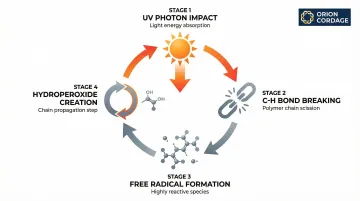
UV photons carry enough energy to break chemical bonds in synthetic polymers, initiating chain scission (bond-breaking) reactions. When UV breaks C-H bonds on the polymer backbone, it creates free radicals that react with oxygen to form hydroperoxides. These compounds decompose to produce more radicals and carbonyl groups, perpetuating the degradation cycle.
The Photodegradation Process
The damage is cumulative and accelerates with exposure intensity and duration. What makes UV degradation particularly problematic is that it starts at the rope surface but progressively penetrates deeper into the core structure.
Key degradation indicators:
- Formation of carbonyl groups (detectable via laboratory testing)
- Chain scission reducing average molecular weight
- Decreased tensile strength and flexibility
- Surface brittleness and fiber breakage
Material-Specific Vulnerabilities
Not all synthetic fibers respond equally to UV exposure. The material composition determines how quickly degradation occurs.
Polypropylene ranks as the most UV-sensitive marine rope material. Untreated polypropylene can lose approximately 30% of tensile strength within six months of high-intensity sun exposure.
The degradation accelerates over time. Without stabilization, these ropes can eventually lose 70-90% of their strength and become dangerously brittle.
Polyester offers superior UV resistance. Polyester ropes retain over 90% of their original tensile strength after 12 months of continuous UV exposure, making them the best choice for permanent marine installations.
Nylon falls between these extremes with moderate UV resistance. It degrades more slowly than polypropylene but faster than polyester, and becomes particularly vulnerable when humidity accelerates the process through hydrolysis (water-based chemical breakdown).
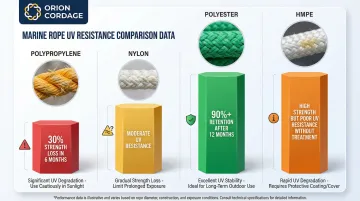
High-Modulus Polyethylene (HMPE)—sold as Dyneema or Spectra—presents a paradox. Despite exceptional strength, it has poor inherent UV resistance. Larger diameter HMPE ropes fare better because UV radiation penetrates only shallow depths.
Environmental Accelerators
Marine environments compound UV damage through multiple mechanisms. Saltwater residue acts as a lens, concentrating UV rays onto fiber surfaces. Salt crystals embedded in the rope cause additional abrasion, creating microscopic cuts that accelerate photodegradation.
Factors that speed UV damage:
- High temperatures accelerate photodegradation reactions (tropical and summer conditions are particularly harsh)
- Humidity increases degradation rates, especially in nylon
- Seawater alkalinity facilitates hydrolysis of polymer chains
- Pollution particles interact with UV to speed deterioration
Manufacturing Quality and Treatment Factors
Ropes without UV stabilizers degrade significantly faster than treated ropes. Quality manufacturers incorporate UV inhibitors directly into fiber production, not as surface coatings that wash away.
Effective UV protection methods:
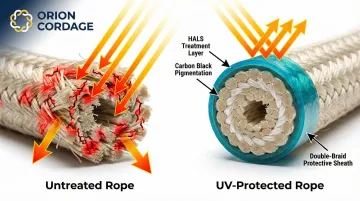
- HALS (Hindered Amine Light Stabilizers) can triple service life—UV-treated polypropylene retains roughly 90% of tensile strength after 2,000 hours of accelerated exposure
- Carbon black pigmentation provides a physical barrier against UV radiation
- Double-braid construction with protective sheaths shields the load-bearing core
- Rope diameter affects penetration—thicker ropes resist UV damage better than thin lines
What Happens If UV Degradation Is Ignored
Ignoring UV degradation creates serious safety and operational risks. Weakened mooring lines can snap during storms or under heavy loads, causing vessels to break free and potentially collide with other boats, docks, or structures.
The financial consequences extend beyond rope replacement—emergency repairs, operational downtime, missed fishing or charter opportunities, and potential cargo damage add up quickly.
Crew safety is the most critical concern. Lines parting suddenly under tension can cause severe injuries or equipment damage during sail handling and mooring operations.
In commercial operations, a single rope failure can cascade into significant liability issues.
Warning Signs You're Experiencing UV Degradation
Early detection prevents catastrophic failure. Inspect your marine ropes regularly for these indicators:
Surface discoloration and fading:
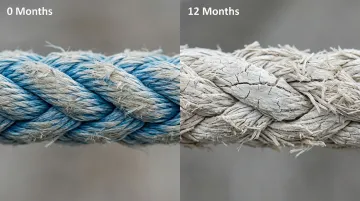
- Colors become washed out or bleached
- White rope turns yellow or dingy
- Vibrant hues fade to pale versions
Texture changes:
- Surface feels rough, fuzzy, or powdery
- Fibers look "chalky" when bent
- Rope feels brittle when handled
Loss of flexibility:
- Stiffness and resistance to bending
- Kinks won't smooth out
- Rigidity compared to new condition
Visible fiber damage:
- Individual fibers break or fray
- Fraying without mechanical wear
- Shedding fiber dust when handled
- Outer yarns crush easily by hand
How to Prevent UV Degradation
Prevention requires a multi-layered strategy combining material selection, protective treatments, and operational practices.
Select UV-Resistant Rope Materials
Polyester offers the best balance of UV resistance, strength, and cost for most marine applications. Studies show polyester can reduce rope replacement costs by up to 35% and extend outdoor service life to 3-5 years.
Orion Cordage manufactures several polyester options specifically for marine use, including Durastat Double Braid Polyester for permanent mooring applications and Powerplex 12-Strand Polyester for high-stress environments.
Their 8-Braid Polyester features enhanced UV and weather resistance engineered for demanding marine conditions.
Nylon works well for applications requiring stretch and shock absorption, but needs more frequent inspection. Orion's Superior 3-Strand Nylon features enhanced UV resistance specifically engineered for marine applications.
Avoid polypropylene for critical or long-term applications unless cost constraints require it. If you must use it, ensure it contains UV stabilizers and plan for more frequent replacement during purchase cycles.
Choose Ropes with UV Stabilizers
Quality manufacturers incorporate UV inhibitors during fiber production, not as surface coatings that wear off. Seek ropes from established manufacturers with rigorous testing protocols and documented UV resistance specifications.
Dark-colored ropes, especially black with carbon black pigment, typically offer better UV protection than light colors. The pigment acts as a physical barrier preventing radiation penetration—specify these when ordering new inventory.
Implement Protective Storage Practices
Small storage habits compound into years of extended rope life.
Storage best practices:
- Coil loosely in covered lockers or rope bags
- Keep dock lines in shaded areas between uses
- Cover lines that must remain deployed
- Store in cool, dry, ventilated areas away from sunlight
Double-braid construction provides built-in protection, with the outer sheath shielding the load-bearing core from UV penetration. Orion's double-braid products offer this advantage across their polyester and nylon lines—making them ideal choices for lines that see extended sun exposure.
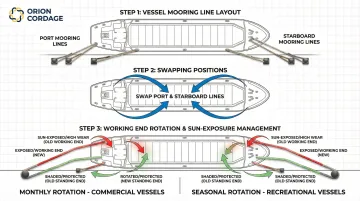
Establish Rope Rotation Systems
Rotation distributes UV exposure across the entire rope length, preventing localized weak points.
Rotation strategies:
- Regularly swap port and starboard lines
- Rotate working ends with standing ends
- Move frequently-used sections to less-exposed positions
- Keep usage logs tracking which ropes have had the most sun exposure
Commercial operations should rotate monthly, while recreational vessels can implement seasonal rotations.
Apply Protective Treatments and Coatings
UV-protective sprays and treatments designed for marine ropes supplement (but don't replace) quality materials. Effectiveness varies, and these products require reapplication.
Some operators use rope wax or protective coatings, though these may affect rope handling characteristics. Test any treatment on a small section first—especially before applying to critical safety lines.
Apply these treatments to ropes that cannot be stored out of direct sunlight, such as permanent mooring lines or dock configurations without shade options.
Tips for Long-Term Prevention and Control
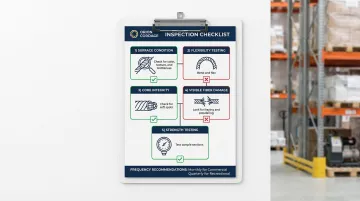
Establish Inspection Schedules
Commercial operations: Monthly detailed inspections for daily sun exposure Recreational vessels: Quarterly inspections Seasonal boats: Pre-season and post-season checks
During each inspection, evaluate these critical factors:
Inspection checklist:
- Surface condition (color, texture, brittleness)
- Flexibility testing (bend and flex the rope)
- Core integrity (check for soft spots or inconsistencies)
- Visible fiber damage (fraying, powdering, breakage)
- Strength testing on sample sections
Implement Replacement Protocols
Retire ropes based on cumulative UV exposure hours, usage intensity, and inspection findings—not just age.
A rope stored properly for five years may be safer than one exposed to daily sun for two years. Check manufacturer guidelines for service life recommendations specific to your rope material and construction. Orion Cordage provides detailed specifications for their UV-resistant marine ropes, with protection built into the fiber structure during manufacturing.
Retirement triggers:
- Visible UV damage (crushed fibers, brittleness)
- Color change exceeding 50% of original
- Strength loss exceeding 10-15% (if tested)
- Surface fibers break easily when flexed
- Core exposure in double-braid ropes
Maintain Documentation Systems
Log the following information:
- Rope purchase dates
- Usage intensity (hours in sun per week)
- Inspection findings and dates
- Rotation schedules
- Environmental conditions (tropical vs. temperate)
Use tagging systems to identify rope age and service history at a glance. Simple tags with purchase date and location can prevent confusion in busy marine operations.
Conclusion
You can prevent UV degradation through smart material choices, protective measures, and regular inspections. While molecular damage from ultraviolet radiation is irreversible, early detection prevents catastrophic failures and safety incidents.
Investing in quality UV-resistant ropes saves money long-term by preventing premature replacement and costly operational failures.
Manufacturers like Orion Cordage specialize in polyester ropes designed specifically for marine UV exposure. With manufacturing and testing facilities in the USA and Canada, they produce ropes engineered to withstand the demanding conditions of both commercial and pleasure marine applications.
Quality materials work best when paired with proper maintenance practices:
- Store ropes out of direct sunlight when not in use
- Rotate lines regularly to distribute UV exposure evenly
- Inspect frequently for early warning signs of degradation
Your ropes and your crew will be safer for it.
Frequently Asked Questions
How long does it take for UV light to significantly damage marine rope?
Polypropylene can lose 25-50% strength in 6-24 months of regular sun exposure, while polyester retains over 90% strength after 12 months. Timeframes vary based on exposure intensity, climate, and rope quality, with tropical environments accelerating degradation significantly.
What are the first visible signs that my rope has UV damage?
Colour fading or bleaching appears first, followed by surface stiffness and roughness. As damage progresses, you'll see fiber breakage, powdery texture when flexed, and outer yarns that crush easily by hand—indicating the rope has exceeded safe usage limits.
Can UV-damaged rope be repaired, or must it be replaced?
UV damage affects the molecular structure throughout the rope and cannot be reversed. Chain scission and polymer breakdown are permanent. Once significant degradation occurs, the rope must be replaced for safety-critical applications. There is no repair option.
Which rope materials offer the best UV resistance for marine use?
Polyester offers the best balance of UV resistance and performance for most marine applications. Nylon is moderately UV-resistant with good strength. Polypropylene degrades fastest and requires UV stabilizers. HMPE requires UV-stabilized coatings or protective jackets despite its exceptional strength.
Does the color of marine rope affect its UV resistance?
Yes. Darker colors, especially black with carbon black pigment, typically provide better UV protection than light colors. However, UV stabilizers incorporated into the fiber itself during manufacturing matter more than color alone. A light-colored rope with proper stabilizers outperforms a dark rope without them.
How can I protect dock lines and mooring ropes that must stay in the sun?
Use rope covers or protective sleeves for permanent installations, and implement rotation schedules to distribute exposure. Store lines when not needed, even briefly. Choose UV-stabilized ropes from quality manufacturers like Orion Cordage, whose polyester and treated nylon products are engineered for extended marine exposure.