Introduction
A single failed dock line during a storm can cost $5,000-$15,000 in hull damage, damaged dock infrastructure, or worse. Your choice of dock line material directly impacts vessel safety, maintenance costs, and your peace of mind during docking.
The polypropylene vs polyester rope debate matters because these materials perform drastically differently in marine environments where UV exposure, saltwater, and constant load cycles take their toll.
This guide compares both materials across specific performance criteria including strength, UV resistance, cost, and real-world durability to help you make an informed choice that protects your investment and keeps your vessel secure.
Key Takeaways
- Polyester delivers superior UV resistance and minimal stretch for permanent docking
- Polypropylene degrades quickly in sunlight but costs less for temporary use
- Polyester lasts 3-5x longer in marine environments despite higher upfront cost
- Match rope diameter to boat size: 3/8" for boats under 25', 1/2" for 25-35', 5/8" for larger vessels
Polypropylene vs Polyester Rope: Quick Comparison
Strength and Breaking Load
Polyester significantly outperforms polypropylene in tensile strength across all common dock line diameters:
- 3/8" diameter: 3,700 lbs (polyester) vs 2,700 lbs (polypropylene)—37% stronger
- 1/2" diameter: 6,400 lbs (polyester) vs 4,200 lbs (polypropylene)—52% stronger
- 5/8" diameter: 10,000 lbs (polyester) vs 6,200 lbs (polypropylene)—61% stronger
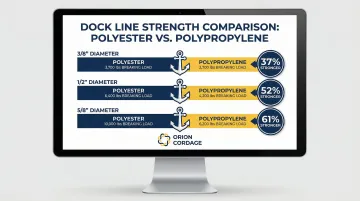
Polypropylene typically delivers 10-20% lower tensile strength compared to polyester of the same diameter, though the actual gap often exceeds this industry rule of thumb. This strength disadvantage becomes more pronounced as the rope ages and UV damage accumulates.
UV Resistance and Lifespan
Polyester excels in UV resistance, retaining over 95% of its tensile strength after 1,000 hours of UV exposure. With proper care, polyester dock lines last 5-10 years in marine environments, with some installations reaching 10-15 years of service life.
Polypropylene degrades rapidly under UV exposure, losing over 20% of its strength after just 600 hours in accelerated UV tests. In tropical climates with intense sun, untreated polypropylene can lose close to 30% of its strength within six months.
The rope becomes brittle, fades in color, and typically fails within 1-2 years of regular sun exposure—making it unsuitable for permanent dock lines.
Stretch and Shock Absorption
Polyester is known for low stretch characteristics, typically exhibiting 12-15% elongation at break. At working loads (10-20% of breaking strength), elongation is minimal—often just 1-2%. This dimensional stability keeps boats securely positioned without excessive movement.
Polypropylene offers moderate stretch, typically 15-25% elongation at break. While this provides some shock absorption, it lacks the elasticity of nylon and the stability of polyester.
As polypropylene ages and UV damage occurs, it becomes brittle, reducing its ability to elongate under load and increasing the risk of sudden failure.
Water Absorption and Resistance
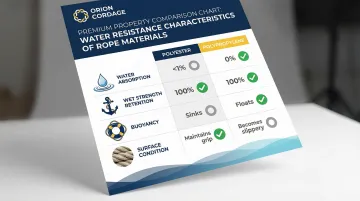
Polyester absorbs very little water (less than 1%), retaining 100% of its dry strength when wet. It remains flexible and easy to handle after submersion, and resists rot and mildew even in constant moisture.
Polypropylene floats on water due to its specific gravity of 0.91 (less than water's 1.0) and absorbs virtually no water. It also retains 100% of its strength when wet.
However, this buoyancy benefit is outweighed by poor UV resistance for dock line use, and the surface can become slippery, affecting knot security.
Cost and Value
Polyester sits at a mid-to-high price point (ranging from moderate to premium for 6mm diameter), but delivers better long-term value. A polyester dock line lasting 5-10 years costs roughly a fraction of its initial price annually, making it economical over time.
Polypropylene offers the lowest upfront cost (typically 30-40% less than polyester initially), but higher replacement frequency makes it more expensive over time. Replacing lines every 1-2 years can often double or triple the cost of polyester on an annual basis.
What is Polypropylene Rope?
Polypropylene is a lightweight, synthetic fibre rope made from thermoplastic polymer, commonly used in marine and industrial applications where affordability and buoyancy are priorities. It's the most economical synthetic rope option, making it attractive for budget-conscious buyers.
Key characteristics include:
- Floats on water due to specific gravity below 1.0
- Highly resistant to chemicals and mildew
- Lowest cost among synthetic ropes
- Poor UV resistance leading to rapid degradation
- Melting point of 302°-330°F (150°-165°C)
Polypropylene comes in multiple construction types. 3-strand twisted construction is the most common and economical, offering easy splicing but stiffening over time.
Braided construction (8-strand or hollow braid) provides better handling and flexibility but is less common for dock line applications due to the material's inherent limitations.
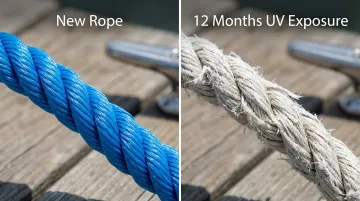
The degradation process is straightforward: UV photons break down the polymer chains, causing the fibres to become brittle, lose their original color (often fading to a chalky white or yellow), and eventually fail structurally.
Significant strength loss can occur without obvious external signs beyond discoloration, making visual inspection unreliable.
Use Cases for Polypropylene Rope in Marine Settings
Polypropylene has appropriate applications in marine environments, but permanent dock lines are not among them:
Appropriate applications:
- Temporary dock lines for short-term tie-ups (days, not weeks)
- Emergency towing lines where buoyancy prevents propeller entanglement
- Dinghy painters that need to float clear of the hull
- Water sports tow ropes for skiing or tubing
- Rescue throw lines where visibility and floatation are critical
For permanent mooring, however, polypropylene falls short. West Marine explicitly states that polypropylene is "not recommended for long-term mooring use" due to its lack of durability and UV resistance. Some marinas, including the Marquette Yacht Club, list "yellow polypropylene rope" as an example of lines that are "NOT ok to use" for permanent mooring.
Polypropylene remains popular in commercial fishing and aquaculture where floatation is essential, though these industries accept frequent replacement cycles as part of operational costs.
What is Polyester Rope?
Polyester is a high-strength synthetic fiber rope known for minimal stretch, excellent UV resistance, and superior abrasion resistance. Often marketed under the brand name Dacron, polyester has become the material of choice for applications requiring dimensional stability and long-term durability.
Key benefits for marine use include:
- Maintains full strength when wet (100% wet strength retention)
- Resists degradation from sunlight and saltwater
- Provides stable, low-stretch performance (12-15% elongation at break)
- Excellent abrasion resistance for chafe-prone applications
- Melting point of 490°-500°F (254°-260°C)
Common construction types include:
- Double-braid (braided core with braided cover) — marine professionals prefer this for dock lines due to superior handling, strength, and ease of splicing
- 3-strand twisted — offers traditional appearance with modern synthetic performance
- 12-strand single braid — provides maximum strength-to-weight ratio for commercial applications
These construction options support diverse marine applications. For sailboat running rigging—sheets and halyards—polyester's low stretch and UV resistance make it the go-to choice.
The same properties excel in dock line applications. Dimensional stability prevents excessive boat movement at the dock, while UV resistance ensures years of reliable service.
Use Cases for Polyester Rope in Marine Settings
This material excels in applications requiring strength, stability, and longevity:
Primary marine applications:
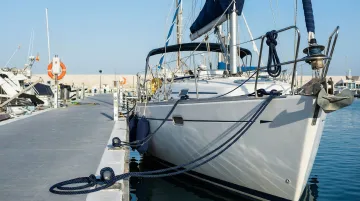
- Permanent dock lines for seasonal and year-round mooring
- Mooring lines for commercial vessels
- Anchor rodes, especially in combination with chain
- Sailboat running rigging (sheets, halyards, control lines)
- Heavy weather mooring where low stretch is critical
Low stretch characteristics make it particularly suitable for larger vessels (30+ feet) where excessive movement at the dock can cause damage.
The material's ability to maintain tension without creeping under constant load makes it ideal for permanent installations.
Beyond marine environments, polyester is widely used in industrial rigging and towing applications where high strength and minimal elongation are required, demonstrating its versatility beyond marine environments.
Polypropylene vs Polyester: Which is Better for Dock Lines?
For permanent dock lines, polyester is superior due to UV resistance, strength retention, and longevity. Polypropylene should only be used for temporary or emergency situations.
When Polyester Is the Right Choice
Polyester delivers performance where it matters most: UV stability and long-term strength retention. Unlike polypropylene, which breaks down rapidly under sunlight, polyester maintains its molecular structure even after years of exposure.
Choose polyester if:
- You need reliable, long-term dock lines for regular use
- Your boat remains at a slip for weeks or months at a time
- You want to minimize maintenance and replacement costs over time
- Your vessel is 30+ feet and requires maximum strength and stability
- You dock in exposed locations with significant UV exposure
When Polypropylene Makes Sense
Polypropylene has limited applications for permanent docking. Its floating property and low initial cost suit specific short-term scenarios only.
Choose polypropylene only if:
- You need an inexpensive, temporary solution for short-term tie-ups (days, not weeks)
- You require a floating line for specific applications (rescue lines, dinghy painters)
- Budget constraints require the absolute lowest upfront cost and you accept frequent replacement
Sizing and Environmental Factors
Your boat size and docking environment directly impact which material will perform safely.
Larger boats (30+ feet) should always use polyester or nylon dock lines—the strength difference is critical for safety. Smaller boats in covered slips might tolerate polypropylene for short periods, but polyester remains the better investment.
Saltwater environments with intense sun accelerate polypropylene degradation—polyester is essential. Freshwater environments with shade may extend polypropylene life slightly, but UV exposure remains the limiting factor.
Real-World Performance Comparison
A marina case study demonstrates the total cost advantage of polyester over polypropylene for permanent dock line applications.
The Marina Challenge
The Challenge: A mid-sized marina with 150 slips initially equipped rental boats with polypropylene dock lines to minimize upfront costs. Within the first season, dock staff noticed rapid deterioration—lines became stiff and brittle, with visible color fading from dark blue to chalky white.
By the end of the second season, approximately 40% of polypropylene lines required replacement due to visible degradation or reduced strength.
The Decision Trigger: A severe storm event brought the issue to a head—three boats broke free from their moorings when aging polypropylene lines failed under surge loads.
While no vessels were seriously damaged, the incident prompted a cost analysis comparing polypropylene replacement frequency versus polyester's higher upfront investment.
Cost Analysis Results
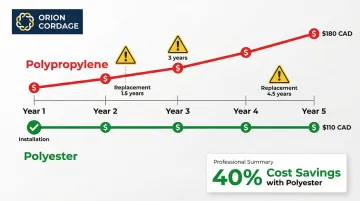
The Results: Following the switch to polyester dock lines for all permanent slips, the marina reduced dock line replacements by 60% over three years, resulting in a 40% cost savings despite the higher upfront investment. Maintenance staff reported significantly reduced inspection time, as polyester lines showed minimal degradation compared to the constant monitoring required for polypropylene.
Key Metrics:
- Polypropylene replacement cycle: Every 12-18 months on average
- Polyester replacement cycle: 5-7 years with proper maintenance
- Cost per slip over 5 years: $180 CAD (polypropylene) vs $110 CAD (polyester)
- Labor savings: 30% reduction in inspection and replacement time
Orion Cordage manufactures high-quality polyester and nylon dock lines designed for the demanding conditions of North American marine environments. Contact us at 877-224-2673 to discuss the right dock line solution for your vessel or marina.
Conclusion
While polypropylene rope has its place in marine applications—particularly where buoyancy is required for short-term use—it is not suitable for permanent dock lines due to rapid UV degradation and lower strength compared to polyester.
Polyester rope delivers superior long-term value through its UV resistance, strength retention, and minimal maintenance requirements. This makes it the clear choice for boat owners who prioritize safety and cost-effectiveness.
The higher upfront investment delivers real returns: reduced replacement frequency, lower maintenance costs, and the confidence that reliable, durable lines secure your vessel.
Frequently Asked Questions
What is the best material for docking lines?
Nylon is the best all-around dock line material due to its elasticity and shock absorption, which cushions boats against wave action. Polyester excels for low-stretch applications and larger vessels, while polypropylene should be avoided for permanent dock lines.
Which is stronger, polyester or polypropylene rope?
Polyester rope is 10-20% stronger than polypropylene of the same diameter, though the difference often exceeds 50% in common dock line sizes. Polyester also maintains strength over time, while polypropylene loses 20-30% within the first year of sun exposure.
How long do polypropylene dock lines last compared to polyester?
Polypropylene dock lines degrade within 1-2 years of UV exposure, becoming brittle and losing strength. Polyester dock lines last 5-10 years with proper care, making them more economical despite higher upfront costs.
Can I use polypropylene rope for temporary dock lines?
Yes, polypropylene works for short-term or emergency dock lines lasting days or a few weeks, especially when buoyancy is beneficial. However, replace it with polyester or nylon for extended mooring periods.
Does polyester rope stretch like nylon for dock lines?
No, polyester has significantly less stretch than nylon—12-15% elongation versus 25-30% for nylon. This makes polyester more stable for maintaining vessel position but provides less shock absorption. For shock absorption needs, nylon is preferred.
What size dock line should I use for my boat?
Use 3/8" diameter for boats up to 20 feet, 1/2" for 20-30 feet, 5/8" for 30-40 feet, and 3/4" or larger for boats over 40 feet. Material quality matters as much as diameter when selecting dock lines.