Introduction: The Real Cost of Guessing Wrong About Mooring Line Lifespan
A tanker captain faces a critical decision: retire mooring lines that appear serviceable, wasting $30,000, or keep them in service and risk a catastrophic failure during the next port call. Unlike equipment with stamped expiration dates, synthetic mooring lines don't come with simple answers.
The challenge is real. Retire lines too early, and you're throwing away thousands of dollars in perfectly good equipment. Wait too long, and you're gambling with crew safety and vessel security.
One unexpected failure during critical operations can cost far more than premature replacement—in repair expenses, port delays, and potential injuries.
This guide cuts through the uncertainty with practical insights on:
- Realistic lifespan expectations based on industry data
- Factors that actually affect longevity
- Maintenance practices that extend service life
- Retirement criteria grounded in OCIMF MEG4 standards
TLDR: Quick Reference Guide to Synthetic Mooring Line Lifespan
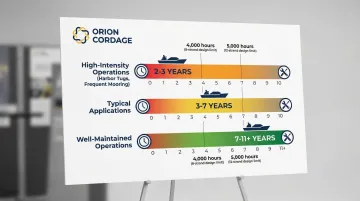
- Designed lifetime: 4,000 hours (8-strand) to 5,000 hours (12-strand construction)
- Real-world range: 2-3 years in high-intensity operations to 11+ years in well-maintained applications
- Measure in mooring hours, not calendar age: a line used 2 hours daily ages differently than one used 12 hours daily
- OCIMF MEG4 standard: Retire at 75% residual strength of Ship Design MBL
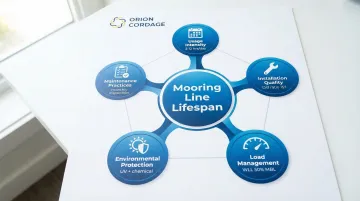
- Lifespan drivers: Usage intensity, maintenance quality, installation precision, and environmental conditions
Understanding Synthetic Mooring Line Lifespan: Why "It Depends"
Synthetic mooring lines age through use, not calendar time. This fundamental difference explains why identical lines installed on the same day can have dramatically different lifespans.
Two ways to measure lifespan:
Calendar time (months/years from installation) is the simplest metric but also the least accurate. A line installed 5 years ago might be nearly new if the vessel spent most of that time at sea, or completely worn if the vessel operates as a harbor tug.
Mooring hours (actual time under load) provides the accurate measure. A line used 2 hours per day accumulates 730 mooring hours annually. One used 12 hours daily accumulates 4,380 hours, nearly reaching its designed lifetime in a single year.
Manufacturer specifications provide baselines:
Leading manufacturers specify designed lifetimes of 4,000 mooring hours for 8-strand construction and 5,000 hours for 12-strand designs.
These figures assume ideal conditions: proper installation, correct equipment ratios, regular maintenance, and operation within load limits.
Real-world performance tells a different story:
Industry data shows a broad range from 3 to 7 years for most applications. High-intensity operations—harbor tugs, frequent mooring vessels, ships in congested ports—often see retirement in 2-3 years. Well-maintained lines on vessels with longer sailing periods between port calls can perform for 7+ years.
The exceptional cases prove the point: Dyneema SK78 lines on the COSPEARL LAKE remained in service for over 11 years, logging 11,200 mooring hours while retaining 87% of original strength.
This wasn't luck. It was the result of proper installation, consistent maintenance, and detailed documentation.
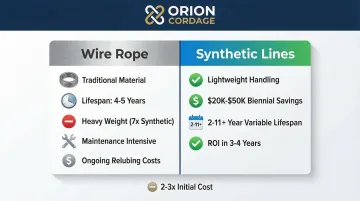
Wire rope offers a predictable 4-5 year lifespan, but synthetic lines' upper limit is still being determined through ongoing real-world use. The uncertainty cuts both ways: retire too early and waste money, retire too late and risk failure.
Factors That Affect Mooring Line Longevity
Vessel Type and Usage Patterns
A harbor tugboat making 6-8 port calls daily accumulates mooring hours at a significantly different rate than an ocean-going tanker with 30-day voyages between ports. This usage intensity is the single biggest determinant of calendar lifespan.
Position-specific wear patterns compound the challenge. Spring lines and breast lines—positioned at angles and subject to vessel movement—typically show wear 30-40% faster than head and stern lines under pure tension loads. Rotating lines between positions can equalize this wear, but many operators overlook this practice.
Environmental and Operational Conditions
Port infrastructure quality directly impacts line lifespan. Well-maintained bollards with smooth surfaces preserve fiber integrity. Rough concrete bollards, dragging across piers, and sharp edges on fittings can cut mooring hours by half.
Environmental stressors vary by location:
- UV exposure intensity increases dramatically at lower latitudes—lines operating in tropical ports degrade faster than those in northern climates
- Saltwater provides excellent corrosion resistance for synthetic fibers, but salt crystals embedded in fibers act as internal abrasives when lines stretch under load
- Extreme temperatures affect fiber properties—high heat reduces strength, while freezing conditions can make lines stiff and difficult to handle
- Chemical exposure from cargo operations, particularly acids and solvents, can destroy synthetic fibers within moments
Installation and Equipment Quality
Installation quality determines whether a line reaches its designed lifetime or fails prematurely. Each twist per meter reduces strength by approximately 6%—a line installed with 10 twists loses 60% of its strength before ever bearing load.
Proper Installation Techniques
Critical installation requirements:
- Use rotating platforms during deployment to prevent twist introduction
- Verify correct winding direction on drums (following manufacturer specifications)
- Employ 2-color ropes for immediate twist detection
- Engage experienced crew familiar with synthetic line characteristics
Equipment compatibility matters just as much. OCIMF MEG4 recommends a minimum D/d ratio of 15:1 (fitting diameter to rope diameter). Smaller ratios create excessive bending stress, dramatically reducing working life. A 60mm rope requires fairleads and bollards with at least 900mm diameter.
Deck hardware maintenance prevents premature wear:
- Maintain smooth surfaces on panama chocks—remove rust and rough spots
- Ensure roller fairleads rotate freely under load
- Eliminate sharp edges that cut individual fibers
- Replace worn fittings before they damage expensive mooring lines
Operating Within Load Limits
The Working Load Limit (WLL) for synthetic ropes is 50% of Ship Design MBL, with typical operating range up to 22% of Ship Design MBL. These aren't suggestions—they're engineering limits that determine lifespan.
Exceeding WLL causes internal damage that may not be visible externally but significantly reduces residual strength. A line overloaded to 65% of MBL might look fine but have lost 20-30% of its breaking strength through internal fiber damage.
Shock loading poses the most severe risk. Sudden loads from swells, passing vessels, or rapid winch operation can cause internal fiber melting—temperatures at fiber contact points can exceed 200°C in milliseconds. This catastrophic damage often goes undetected until the line fails under normal loads.
Winch brake rendering should be set at 60% of Ship Design MBL to protect lines from overload events. This setting allows controlled slippage rather than shock loading.
Material Quality and Construction
Construction type affects designed lifetime:
- 8-strand braided: 4,000 mooring hours designed lifetime
- 12-strand with SBA core: 5,000 mooring hours designed lifetime
Fiber quality determines real-world performance. High molecular weight polyethylene (Dyneema SK-75 and SK-78) offers superior tension fatigue resistance, abrasion resistance, and creep life compared to mixed polyolefin/HT polyester blends. The fiber quality difference can translate to 20-30% longer service life in demanding applications.
Manufacturing standards matter. Domestic manufacturers like Orion Cordage, with over 168 years of rope manufacturing experience across USA and Canada facilities, maintain consistent quality control throughout the production process.
Consistent fiber tension, precise braiding patterns, and thorough testing contribute to predictable performance and longevity. This manufacturing consistency means operators can rely on performance data from previous installations when planning replacement schedules.
Synthetic vs. Wire Rope: Lifespan and Cost Comparison
The initial sticker shock of synthetic lines—often 2-3 times the cost of wire rope—hides the total cost of ownership advantage that typically emerges within 3-4 years.
Initial cost vs. maintenance savings:
Synthetic lines generate $20,000 to $50,000 in maintenance savings per vessel every two years by eliminating:
- Relubing requirements and internal corrosion prevention
- Special spooling trucks for end-for-ending operations
- Deck hardware replacement from wire rope abrasion
- Environmental compliance costs for lubricants and cleanup
Return on Investment Timeline
Operators typically see ROI within 3-4 years. This timeline equals or slightly exceeds wire rope's entire 4-5 year lifespan.
After reaching ROI, synthetic lines may continue performing for years while wire rope requires replacement.
Operational efficiency adds hidden value. Synthetic lines weigh 1/7th as much as equivalent wire rope, enabling faster deployment. The BW Shipping fleet documented a 50% reduction in mooring time, from 80 minutes to 40 minutes, saving an estimated $81,000 annually per vessel in crew time and port costs.
The economic case strengthens over time. Wire rope performance degrades predictably, requiring replacement at 4-5 years regardless of maintenance. Synthetic lines with proper care can exceed this timeline significantly. Some installations perform well after 11 years.
Extending Your Mooring Lines' Service Life: Best Practices
Installation Best Practices
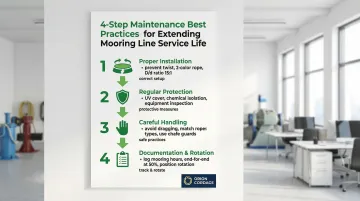
Generic installation procedures don't account for the specific characteristics of different synthetic fiber types and constructions. Follow manufacturer instructions precisely—Orion Cordage and other quality manufacturers provide detailed installation guides that reflect years of testing and real-world experience.
Deploy rotating platforms during installation to prevent twist introduction. Even minor twisting reduces starting strength.
Use 2-color ropes for immediate visual twist detection. Orion manufactures several options including blue/orange Superpro® and white/orange Extra-Lene® combinations that make twist identification simple.
Before putting lines into service, verify proper drum winding. Incorrect winding direction or uneven spooling creates localized stress points that accelerate wear.
Maintenance Requirements
UV protection extends service life significantly:
- Keep ropes covered when not in use
- Store lines out of direct sunlight in well-ventilated areas
- Remember that even UV-resistant synthetics degrade with prolonged exposure
Chemical isolation prevents serious damage. Acids and solvents can destroy synthetic fibers within moments.
Store mooring lines away from chemicals and keep lines off deck surfaces where cargo residue, hydraulic fluid, or cleaning chemicals might contact them.
Regular equipment inspection prevents line damage. Check mooring fittings monthly for:
- Sharp edges or burrs that cut individual fibers
- Rough surfaces from rust or corrosion
- Worn roller bearings in fairleads
- Damaged panama chocks
Address issues immediately—deck hardware maintenance is cheaper than mooring line replacement.
Proper Handling Procedures
Avoid dragging lines on rough surfaces. The abrasion from concrete piers or steel decks cuts years off service life. Use deck protection or carry lines to deployment positions.
Match rope types on parallel positions:
- Mixing different fiber materials creates uneven loading
- Mismatched elongation characteristics mean the stiffer rope bears more load
- This imbalance significantly reduces the overloaded rope's lifespan
Deploy rope protection in high-wear areas. Braided jackets or chafe guards on eye sections and contact points can double lifespan in these critical zones. The protection cost is minimal compared to full line replacement.
Documentation and Rotation
Proper record-keeping enables data-driven retirement decisions. Maintain detailed rope logs tracking:
- Mooring hours (actual time under load)
- Inspection results with photos of wear areas
- Incidents (shock loads, chemical exposure, unusual wear)
- Maintenance performed (end-for-ending, rotation, repairs)
Perform end-for-end reversal at 50% of designed lifetime to equalize wear between eye sections and standing sections. For a 5,000-hour designed lifetime rope, schedule end-for-ending at 2,500 hours.
Rotate ropes between positions when practical. Move heavily loaded spring lines to less demanding head line positions, extending overall fleet service life.
When to Replace Your Synthetic Mooring Lines: Retirement Criteria
OCIMF MEG4 Standard
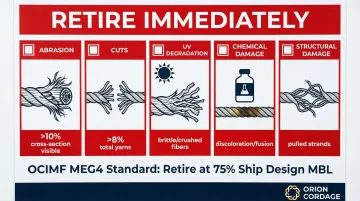
The industry standard is clear: retire mooring lines when residual strength reaches 75% of Ship Design MBL. This threshold provides adequate safety margin while maximizing line use.
Determining residual strength currently requires destructive testing—send a line to a testing facility, and you'll know its exact strength but won't have the line anymore. This makes visual inspection criteria and service hour tracking critical for practical retirement decisions.
Visual Inspection Red Flags
Immediate retirement triggers:
- Abrasion: Clearly visible on more than 10% of rope cross-section
- Cuts: Affecting more than 8% of total yarns in the rope
- UV degradation: Brittle or crushed fibers, particularly on outer surfaces
- Chemical damage: Discoloration, fusion, hardness, or unusual texture
- Constructional damage: Pulled strands causing major structural distortion
Documentation-Based Triggers
Beyond visual inspection, documented incidents require evaluation:
- Shock loads: Any excessive loading events must be recorded and assessed
- Chemical exposure: Even brief contact with aggressive chemicals warrants inspection
- Service hours: Lines approaching designed lifetime without recent inspection (4,000+ hours for 8-strand, 5,000+ hours for 12-strand)
Retirement decisions balance safety against economics, and borderline cases require expert judgment.
Manufacturers like Orion Cordage can provide guidance based on your specific usage patterns and operating conditions. With manufacturing experience since 1856, their technical team understands the nuances of different rope constructions and can help you make informed retirement decisions.
Real-World Lifespan Examples and Case Studies
BW Shipping: Tanker Fleet Conversion
BW Shipping equipped 11 new-build tankers with synthetic mooring lines, documenting comprehensive performance data:
Operational efficiency: Mooring time dropped 50%, from 80 minutes to 40 minutes, due to lighter weight and easier handling.
Financial performance: Maintenance savings of CAD $20,000-$50,000 per vessel every two years justified the investment within 4 years—matching wire rope's entire lifespan.
Safety improvements: Eliminating wire rope snap-back risk and "fish hooks" (broken wire strands causing hand injuries) reduced crew injuries.
While BW Shipping demonstrated efficiency gains, the COSPEARL LAKE case study established the upper boundary for synthetic line longevity.
COSPEARL LAKE: The 11-Year Performance Benchmark
The first VLCC 100% equipped with Dyneema mooring lines established the upper boundary of synthetic line lifespan:
Longevity: The original 22 lines remained in service for over 10 years, logging 11,200 mooring hours.
Residual strength: Breaking tests after a decade showed 87% retention (114 tons vs. 130 tons original)—well above the 75% retirement threshold.
Efficiency: Average docking time of 70 minutes compared to 4-hour average for steel wire operations.
Common factors in longest-lasting installations:
- Proper installation without twist
- Consistent maintenance including UV protection
- Detailed documentation of mooring hours and incidents
- Operation within load limits
These aren't exotic practices. They're basic discipline applied consistently.
The range of real-world performance—from 2-3 years in high-intensity operations to 11+ years in well-maintained applications—shows that lifespan is largely within operator control.
Lines don't fail randomly. They fail when installation, maintenance, or operating practices fall short.
Frequently Asked Questions
What is the average lifespan of synthetic mooring lines?
Designed lifetime is 4,000-5,000 mooring hours depending on construction. Real-world lifespan ranges from 2-3 years in high-intensity operations to 11+ years in well-maintained applications.
How do synthetic mooring lines compare to wire rope in terms of longevity?
Wire rope typically lasts 4-5 years with ongoing maintenance costs. Synthetic lines match or exceed this lifespan with proper care, while offering $20,000-$50,000 in maintenance savings every two years.
What factors most significantly impact mooring line lifespan?
Load management (avoiding overloading and shock loads), installation quality (D/d ratios, smooth fittings), UV exposure control, and proper handling. Installation precision is critical—a single twist per meter reduces strength by 6%.
How often should synthetic mooring lines be inspected?
Monthly for high-frequency operations, quarterly for vessels with longer sailing periods. Any incident (shock load, unusual wear, chemical exposure) should trigger immediate inspection regardless of schedule.
Can synthetic mooring lines be repaired or must they be replaced?
Minor damage (pulled yarns, localized abrasion) can be managed through end-for-ending. Significant damage (major cuts, UV degradation, abrasion exceeding 10%) requires line retirement.
What is the OCIMF MEG4 retirement recommendation for mooring lines?
OCIMF MEG4 recommends retirement at 75% of Ship Design MBL. Practical decisions rely on visual inspection criteria (10% abrasion, 8% cut yarns, UV degradation) and mooring hour tracking.