Introduction
Choosing mooring lines with inadequate breaking strength isn't just a technical oversight—it's a recipe for disaster. Undersized lines can snap under storm loads, sending vessels crashing into docks, damaging nearby boats, and creating serious safety hazards.
The financial consequences are equally severe: insurance claims for mooring failures can exceed tens of thousands of dollars, and some policies may not cover damage caused by improperly specified equipment.
Your goal is matching breaking strength specifications to your vessel's weight, environmental conditions, mooring configuration, and safety requirements. Each vessel presents unique demands: a 30-foot sailboat in a protected marina has vastly different needs than a 60-foot trawler exposed to tidal currents and storm surges.
This guide shows you how to calculate the actual breaking strength you need, accounting for vessel displacement, environmental loads, safety factors, and inevitable strength degradation over time.
You'll learn why breaking strength is only part of the equation—and how working load limits, material selection, and proper maintenance determine whether your mooring system holds when it matters most.
Key Takeaways
- Breaking strength ratings reflect new rope under ideal conditions—real-world strength drops 40-60% due to knots, UV damage, and ageing
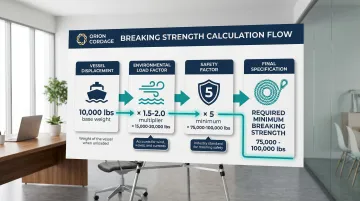
- Required strength calculation: vessel weight × environmental load factor (1.5-2.0) × safety factor (minimum 5:1)
- Material selection: nylon absorbs shock loads through stretch; polyester offers dimensional stability; HMPE delivers maximum strength-to-weight
- Working load limit should never exceed 20% of rated breaking strength to account for degradation and dynamic forces
- Replacement schedule: every 2-3 years in harsh conditions or when damage appears
What is Breaking Strength in Mooring Lines?
Breaking strength—also called tensile strength, minimum breaking load (MBL), or line design break force (LDBF)—is the maximum load a new, unused rope can withstand under standardized laboratory testing before it fails. Manufacturers determine this value by testing new rope samples according to protocols like ISO 2307:2019 or Cordage Institute CI 1500, measuring the force required to break the rope under controlled conditions.
Breaking strength is the absolute failure point, not a working load target. You should never design a mooring system to operate anywhere near this number.
Real-world breaking strength is always significantly lower than the rated specification. Knots reduce rope strength by 40-60%, while well-executed splices retain 90-100% of original strength.
Multiple factors degrade rope performance invisibly over time:
- UV exposure breaks down synthetic fibers
- Abrasion weakens outer strands through friction
- Water absorption reduces nylon strength by 10-15%
- Previous shock loads create internal damage
- Marine environment accelerates degradation
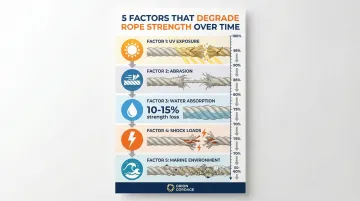
A rope rated at 50,000 lbs breaking strength might only deliver 25,000-30,000 lbs of actual capacity after a year of marine exposure.
The maritime industry has evolved its terminology to address safety gaps. Commercial operators now use "Ship Design MBL (MBLsd)" and "Line Design Break Force (LDBF)" under OCIMF MEG4 standards, ensuring all fittings and winch capacities are sized against these values to prevent equipment failures before line breakage occurs.
Key Factors That Determine Required Breaking Strength
Selecting proper breaking strength requires analyzing multiple variables specific to your vessel and mooring environment. The following factors connect technical rope specifications to real-world safety requirements.
Vessel Displacement and Size
Vessel weight (displacement) is the starting point for all mooring calculations. Heavier vessels require proportionately stronger mooring lines to resist movement from wind, current, and wave action.
As a baseline, mooring lines should have a breaking strength of at least 15-20% of the vessel's displacement, multiplied by your safety factor. For a 10,000 lb vessel with a 5:1 safety factor, this translates to 7,500-10,000 lbs minimum breaking strength.
This baseline assumes calm conditions. Environmental loads can multiply these requirements significantly.
Environmental Loads (Wind, Current, Wave Action)
Wind pressure creates lateral forces that can exceed the vessel's weight in storm conditions. Wind force is calculated as F = 0.5 × C × ρ × V² × A, where C is the wind coefficient, ρ is air density, V is wind speed, and A is the exposed windage area.
For perspective, a 50-knot beam wind on a 250,000 DWT tanker generates approximately 300 tonnes of transverse force—five times the longitudinal force from a head wind.
Recreational vessels face similar proportional challenges. A 40-foot powerboat with high freeboard can experience wind loads 2-3 times its displacement in gale-force conditions.
Current and wave action add dynamic loading that varies with tidal range and exposure. Tidal currents in exposed locations can generate sustained loads approaching static wind forces, while wave action introduces cyclic loading that accelerates rope fatigue.
Mooring Configuration and Line Angle
The number of mooring lines and their angles dramatically affect load distribution. A single line bears 100% of the load, whereas properly configured multiple lines share the burden. However, line angle matters significantly.
Lines at steep angles (pulling upward from the cleat) experience higher tension than horizontal lines for the same vessel movement. A line at 45 degrees carries approximately 1.4 times the load of a horizontal line, and a line at 60 degrees carries nearly 2 times the load.
This geometric reality means bow and stern lines angled steeply require higher breaking strength specifications than spring lines running parallel to the dock.
Safety Factor Requirements
Understanding these complex loading scenarios explains why safety margins must be substantial.
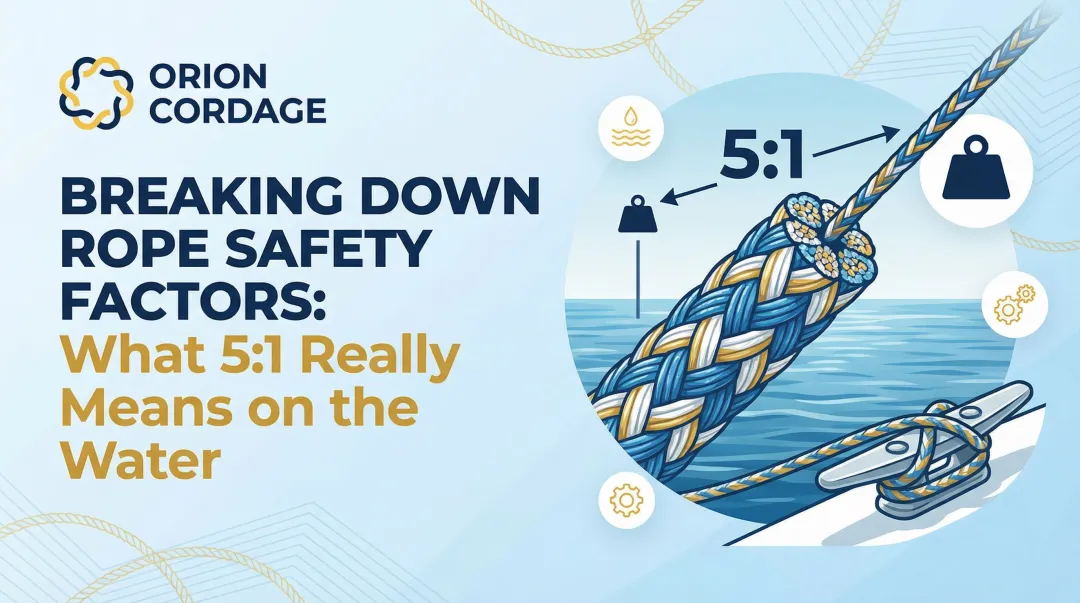
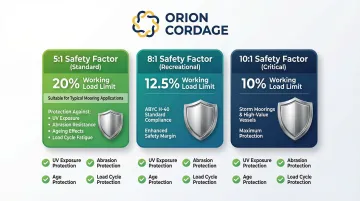
The marine industry standard is a 5:1 safety factor minimum—meaning working load limit should not exceed 20% of breaking strength. Commercial operations following OCIMF MEG4 set working loads at 50-55% of MBLsd, while recreational vessels under ABYC H-40 use an 8:1 design factor for nylon anchor rodes and mooring lines.
Why such conservative margins? Safety factors account for:
- Strength loss from knots and splices (20-60%)
- Aging and UV degradation (10-30% per year in harsh conditions)
- Shock loading (2-5× static loads)
- Unpredictable environmental conditions
Critical applications—storm moorings, commercial vessels, high-value boats—often use 8:1 or 10:1 safety factors to provide additional margin against the unknown.
Shock Loading Potential
Shock loading occurs when a vessel surges against a tight line, creating sudden tension spikes that can reach 3-5 times the static load. These momentary forces are particularly dangerous with low-stretch materials like polyester and HMPE, which transfer peak loads directly to deck fittings.
Nylon's high elasticity (10-20% at working load) absorbs shock loads effectively, smoothing out peak forces. HMPE offers precise control with less than 2% elongation but lacks energy absorption, requiring elastic tails or careful line management to prevent shock damage.
Duration of Mooring (Temporary vs. Permanent)
Permanent moorings require higher breaking strength specifications because ropes degrade over time from UV exposure, chafe, and repeated loading cycles. A rope that meets specifications when installed may retain only 75% of its original strength after two years of continuous exposure.
Temporary moorings for short-term docking can use lower safety factors, while long-term or unattended moorings demand higher specifications and more frequent inspection. Seasonal boats left unattended for months face additional risks from storm events and should use conservative breaking strength specifications with 8:1 or higher safety factors.
Breaking Strength vs. Working Load Limit: Understanding Safety Factors
Working Load Limit (WLL) is the maximum load a rope should carry during normal operations—typically 20% of new rope breaking strength for a 5:1 safety factor. This distinction is fundamental to mooring safety.
The 5:1 safety factor exists because multiple factors reduce actual rope strength:
- Knots and splices: Knots reduce strength by 40-60%; splices retain 90-100%
- Aging and UV degradation: 10-30% loss per year in harsh conditions
- Shock loading: Dynamic forces reach 2-5× static loads
- Environmental unpredictability: Unexpected conditions exceed design assumptions
These factors explain why simply matching rope strength to vessel weight isn't enough.
Here's a practical calculation: A 10,000 lb vessel in moderate conditions with a 5:1 safety factor requires mooring lines with approximately 50,000 lbs breaking strength (10,000 lbs × 5 = 50,000 lbs minimum).
This assumes the vessel's weight represents the maximum expected load. In reality, you should multiply vessel weight by an environmental load factor of 1.5-2.0 before applying the safety factor.
Breaking strength ratings assume NEW rope under ideal conditions. Real-world working loads must account for rope condition, age, and exposure history. OCIMF MEG4 recommends retiring lines when residual strength drops to 75% of the original specification, meaning a rope that started at 50,000 lbs should be replaced when strength falls to 37,500 lbs—still well above the 10,000 lb working load in our example.
Common Mooring Line Materials and Their Breaking Strengths
Material selection affects both breaking strength per diameter and performance characteristics like stretch, UV resistance, and durability.
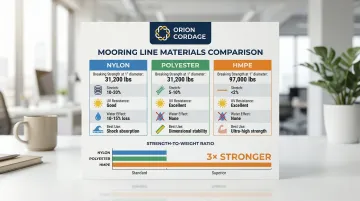
Nylon offers high stretch (10-20% elongation at working load, up to 40% at break), providing excellent shock absorption that smooths out peak loads. It loses 10-15% of tensile strength when wet and has good UV resistance. At 1-inch diameter, nylon double braid typically delivers 31,200 lbs breaking strength.
This makes nylon ideal for dynamic environments where shock absorption is critical.
Polyester provides low stretch (5-10% at working load), excellent UV resistance, and superior dimensional stability. It's unaffected by water and offers excellent abrasion resistance. At 1-inch diameter, polyester double braid delivers similar breaking strength to nylon (31,200 lbs), but its low-stretch characteristics make it ideal for applications requiring precise vessel positioning.
HMPE (High-Modulus Polyethylene) delivers ultra-high strength-to-weight ratios—approximately 3× stronger than nylon or polyester at the same diameter. A 1-inch HMPE 12-strand rope can achieve 97,000 lbs breaking strength.
With less than 2% elongation, HMPE offers minimal energy absorption, transferring shock loads directly to deck fittings unless paired with elastic tails. It floats and has excellent UV resistance, but requires careful handling due to its low coefficient of friction.
Beyond material choice, construction type significantly impacts breaking strength and handling characteristics:
- 12-plait nylon delivers approximately 25% more strength than 3-strand or 8-plait at the same diameter
- Torque-free constructions (12-plait, double-braid) prevent kinks and hockles
- 3-strand ropes can rotate under load, requiring careful handling
- Splicing retains 90-100% of rope strength versus significant losses from knots
How Orion Cordage Can Help
Orion Cordage has been manufacturing reliable, high-strength mooring lines since 1856, bringing over 165 years of rope-making expertise to help vessel owners select the right breaking strength specifications for their specific needs. The company's engineers understand both rope construction and real-world marine applications, ensuring recommendations match actual operating conditions.
Domestic manufacturing in the USA and Canada ensures consistent quality control, rigorous testing to meet or exceed breaking strength specifications, and the ability to customize mooring lines for specific vessel requirements.
Orion's commercial marine portfolio includes everything from 6,000 lb Premium Double Braid Nylon for recreational applications to 357,000 lb Prodac® 3-Strand Combination for heavy commercial mooring and ship-to-ship operations.
Key advantages include:
- Thousands of SKUs available for immediate delivery to address tight lead times
- Quality domestic manufacturing with transparent testing standards and traceable specifications
- Product range spans commercial and pleasure marine applications across nylon, polyester, HMPE, and proprietary blends
- Construction types include 3-strand, double-braid, 8-plait, and 12-strand—each optimized for specific mooring conditions
- Custom and OEM capabilities for specialized breaking strength requirements
Orion's technical team can calculate the required breaking strength for your vessel and operating conditions, whether you need dock lines for a recreational boat or heavy-duty mooring solutions for commercial operations. Contact them at 877-224-2673 to discuss your specific requirements.
Conclusion
Selecting mooring lines with adequate breaking strength isn't about finding the highest-rated rope—it's about matching specifications to your vessel's weight, environmental conditions, mooring configuration, and safety requirements.
A properly specified mooring system accounts for real-world degradation factors and provides sufficient margin for unexpected conditions.
Breaking strength is just one specification in the equation. You must also consider:
- Working load limits (20% of breaking strength maximum for recreational applications)
- Safety factors (5:1 minimum, 8:1 for critical applications)
- Material properties that match your environment
- Expected service life based on exposure conditions
Beyond initial selection, maintain your mooring system through regular inspections. Monitor for strength loss through stretch testing or visual inspection, and replace lines before they approach end-of-life to maintain safety margins.
The investment in proper specification and timely replacement protects both your vessel and peace of mind on the water.
Frequently Asked Questions
What is the breaking strength of a mooring line?
Breaking strength varies by rope diameter, material, and construction type. For example, 1/2" nylon double braid typically has approximately 7,300 lbs breaking strength, while 1/2" polyester double braid has around 8,200 lbs. Always consult manufacturer specifications, as construction methods and fiber quality significantly affect performance.
What is the breaking strength of 6×24 wire rope?
6×24 wire rope breaking strength depends on diameter and grade—1/2" diameter 6×24 improved plow steel wire rope typically has breaking strength around 16,800 lbs. Synthetic fiber mooring lines are more common in recreational and light commercial applications due to better handling and shock absorption.
How do I calculate the required breaking strength for my boat's mooring lines?
Multiply your vessel's displacement by the expected load factor (typically 1.5-2.0 for wind/current), then multiply by your safety factor (5 minimum). For example: 10,000 lb boat × 2.0 load factor × 5 safety factor = 100,000 lbs minimum breaking strength required. This ensures adequate margin for environmental loads and rope degradation.
What's the difference between breaking strength and working load limit?
Breaking strength is the maximum load before rope failure, tested on new rope under ideal conditions. Working load limit is the safe maximum load during normal use—typically 20% of breaking strength for a 5:1 safety factor. Never exceed the working load limit, as breaking strength doesn't account for aging, knots, or UV damage.
Does rope diameter affect breaking strength?
Yes, significantly. Larger diameter ropes have exponentially higher breaking strength—doubling rope diameter typically quadruples breaking strength. For example, 1/2" nylon double braid has approximately 7,300 lbs breaking strength, while 1" nylon double braid delivers 31,200 lbs.
How often should I replace mooring lines based on breaking strength degradation?
Inspect annually for signs of strength loss including excessive stretch, UV damage, abrasion, or hardening. Replace lines every 2-3 years in harsh conditions (constant sun exposure, heavy use) or 5-7 years in protected conditions. Replace immediately any line showing visible damage regardless of age, including glazed fibers, diameter inconsistencies, or brittleness.