Introduction
A dock line rated at 10,000 lbs breaking strength seems robust. Can you safely load it to 10,000 lbs? Absolutely not—and this misunderstanding has caused equipment failures and serious injuries in marine operations.
Safety factors like 5:1 create the essential buffer between a rope's maximum capacity and its safe working load. This margin accounts for real-world stresses lab tests never capture.
UV degradation, saltwater corrosion, dynamic loading from wave action, and strength loss from knots can reduce actual rope capacity by 30-50% below the rated breaking strength.
This article explains what a 5:1 safety factor means, why it's the marine standard, and how to calculate working loads correctly.
Key Takeaways
- A 5:1 safety factor limits working load to one-fifth of breaking strength (10,000 lbs MBL = 2,000 lbs SWL)
- The ratio protects against dynamic loads, UV degradation, knot strength loss (40-50%), and unpredictable stresses
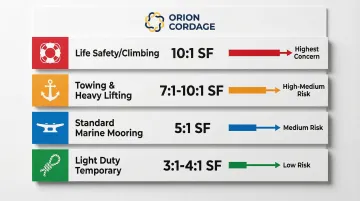
- Routine mooring uses 5:1, while towing and life-safety applications require 7:1 to 10:1
- Exceeding safe working loads cuts rope lifespan by 50%+ and creates dangerous snapback risk
What Safety Factors Represent in Marine Ropes
A safety factor is the ratio between a rope's minimum breaking load (MBL) and its safe working load (SWL), expressed as:
Safety Factor = MBL ÷ SWL
This isn't a random number—it's an engineering margin designed to bridge the gap between controlled laboratory testing and unpredictable field conditions. The Cordage Institute specifies that safety factors for non-critical rope uses typically range from 5 to 12, with 5:1 being the baseline for most marine applications.
Why 5:1 became the standard:
This ratio emerged from decades of research and industry consensus. Organisations like the Oil Companies International Marine Forum (OCIMF) and the Cordage Institute established 5:1 for routine mooring operations based on real-world performance data. Samson Rope explicitly recommends a minimum 5:1 safety factor for rope used under normal conditions, noting this is commonly accepted across most industries.
Here's the fundamental principle: if your rope has a 10,000 lb MBL with a 5:1 safety factor, your safe working load is 2,000 lbs. You should never intentionally load it beyond 2,000 lbs during normal operations.
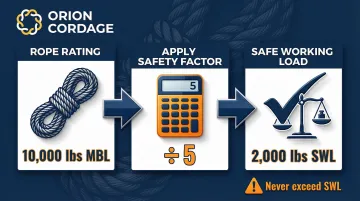
Critical distinction: The safety factor is a design parameter, not a performance buffer you can "use up." It exists to ensure the rope never approaches failure during normal operation.
Operating at or near the MBL—even once—can cause permanent damage that compromises future performance.
Factors That Influence Safety Factors in Real-World Operation
The 5:1 ratio assumes baseline conditions, but actual field performance varies significantly based on multiple factors that reduce effective rope strength.
Design and Environmental Constraints
Material type matters significantly:
- Nylon (Polyamide): Absorbs water and loses approximately 10-15% of dry tensile strength when wet, though it offers excellent shock absorption
- Polyester: Retains strength well but experiences internal abrasion and fatigue over time
- Polypropylene: Highly susceptible to UV degradation unless specially treated
Construction method also affects baseline strength:
- Double-braid: Provides more consistent stretch characteristics than 3-strand twisted designs
- 3-strand twisted: Traditional construction with predictable performance patterns
- 12-strand: Maximizes strength while offering superior handling and flexibility
Environmental stressors accumulate over time:
- UV radiation degrades fibers, particularly in polypropylene and untreated polyester
- Saltwater accelerates corrosion and stiffness in certain fiber types
- Temperature extremes affect creep rates and fiber performance
- Abrasion from chocks, cleats, and hull contact creates localized weak points
- Chemical exposure from fuels, oils, and cleaning agents compromises fiber integrity
Dynamic Loading and Shock Loads
While environmental factors gradually degrade rope strength, operational realities introduce another critical consideration: dynamic forces.
Static load calculations don't capture the full picture. Marine environments generate dynamic forces where shock loads can reach 2-3 times higher than static loads. A boat surging in waves or a sudden wind gust creates these amplified forces—exactly why the safety margin matters.
OCIMF MEG4 demonstrates that dynamic loading causes fatigue in rope yarns, eventually resulting in strength loss that's impossible to detect visually. This hidden degradation makes the 5:1 factor essential for long-term reliability.

Range of Safety Factors
While 5:1 is standard for marine mooring, the appropriate safety factor varies by application, load type, and consequence of failure.
Standard Safety Factor Ranges by Application
| Application | Safety Factor | Reason |
|---|---|---|
| Routine marine mooring/docking | 5:1 | Baseline for predictable, moderate-load scenarios |
| Towing and heavy lifting | 7:1 to 10:1 | Higher stakes and less predictable loading |
| Life-safety/climbing applications | 10:1 | Required for lines supporting human life |
| Light-duty temporary uses | 3:1 to 4:1 | Only when failure consequences are minimal |
Calculating Safe Working Load from Breaking Strength
To determine your rope's safe working load, apply this formula:
Safe Working Load (SWL) = Minimum Breaking Load (MBL) ÷ Safety Factor
Worked example: A rope with 15,000 lbs MBL and 5:1 safety factor has a SWL of 3,000 lbs.
Critical considerations:
- Always use the minimum breaking load, not average or "typical" values—the Cordage Institute defines MBS as two standard deviations below the average tensile strength
- Account for reductions from knots (40-50% strength loss) and splices (10-20% reduction)
- Factor in age and wear, as ropes in service for years have lower effective strength than when new
Why 5:1 Is Not Universal
Higher safety factors are required when:
- Loads are unpredictable or highly variable
- Shock or dynamic forces are present
- Rope condition is uncertain or inspection is infrequent
- Failure would cause injury, death, or major property damage
- The rope is subject to continuous loading or creep conditions
Conversely, lower factors (down to 3:1 or 4:1) may work for well-maintained ropes with documented inspections, purely static loads, and non-critical applications where failure consequences are minimal.
Keep in mind that regulatory bodies and insurance standards often mandate specific safety factors for commercial operations. Always verify compliance requirements for your application before selecting a rope and safety factor.
Key Technical Properties of Safety Factors
The 5:1 safety factor protects against specific failure modes that occur long before a rope physically breaks.
Load Margin and Reserve Capacity
The 5:1 margin is not "extra strength you can tap into"—it's a buffer that keeps the rope in its elastic range where it can stretch and recover without permanent damage.
Operating beyond the safe working load pushes rope into the plastic deformation zone. This causes:
- Permanent elongation that doesn't recover
- Internal fiber breakage that's invisible from the outside
- Progressive failure that weakens the rope for all future use
- Accelerated degradation from subsequent loads
Even if the rope doesn't break immediately, you've compromised its future load capacity. Its service life shortens dramatically.
Interaction with Knots, Splices, and Terminations
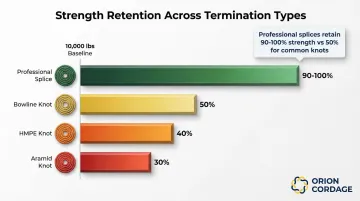
Knots and terminations directly impact how much of your rope's rated strength you can actually use. Common knots reduce rope strength by 50%, while high-modulus materials suffer even greater losses.
| Termination Type | Strength Retention | Effective MBL (10,000 lb rope) | Safe Working Load (5:1) |
|---|---|---|---|
| Bowline knot | 50% | 5,000 lbs | 1,000 lbs |
| HMPE knot | 40% | 4,000 lbs | 800 lbs |
| Aramid knot | 30% | 3,000 lbs | 600 lbs |
| Professional splice | 90-100% | 9,000-10,000 lbs | 1,800-2,000 lbs |
Real-world impact: A rope with 10,000 lbs MBL tied with a bowline has an effective MBL of only 5,000 lbs. At 5:1 safety factor, your safe working load drops to just 1,000 lbs—not the 2,000 lbs you'd calculate from the unknotted rating.
Professional splices retain 90-100% of rope strength, making them vastly superior for critical applications. Manufacturers use spliced terminations to determine tensile strengths precisely because splicing maintains the highest percentage of rated strength.
How Safety Factors Are Specified, Measured, and Validated
Manufacturers specify safety factors based on standardized testing protocols. Understanding how these ratings are established—and their limitations—is essential for proper rope selection and use.
Specification and Documentation
Reputable manufacturers provide certified test data showing minimum breaking loads tested under recognized standards:
- ASTM D-4268: Standard test method for testing fiber ropes
- Cordage Institute CI 1500: Test methods for basic and advanced physical properties
- ISO 2307: Methods for determining breaking force, elongation, and linear density
Manufacturers like Orion Cordage design, manufacture, and test thousands of rope SKUs at their own facilities. This integrated approach ensures consistent quality control from raw materials through final testing.
Minimum vs. Average Breaking Strength: Always design around the minimum. The Cordage Institute defines minimum tensile strength as two standard deviations below the average—typically about 15% lower than average values. This conservative approach accounts for manufacturing variance.
Field vs. Lab Conditions
Lab tests establish baseline performance using new rope with no knots, controlled temperature and humidity, and slow, steady pull-to-failure. Real marine conditions differ significantly.
In the field, ropes face:
- UV exposure and weathering
- Knots and improper terminations
- Dynamic shock loading
- Abrasion against hardware
- Saltwater and chemical exposure
- Temperature fluctuations
Bridging Lab and Field Performance:
OCIMF MEG4 introduced "Line Design Break Force" (LDBF) to better align testing with ship design requirements. The standard specifies LDBF should be 100-105% of the ship design MBL, recognizing the gap between lab and field performance.
This gap reinforces why field inspection and periodic evaluation are essential, especially for ropes in continuous or high-consequence use.
Implications of Operating Outside the Recommended Safety Factor Range
Exceeding safe working loads—even occasionally—creates a chain reaction that compromises rope integrity and safety.
When rope stretches beyond its elastic limit, permanent damage occurs. The line loses elasticity and may not return to original length. This permanent elongation reduces future load capacity and changes handling characteristics, making the rope unpredictable under load.
Fiber abrasion, core damage, and UV degradation accelerate when rope is overstressed. Operating at loads higher than the recommended WLL can shorten service life by 50% or more.
Understanding Rope Failure Modes
When operating outside safety factors, rope fails in three distinct ways:
- Progressive failure: Slow unraveling and strength loss over multiple load cycles
- Catastrophic failure: Sudden, complete breakage without warning
- Localized weak points: Overload creates damage sites that become future failure locations
Using ropes beyond their rated capacity violates marine safety standards, voids manufacturer warranties, and exposes operators to legal and insurance consequences in the event of an accident. The most dangerous consequence, however, is the snapback hazard.
The Snapback Danger
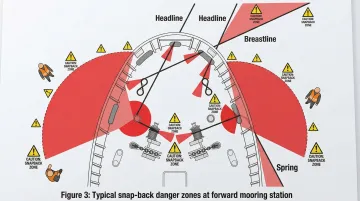
When a synthetic mooring line fails under high tension, the stored elastic energy releases instantly. Recoil velocities have been measured at approximately 700 ft/s (213 m/s)—lethal speeds that can cause serious injury or death to anyone in the recoil zone.
Historical data from the US Navy and Coast Guard documented three fatalities and four severe injuries—including amputations—from synthetic line snapback accidents in just one nine-month period.
The snapback zone is unpredictable, with lines sweeping huge areas in complex trajectories.
Common Misinterpretations of Safety Factors in Practice
Three misconceptions cause the majority of rope failures in marine applications:
Treating breaking strength as the working limit. Many users mistakenly believe "it's rated for 10,000 lbs, so I can load it to 10,000 lbs." OCIMF MEG4 explicitly corrects this misconception, stating that MBS is a test value, not an operational limit.
Assuming the safety factor creates "extra" capacity. A 5:1 safety factor is not a multiplier of your load—it's a divisor of the rope's capacity. You don't have "extra" strength to use; you have a margin to account for unknowns.
Ignoring degradation over time. A rope that started with a 5:1 safety factor when new may only have 2:1 or 3:1 after years of use, UV exposure, and knotting.
OCIMF recommends retiring mooring lines when residual strength reaches 75% of the Ship Design MBL—meaning the rope should be replaced well before it approaches actual failure.
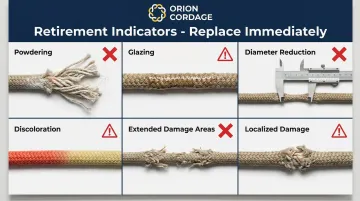
Because degradation compounds over time, regular inspection and retirement schedules are essential. Visual indicators for retirement include:
- Extended areas of damage or significant localized damage
- Powdering between strands (internal abrasion)
- Glazing or hardness (heat damage)
- Diameter reduction (core failure)
- Discoloration (chemical or UV damage)
Conclusion
A 5:1 safety factor is the marine industry's standard for reliable rope performance. It ensures ropes operate well below their breaking point, accounting for real-world stresses, degradation, and unpredictability that lab tests never capture.
Understanding this factor matters because the safe working load is not a suggestion—it's the maximum load under which rope can perform reliably over time. Operating beyond this limit, even occasionally, compromises rope integrity and creates serious safety hazards through progressive damage or catastrophic failure.
That's why proper rope selection, regular inspection, and strict adherence to safety factors are non-negotiable for safe marine operations. When in doubt, consult with manufacturers who understand marine applications—companies like Orion Cordage, manufacturing rope since 1856—or marine rigging professionals who can provide application-specific guidance based on your exact operating conditions.
Frequently Asked Questions
What does a 5:1 safety factor mean in practical terms?
A 5:1 safety factor means the rope's safe working load is one-fifth of its minimum breaking load. A rope rated at 10,000 lbs MBL should not be loaded beyond 2,000 lbs in normal use.
How do I calculate the safe working load of my rope?
Divide the minimum breaking load by the safety factor: 15,000 lbs MBL ÷ 5 = 3,000 lbs SWL. Remember to account for strength reductions from knots (40-50% loss) and wear over time.
Why can't I just use the breaking strength as my guide?
Breaking strength represents catastrophic failure under ideal lab conditions. Real-world factors like dynamic loads, UV damage, and knots require a large safety margin to prevent progressive damage and sudden failure.
When should I use a higher safety factor than 5:1?
Use 7:1 to 10:1 for towing, shock-load applications, life-safety uses, uncertain rope condition, or when failure would cause serious injury or property damage. Life-safety applications always require 10:1 minimum.
How much does a knot reduce rope strength?
Common knots reduce rope strength by 40-50%, dropping a 10,000 lbs MBL rope to 5,000-6,000 lbs effective strength. Professional splices lose only 10-20%.
How often should I inspect and replace my marine ropes?
Inspect before each use for fraying, discoloration, stiffness, or glazing. Replace ropes annually or sooner if they show UV damage, abrasion, or have been shock-loaded.