Introduction
Proper anchor line sizing is the difference between secure mooring and disaster. When weather deteriorates or unexpected currents develop, an undersized anchor rode becomes your boat's single point of failure—and many boaters discover this weakness only when it's too late.
Selecting the right anchor line requires accounting for boat size, displacement, water conditions, anchor type, and intended use.
A 30-foot sailboat weighing 8,000 lbs requires different gear than a 30-foot powerboat weighing 15,000 lbs, yet both owners might assume "30-foot boat" is sufficient guidance. It's not.
To eliminate this guesswork, this guide provides comprehensive sizing charts, material selection criteria, and practical application guidance to ensure your anchor system performs when you need it most.
Key Takeaways
- Size anchor line by boat length, displacement, and conditions—not anchor weight alone
- Use 1/8" rope diameter per 9 feet of boat length and 7:1 scope minimum
- Pair nylon three-strand or double-braid with chain for strength and shock absorption
- Both rope diameter and total rode length matter—undersizing either risks failure
- Storm conditions and rough seas require sizing up 1-2 sizes above minimums
What Anchor Line Size Represents in Marine Anchoring Systems
Anchor line size includes three critical dimensions: rope diameter, total rode length, and chain-to-rope ratio. All three must be properly matched for safe anchoring.
Rope diameter determines breaking strength and working load limit—the maximum force the line can safely handle. A 1/2" nylon rope has roughly double the breaking strength of a 3/8" rope, making diameter selection directly tied to your boat's weight and windage.
Total rode length determines scope—your ability to achieve the proper angle of pull on the anchor. Without sufficient length, even the strongest rope fails to deliver adequate holding power.
Rope Diameter as a Strength Parameter
Rope diameter correlates directly to breaking strength measured in pounds. A 3/8" three-strand nylon rope typically has a breaking strength of 4,400 lbs, while 1/2" jumps to approximately 7,000 lbs.
Diameter also affects:
- Handling characteristics (thicker rope is harder to manage)
- Windlass compatibility (gypsies are machined to specific sizes)
- Storage requirements in anchor lockers
- Grip comfort during manual retrieval
Total Rode Length and Scope Requirements
Scope is the ratio of total rode length to water depth plus freeboard — the vertical distance from the waterline to your bow roller. If you're anchoring in 20 feet of water with 5 feet of freeboard, your total depth is 25 feet.
For secure holding:
- 7:1 scope for normal conditions (175 feet of rode in the example above)
- 10:1 scope for storm conditions (250 feet of rode)
- 5:1 scope minimum for lightweight anchors in protected waters
Insufficient scope increases the angle of pull on the anchor, dramatically reducing holding power and increasing the risk of dragging.
Chain Component Sizing
Chain size must match both rope diameter and windlass specifications.
BBB (Triple B) chain is the standard for windlass applications due to its uniform link pitch, while high-test (G4) chain offers twice the strength at smaller diameters. Chain length typically ranges from 6-30 feet for combination rode, with one boat length being a practical working rule.
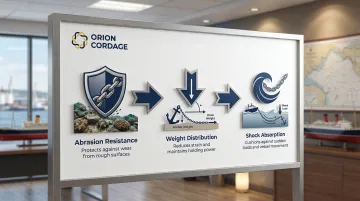
The chain section provides:
- Abrasion resistance where the rode contacts the bottom
- Weight that creates a horizontal pull on the anchor
- Catenary (natural sag) that absorbs shock loads
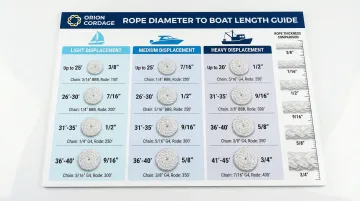
Complete Anchor Line Size Chart for Boat Length and Displacement
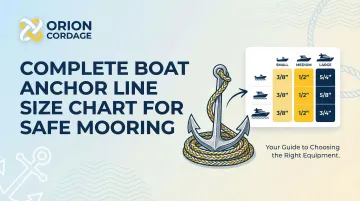
The table below provides minimum specifications for recreational vessels in moderate wind conditions (up to 30 knots) with proper scope on good holding bottoms.
| Boat Category | Length (ft) | Rope Diameter | Chain Size | Minimum Rode Length |
|---|---|---|---|---|
| Light | 20-24 | 3/8" | 3/16" BBB | 150-200 ft |
| Medium | 23-27 | 3/8" | 3/16" BBB | 175-225 ft |
| Heavy | 21-24 | 3/8" | 3/16" BBB | 175-225 ft |
| Light | 26-30 | 7/16" | 1/4" BBB | 200-250 ft |
| Medium | 28-32 | 7/16" | 1/4" BBB | 200-250 ft |
| Heavy | 25-28 | 7/16" | 1/4" BBB | 200-250 ft |
| Light | 36-40 | 1/2" | 1/4" BBB | 250-300 ft |
| Medium | 32-36 | 1/2" | 1/4" BBB | 250-300 ft |
| Heavy | 29-32 | 1/2" | 1/4" BBB | 250-300 ft |
| Light | 41-45 | 9/16" | 5/16" BBB/HT | 300-350 ft |
| Medium | 37-40 | 9/16" | 5/16" BBB/HT | 300-350 ft |
| Heavy | 33-36 | 9/16" | 5/16" BBB/HT | 300-350 ft |
| Light | 46-50 | 5/8" | 5/16" BBB/HT | 350-400 ft |
| Medium | 41-45 | 5/8" | 5/16" BBB/HT | 350-400 ft |
| Heavy | 37-40 | 5/8" | 5/16" BBB/HT | 350-400 ft |
| Light | 51-60 | 3/4" | 3/8" BBB or 5/16" HT | 400-450 ft |
| Medium | 46-54 | 3/4" | 3/8" BBB or 5/16" HT | 400-450 ft |
| Heavy | 41-48 | 3/4" | 3/8" BBB or 5/16" HT | 400-450 ft |
Use these categories to match your vessel type:
- Light: Racing sailboats, lightweight powerboats (displacement below typical range)
- Medium: Standard cruising sailboats, express cruisers (typical displacement)
- Heavy: Trawlers, displacement cruisers, heavily loaded vessels (above-average displacement)
Important: These specifications represent minimums. Sizing up is always safer than sizing down.
Interpreting the Chart for Your Specific Vessel
When boat length and displacement don't align perfectly with the chart categories, use displacement as the primary factor.
A heavy 28-foot trawler displacing 12,000 lbs should use the "Heavy" category specifications, even though its length might suggest otherwise.
Adjustments for high windage:
Boats with flying bridges, tall masts, or large cabin superstructures catch more wind. Make these adjustments:
- Size up one increment (e.g., from 1/2" to 9/16")
- Increase total rode length by 25-50 feet
- Consider windage as equal weight factor to displacement
Multihull considerations:
Catamarans and trimarans present unique anchoring challenges:
- Use the "Light" displacement category but increase rope diameter one size
- Deploy bridles to distribute loads across both hulls
- Add 50 feet to minimum rode length for wider swing radius
Factors That Influence Anchor Line Sizing Beyond Boat Length
Minimum chart values represent baseline requirements. Real-world conditions often demand more robust gear.
Environmental and Weather Conditions
Wind loads increase with the square of wind velocity—when wind speed doubles from 30 to 60 knots, the load on your rode quadruples. A 30-foot boat might experience 300 lbs of load in 30 knots but 1,200 lbs in 60 knots.
Wave action and currents compound these forces:
- Surge loading from waves can double rode loads in severe conditions
- A 5-knot current adds approximately 300 lbs of load to a 40-foot boat
- Shallow water anchoring increases the impact of swells on rode angle
Your anchoring location determines acceptable margins. Protected anchorages allow minimum specifications, while open roadsteads need sizing up. Overnight anchoring requires higher safety margins than lunch stops.
Bottom Type and Holding Characteristics
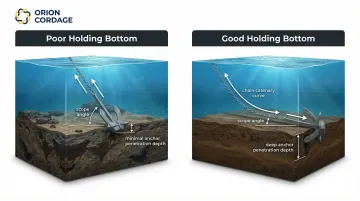
Bottom conditions directly affect how well your anchor sets and holds.
Poor holding bottoms reduce anchor effectiveness:
- Hard sand, rock, or grass bottoms need longer scope to compensate for reduced holding
- Larger diameter rope adds weight and catenary
- Extended chain sections improve bottom contact
Soft mud bottoms offer good holding but benefit from extended chain sections that create more catenary effect and keep the pull angle low.
Duration and Type of Anchoring
Lunch-hook anchoring (short duration, boat attended):
- Minimum chart specifications acceptable
- 5:1 scope may suffice in calm conditions
- Constant monitoring makes up for lighter gear
Overnight or extended anchoring:
- Use full chart specifications minimum
- Deploy 7:1 scope as standard
- Consider weather forecasts and plan for deterioration
Storm preparation:
- Size up at least one increment
- Deploy 10:1 scope or maximum available rode
- Consider deploying a second anchor with separate rode
Boat Design Characteristics
High windage boats need special attention:
- High freeboard increases wind loads significantly
- Large cabins and superstructures act as sails
- Tall masts on sailboats multiply wind forces
- Size up one diameter increment for these vessels
Hull characteristics also affect rode requirements:
- Deeper draft boats may need less scope in shallow water but need stronger rode
- Full-keel sailboats track steadier than fin keels, reducing shock loads
- Light displacement hulls with shallow draft experience more violent motion
Anchor Line Material Properties and Selection Criteria
Material selection matters as much as sizing. Choose the wrong material and even properly sized rode fails to perform.
Why Nylon Dominates Anchor Line Applications
Nylon stretches 15-30% under load, providing critical shock absorption that protects both the anchor set and your boat's deck hardware.
Without this elasticity, sudden loads from waves or wind gusts would shock-load the entire system.
Additional advantages include:
- High strength-to-weight ratio (stronger per diameter than most alternatives)
- Good abrasion resistance for contact with chocks and rollers
- UV resistance for extended sun exposure
- Sinks rather than floats, keeping rode profile low
- Widely available and reasonably priced
Extended water immersion can reduce nylon strength by up to 10%, though this remains acceptable given the material's other benefits.
Understanding nylon's benefits is only half the equation—construction type affects performance just as much.
Three-Strand Versus Double-Braid Construction
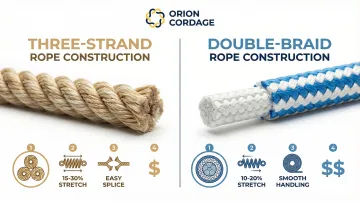
Three-strand (traditional twisted) offers:
- Offers superior stretch characteristics (more shock absorption)
- Easy to splice—boaters can make their own eyes and connections
- More affordable than double-braid
- Tendency to kink and hockle if not properly coiled
- Slightly lower strength per diameter
Double-braid construction provides:
- Higher breaking strength (1/2" double-braid: ~7,400-8,200 lbs vs. lower for three-strand)
- Less stretch than three-strand (still adequate for anchoring)
- Easier handling and less prone to kinking
- Flakes more compactly in anchor lockers
- More expensive and harder to splice
Both constructions work well for anchoring. Three-strand remains more popular due to superior shock absorption and easier field repairs.
While nylon handles the rode's length, chain at the anchor end provides abrasion resistance and holding weight.
Chain Material and Galvanization Requirements
| Chain Type | Grade | Working Load | Best For |
|---|---|---|---|
| BBB (Triple B) | 30 | Standard | Windlass gypsies; most common choice |
| Proof Coil | 30 | Standard | Not recommended for windlasses (less uniform) |
| High-Test (G4) | 43 | 2x BBB | Smaller/lighter chain with same strength |
Hot-dip galvanization provides 5-10 times thicker zinc coating than electro-galvanizing, delivering superior corrosion resistance in saltwater.
Always specify hot-dip galvanized chain for marine use.
Stainless steel chain offers excellent corrosion resistance but costs significantly more and can be difficult to inspect for fatigue cracks.
How Anchor Line Size Is Specified, Measured, and Verified
Ensuring you're getting what you paid for—and what your boat needs—requires understanding specifications and measurement methods.
Reading Specifications and Breaking Strength Ratings
Rope diameter is measured in inches (US) or millimetres (international). Measure across the rope perpendicular to the lay, not corner-to-corner on three-strand.
Critical specifications:
- Breaking Strength: Maximum load before failure (theoretical)
- Working Load Limit (WLL): Safe working load, typically 10-15% of breaking strength
- Safety Factor: ABYC recommends a factor of 8 for anchor rode
Example: A 1/2" three-strand nylon rope with 7,000 lbs breaking strength has a WLL of approximately 875 lbs (7,000 ÷ 8). You should never approach breaking strength in normal use.
Measuring Existing Anchor Line
Once you understand specifications, verify what you already have onboard.
Diameter verification:
- Use calipers or a diameter gauge
- Measure at multiple points (rope can vary slightly)
- Measure perpendicular to the rope's axis
Condition assessment:
- Check for abrasion (fuzzy or worn exterior)
- Look for UV damage (stiffness, discolouration, brittleness)
- Inspect for internal damage (flex the rope—if it feels stiff or crackly, replace it)
- Replace rode showing significant wear every 3-5 years depending on use
Windlass Compatibility Verification
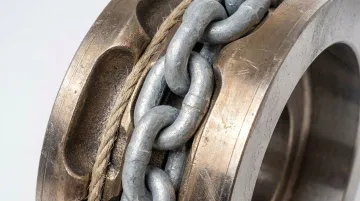
Windlass gypsies are machined to exact tolerances and must match both rope diameter and chain size/type. A gypsy designed for 10mm chain won't work with 8mm chain.
Compatibility requirements:
- Exact rope diameter (not "close enough")
- Specific chain grade (BBB, G4, ISO, DIN—they have different link pitches)
- Rope construction type (some gypsies work only with three-strand or only with 8-plait)
Using incorrect sizes causes:
- Slippage under load
- Jamming in the gypsy
- Accelerated wear on both rode and windlass
- Potential windlass damage
Solution: Check your windlass manual or manufacturer website for exact specifications before purchasing rode.
Common Sizing Mistakes and Their Consequences
Undersizing represents the most common and dangerous mistake, often driven by cost savings or storage constraints.
Using Boat Length Alone Without Considering Displacement
Two 30-foot boats can have vastly different weights: a performance sailboat might displace 8,000 lbs while a trawler displaces 15,000 lbs. Using the same rode for both invites failure.
This mismatch leads to:
- Inadequate breaking strength margin
- Shock loading that damages deck hardware
- Premature rope failure
- Anchor dragging under loads that should be manageable
Always consider displacement alongside length. When in doubt, size up.
Insufficient Total Rode Length
Proper diameter means nothing without adequate length to achieve proper scope. Many boaters carry only 100-150 feet of rode, severely limiting safe anchoring depth.
Anchoring in 20 feet of water with 5 feet of freeboard (25 feet total) requires:
- 7:1 scope: 175 feet of rode
- 10:1 scope (storm): 250 feet of rode
With only 100 feet aboard, you can't safely anchor in more than 10-12 feet of water under normal conditions.
Carry at least 200-250 feet of rode for boats under 30 feet, 300-400 feet for larger vessels.
Mixing Incompatible Components
Mismatched connections create weak points throughout your ground tackle system:
- Wrong size shackles (use shackles one size larger than chain)
- Improper splicing techniques that reduce rope strength
- Using hardware-store chain instead of marine-grade galvanized chain
- Incompatible windlass components
Using a 1/4" shackle with 1/4" chain creates a weak point. The shackle should be 5/16" to match the chain's strength.
Non-marine chain lacks proper galvanization and corrodes rapidly in saltwater, significantly reducing strength within months.
Conclusion
Proper anchor line sizing isn't an optional upgrade—it's a critical safety system that keeps your boat secure when conditions worsen. Undersized rode typically fails at the worst possible moment—when wind picks up and seas build.
The sizing charts and formulas in this guide provide minimum baselines. Real-world conditions demand more robust gear than calculations suggest.
Key takeaways for safe anchoring:
- Always size up when choosing between two rope diameters
- Treat rode as a complete system—rope, chain, shackles, and connections must match in strength
- Replace rope showing UV damage, chafe, or loss of flexibility before it fails
- Carry more total length than you think you'll need (minimum 7:1 scope in most conditions)
Your anchoring system is only as reliable as its weakest component. In most cases, that's undersized rope or inadequate total length.
For marine-grade anchor line engineered to handle demanding conditions, Orion Cordage manufactures three-strand nylon and double-braid rope specifically designed for anchoring applications. Our marine cordage has been tested in North American waters since 1856.
Frequently Asked Questions
What size anchor chain for a 20 ft boat?
Use 1/4" chain diameter with 15-20 feet minimum length, paired with 3/8" nylon rope. This suits boats in the 2,000-3,000 lb displacement range typical of 20-foot vessels.
How long should an anchor line be for a 25 foot boat?
Carry 200-250 feet total rode length to achieve 7:1 scope in depths up to 30 feet, covering most recreational anchoring with adequate safety margin.
What's the difference between anchor line diameter and working load limit?
Diameter is the physical rope size (3/8", 1/2", etc.), while working load limit is the safe working load (typically 10-15% of breaking strength). Larger diameter means higher working load capacity.
Should I use all chain, all rope, or a combination for my anchor rode?
Use combination rode (chain at anchor, rope to boat) for most recreational applications, balancing weight and abrasion protection without requiring a windlass.
How do I know if my anchor line is too small for my boat?
Check the sizing chart against your boat's displacement. Warning signs include excessive stretch under moderate winds or difficulty holding position in conditions similar boats handle.
Do I need to increase anchor line size for overnight anchoring or storm conditions?
Yes. Extended anchoring and heavy weather require either sizing up one increment or deploying a second anchor with separate rode. This distributes loads and provides redundancy if one system fails.