Introduction
Your truck is axle-deep in mud, wheels spinning uselessly. You reach for your recovery gear—but do you know how it actually works?
Most off-road enthusiasts and recovery operators carry kinetic recovery ropes without understanding the physics behind them. This knowledge gap leads to improper usage, wrong product selection, and dangerous recovery attempts.
Kinetic recovery ropes have replaced traditional tow straps as the preferred method for vehicle recovery. Where static straps deliver jarring, immediate force, kinetic ropes use controlled stretch to store energy and deliver smooth, powerful pulls that protect both vehicles and occupants.
This guide explains what kinetic recovery ropes are, the physics behind their energy storage mechanism, and when to use them for safe and effective vehicle recovery.
Key Takeaways
- Elastic nylon rope that stretches 20-30% to store kinetic energy for vehicle recovery
- Stretches with recovery vehicle momentum, then releases energy smoothly to extract stuck vehicles
- Ideal for mud, sand, or snow recoveries with limited traction
- Designed for off-road recovery only—pavement abrasion damages the rope
- Cuts shock loads by 40% vs. static straps
What Is a Kinetic Recovery Rope?
A kinetic recovery rope is a vehicle extraction tool constructed from high-stretch nylon fibres—typically double-braided—designed to store and release kinetic energy during recovery operations.
Unlike tools designed for steady pulling, kinetic ropes function as both a recovery device and a shock absorber, converting the forward momentum of a moving vehicle into stored elastic energy.
What Kinetic Recovery Ropes Are NOT:
- Not tow straps (which have minimal stretch and transmit immediate force)
- Not winch lines (which use mechanical advantage for constant-tension pulling)
- Not suitable for constant-tension highway towing
So what makes kinetic ropes different? Stretch capacity.
Quality kinetic ropes stretch 20-30% of their length under load, with some high-performance models reaching up to 35% at maximum breaking strength. A 30-foot rope, for example, can extend to 36-39 feet during a recovery pull.
This elasticity transforms the rope into an energy storage device rather than just a connection point.
Breaking Strength and Sizing
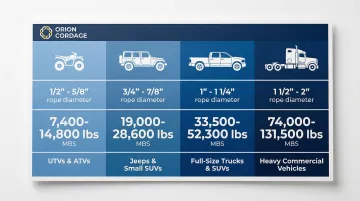
Proper sizing is critical for both safety and performance. Manufacturers recommend a Minimum Breaking Strength (MBS) of 2 to 3 times the Gross Vehicle Mass (GVM) of the lighter vehicle.
If a rope is too strong for the vehicle, it won't stretch enough to be effective. If too weak, it risks failure.
Typical Breaking Strength by Vehicle Class:
| Vehicle Class | Rope Diameter | Typical MBS Range | Recommended Use |
|---|---|---|---|
| UTVs / Side-by-Sides | 1/2" - 5/8" | 7,400 - 14,800 lbs | ATVs, golf carts, UTVs |
| Jeeps / Small SUVs | 3/4" - 7/8" | 19,000 - 28,600 lbs | Wranglers, mid-size trucks |
| Full-Size Trucks | 1" - 1 1/4" | 33,500 - 52,300 lbs | 1/2-ton to 1-ton pickups |
| Heavy Commercial | 1 1/2" - 2" | 74,000 - 131,500 lbs | Dump trucks, semis, tractors |
Manufacturing Quality
Quality kinetic recovery ropes are manufactured from 100% double-braided Nylon 66, chosen for its high tensile strength and elongation properties.
Premium ropes feature protective coatings (vinyl polymer or similar) that guard against:
- UV radiation exposure
- Water absorption
- Abrasion damage
These factors can significantly reduce rope lifespan and safety.
North American manufacturers like Orion Cordage produce kinetic recovery ropes through domestic manufacturing processes that ensure consistent quality. Their double-braided nylon construction—featuring a braided core inside a braided outer jacket—shares the load between the core and cover, delivering the superior strength and shock absorption required for demanding off-road recovery operations.
How Does a Kinetic Recovery Rope Work?
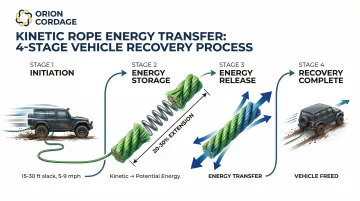
Kinetic recovery ropes operate through a four-stage energy transfer process that converts the recovery vehicle's forward momentum into stored elastic energy, then releases that energy to extract the stuck vehicle.
Initiation: Building Momentum
The recovery process begins with the recovery vehicle backing up to create slack in the rope, which lies loose between both vehicles. The recovery vehicle then accelerates forward while the stuck vehicle remains stationary.
Distance and speed requirements:
- Approach distance: 15-30 feet of slack before the rope becomes taut
- Target speed: 5-9 mph (8-15 km/h) at the moment of rope engagement
- This controlled speed prevents overloading the rope or recovery points
Energy Storage: The Stretch Phase
As the moving recovery vehicle reaches the end of the rope's slack, the rope begins to stretch rather than immediately transferring force. The nylon fibers elongate, storing the kinetic energy from the recovery vehicle's momentum.
The physics behind the stretch:
The recovery vehicle's kinetic energy (energy of motion) converts into elastic potential energy stored in the rope's molecular structure. Nylon 66 can elongate significantly under load while maintaining structural integrity—a property that allows it to stretch without breaking.
During the stretch phase:
- The rope extends 20-30% of its original length (a 30-foot rope stretches to 36-39 feet)
- The recovery vehicle can reduce throttle or even brake, as the rope is now storing the energy
- The nylon fibers absorb the force gradually, extending the duration of the impulse and reducing peak shock loads by up to 40% compared to static straps
This energy storage mechanism is what makes kinetic ropes fundamentally different from static tow straps. The rope acts like a giant rubber band, capturing energy that would otherwise be transmitted as a violent shock to both vehicles.
Energy Release: The Pull
Once the rope reaches maximum stretch, the stored elastic energy releases. The rope contracts back toward its original length, creating a smooth but powerful pulling force on the stuck vehicle—a controlled slingshot effect.
Why this method is effective:
- The gradual energy release means both vehicles experience far less shock
- The stored energy often provides enough force to break the stuck vehicle free from mud, sand, or snow
- The smooth pull prevents the recovery vehicle from breaking traction and digging itself in
Recovery Completion
As the rope contracts, it pulls the stuck vehicle forward. If successful, the stuck vehicle gains enough momentum to continue moving under its own power. Once the vehicle is unstuck, operators should immediately stop, inspect the rope for damage, and reposition if another pull is needed.
Kinetic Rope vs. Tow Strap: Key Differences
Both kinetic recovery ropes and tow straps can move vehicles, but they serve fundamentally different purposes. Understanding these differences is critical for safe recovery operations.
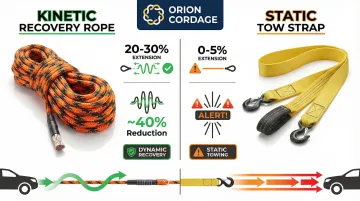
| Feature | Kinetic Recovery Rope | Static Tow Strap |
|---|---|---|
| Material | Double-braided Nylon 66 | Polyester webbing |
| Stretch | 20-30% (energy absorbing) | 0-5% (static transfer) |
| Function | Dynamic recovery (snatch) | Static towing / winch extension |
| Shock Load | Reduced by ~40% | High / immediate transfer |
| Ideal Use | Soft terrain, stuck vehicles | Gentle pulls on solid ground |
Why Static Straps Create Dangerous Shock Loads
Static tow straps transmit force almost instantaneously. When used for dynamic (momentum-based) recovery, this creates a massive spike in force that can:
- Shear metal recovery points or damage vehicle frames
- Cause metal fatigue leading to catastrophic failure
- Turn failed components into lethal projectiles
A 2018 incident documented by WorkSafe Queensland involved a tow hitch failing during a snatch recovery, catapulting 15 metres through a tractor cabin and causing severe injury. This illustrates the extreme danger of using static equipment for dynamic recoveries.
Choosing the Right Tool for Your Recovery Situation
Understanding when to use each tool prevents equipment failure and injury.
Tow straps work well for:
- Gentle pulls on solid ground with good traction
- Highway towing with constant tension
- Winch line extensions where steady pull is needed
Kinetic ropes excel in:
- Deep sand, thick mud, or heavy snow
- Situations where the recovery vehicle has poor traction
- Recoveries requiring momentum-based pulling
- Scenarios where shock load reduction is critical
The Common Misconception
Many vehicle owners believe "any strap will work" for recovery. This is dangerously incorrect. Using a tow strap for kinetic recovery (with momentum) can lead to catastrophic failure, broken recovery points, or serious injury due to the sudden shock load. The tools are not interchangeable.
When and Where to Use Kinetic Recovery Ropes
Optimal Terrain Conditions
Kinetic ropes are specifically engineered for loose, high-resistance terrains where traction is compromised:
Best applications:
- Deep sand - The smooth application of force prevents the recovery vehicle from digging in
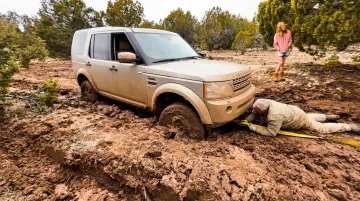
- Thick mud - Stored energy helps overcome the suction effect of deep mud bogs
- Heavy snow - The rope's elasticity allows momentum buildup before load application
- Beach driving recoveries - Soft, shifting substrate where constant traction is impossible
- Desert dune extraction - Where recovery vehicles cannot maintain steady pulling force
Where NOT to Use Kinetic Ropes
Avoid kinetic ropes in these situations:
- Pavement or highways - Abrasion destroys nylon fibers rapidly, and the elasticity creates a dangerous "slingshot" effect
- Rock crawling or technical terrain - The "spring" effect is dangerous where precision is paramount; static control is required
- Winching operations - Kinetic ropes are not designed for the constant tension and abrasion of winching
- Constant-tension towing over distance - The stretch makes speed matching difficult and creates control issues
- When the rope shows damage - Frayed sections, cuts, or glazing indicate the rope must be retired
Safety Guidelines and Best Practices
Proper Attachment Points
CRITICAL REQUIREMENT: Kinetic ropes must connect only to rated recovery points:
Acceptable attachment points:
- Frame-mounted D-rings with proper ratings
- Receiver hitches with appropriate Working Load Limits
- Manufacturer-designated recovery points directly connected to the vehicle frame
NEVER attach to:
- Tow balls (not rated for shear forces; can shear off and become lethal projectiles)
- Bumpers (unless specifically rated for recovery)
- Suspension components
- Tie-down points
Exclusion Zones
Once attachment points are secure, establish a safe perimeter. All bystanders must maintain a distance of 1.5 to 2 times the unstretched rope length from the vehicles and the line of recovery.
No personnel should ever stand directly between the vehicles or step over a tensioned rope. Position observers perpendicular to the rope line, never in line with it. If a rope or recovery point fails, the recoil can strike occupants or bystanders at high velocity, causing severe injury or death.
Inspection and Retirement Criteria
Inspect before every use. Retire the rope immediately if you observe:
- Strands cut by 50% or more
- Fused fibers, glazing, or extreme stiffness from heat damage
- Lumps, flat spots, or necking that signal internal core failure
- Severe fuzziness or abrasion on the outer sheath
- Significant discoloration or brittleness from sun exposure
According to rope inspection standards, any of these conditions compromise the rope's structural integrity and create unacceptable safety risks.
Operational Safety
- Never exceed 5-9 mph during the recovery approach
- Use rated shackles (soft shackles are preferred for safety) that match the Working Load Limit
- Place a damper (recovery blanket or heavy jacket) over the center of the rope to reduce recoil energy if failure occurs
- Clear the area of all non-essential personnel before beginning the recovery
- Ensure both vehicle operators understand the recovery plan and hand signals
Frequently Asked Questions
How does a kinetic recovery rope work?
The rope stores the recovery vehicle's forward momentum as elastic energy when it stretches, then releases that energy smoothly to pull the stuck vehicle free. Its nylon construction stretches 20-30% under load, converting kinetic energy into a controlled, sustained pull with minimal shock to either vehicle.
How long should your kinetic recovery rope be?
Most recreational users should choose 20-30 foot ropes for general off-road recovery. A 30-foot rope is typically the best primary choice because it provides more stretch capacity (increasing energy storage) and safer vehicle spacing. Shorter 20-foot ropes work well for tight trails where space is limited.
Are kinetic recovery ropes worth it?
Yes, kinetic recovery ropes are worth the investment for anyone who regularly drives off-road. They provide safer, more effective recoveries than tow straps while reducing vehicle damage risk by up to 40% and eliminating violent shock loads that can injure occupants or cause recovery point failures.