Introduction
When a trawl line snaps mid-haul or a mooring line fails during a storm, commercial fishermen face more than lost catch—they face crew injuries, vessel damage, and costly operational downtime. In an industry where commercial fishing fatality rates are 21 times higher than the U.S. average, rope selection functions as a critical safety control, not merely a purchasing decision.
The stakes are clear: rope choice directly impacts vessel safety, catch efficiency, and equipment longevity. In an industry where margins are tight and fishing windows are limited, profitability depends on these factors.
Between 2013 and 2022, gear entanglement and equipment strikes caused a substantial share of onboard fatalities. This makes reliable rope a non-negotiable investment for commercial fishing operations.
Key Takeaways
- Fishing rope must withstand UV exposure, saltwater, and abrasion while delivering strength and durability
- Each material serves distinct needs: nylon for shock absorption, polyester for UV resistance, polypropylene for flotation, HMPE for strength-to-weight
- Different fishing methods demand different specifications—trawl warps need low stretch, mooring lines require high elasticity, and pot warps benefit from buoyancy
- North American manufacturing delivers supply chain reliability, shorter lead times, and consistent quality that imported alternatives can't match
- Total cost of ownership matters more than purchase price—quality rope reduces replacement frequency, downtime, and safety incidents
What is Commercial Fishing Rope?
Commercial fishing rope is specialised cordage engineered to withstand extreme marine conditions while performing critical functions in fishing operations. Unlike recreational fishing line, commercial rope features larger diameters (typically 5/16" to several inches), industrial-grade construction methods, and materials selected for strength, durability, and regulatory compliance.
These ropes serve multiple purposes across fishing operations:
- Trawl warps that pull nets through the water
- Mooring lines that secure vessels to docks
- Anchor lines that hold position in challenging conditions
- Net hauling lines that retrieve catch
- Longline gear that extends for miles
- Safety lines that protect crew members
Each application demands specific performance characteristics that recreational cordage can't deliver.
Core Properties of Commercial Fishing Rope
Understanding rope properties helps fishermen match technical specifications to operational demands and safety requirements. The wrong rope can fail catastrophically; the right rope becomes a reliable tool that performs consistently across thousands of cycles.
Working Strength and Breaking Strength
Breaking strength represents the laboratory-tested failure point of new rope under ideal conditions. Working load is the safe maximum load for real-world operations—typically just 20-25% of breaking strength to maintain adequate safety margin.
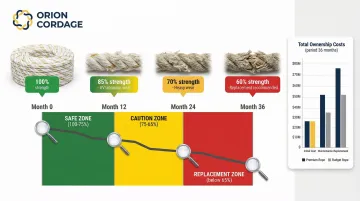
Rope strength degrades with use, making this safety margin essential. UV exposure causes photo-oxidation and surface embrittlement, while saltwater and moisture weaken certain fibers.
Abrasion from winches, pulleys, and deck surfaces wears away material. A rope rated at 100,000 lbs breaking strength might safely handle only 20,000-25,000 lbs in actual fishing operations, and even less as it ages.
Industry standards recommend minimum safety factors of 5:1 for general use and 10:1 for life-safety applications. Splicing, the preferred termination method, typically operates at about 80% efficiency compared to unspliced rope strength.
Stretch and Elasticity Characteristics
Stretch characteristics determine how rope responds to sudden loads and whether it maintains precise control during operations.
Different stretch profiles suit different applications:
High-stretch options (nylon: 18-35% elongation at break, 8-12% working):
- Excel at absorbing shock loads in mooring and anchoring
- Prevent catastrophic loads when vessels surge or lines catch suddenly
- Protect cleats, bollards, and rope structure through elasticity
Low-stretch options (polyester: 12-20% at break, HMPE: 1-3.5% at break):
- Provide better control in trawling and net hauling
- Maintain precise net geometry during operations
- Minimize slippage when retrieving gear
The trade-off is real: excessive stretch reduces hauling efficiency and makes it harder to judge load, but too little stretch transfers shock loads directly to equipment and increases failure risk.
UV, Rot, and Mildew Resistance
Constant UV radiation and moisture create a harsh combination that degrades rope rapidly. Untreated nylon can lose up to 28% of tensile strength in the first year in tropical fisheries with intense UV exposure.
Synthetic fibers offer superior resistance to rot and mildew compared to natural fibers like manila or sisal. Polyester provides excellent UV resistance naturally, while polypropylene requires UV stabilizers to achieve acceptable lifespan. HMPE demonstrates excellent UV resistance, though small-diameter ropes show logarithmic strength decay over extended outdoor exposure.
Water absorption creates additional challenges:
- Nylon absorbs 2-8% water, losing 10-20% strength when wet
- Polyester and HMPE are hydrophobic (water-resistant), retaining 100% dry strength when submerged
- Wet strength factors critically into safety calculations
Abrasion Resistance
Rope constantly rubs against winches, pulleys, deck surfaces, and itself during fishing operations. This friction causes progressive fiber wear that weakens rope from the outside in and the inside out.
Abrasion resistance depends on both material choice and construction method. HMPE offers excellent abrasion resistance, followed closely by nylon and polyester. Braided ropes with protective jackets (double-braid construction) provide better abrasion protection than twisted 3-strand ropes, though the outer cover takes damage first.
For braided ropes, industry guidelines recommend retirement at 25% visible abrasion wear. The surface roughness initially acts as a protective cushion, but excessive wear indicates significant strength reduction. Internal abrasion—fiber-on-fiber friction within the rope—is harder to detect but equally damaging.
Durability and Lifespan Factors
Rope durability results from the combination of material selection, construction quality, proper use, and maintenance practices. Quality rope from established manufacturers provides more predictable performance and longer service life, reducing total cost of ownership.
HMPE mooring lines have demonstrated 75% strength retention after 9 years and 20,000 mooring hours in oil tanker applications. In tropical fisheries, switching to UV-stabilized double-braided nylon with polyurethane coatings extended service intervals from 18 months to 36 months, reducing annual replacement costs by 35-40%.
What to Consider When Selecting Commercial Fishing Rope
Rope selection must balance multiple factors: vessel operations, fishing methods, environmental conditions, and business priorities.
The "best" rope isn't the strongest or cheapest—it's the one that aligns with specific operational requirements and delivers the best total value over its service life.
Application and Fishing Method
Different fishing methods impose different demands on rope systems.
Trawling operations require high-strength, low-stretch lines to maintain net geometry and reduce drag. HMPE has become the standard for trawl warps due to its exceptional strength-to-weight ratio, which reduces drag and fuel consumption compared to traditional wire rope.
NOAA protocols specify 1/2" 6x19 galvanized wire rope or equivalent synthetic alternatives like 3/4" Spectra braided rope for splitting straps.
Longlining demands mainlines that resist abrasion and maintain strength over extended lengths. HMPE's low stretch and high abrasion resistance make it ideal for these applications, facilitating hauling and maintaining precise gear positioning.
Mooring and anchoring need high shock absorption to handle surge loads. Nylon is the material of choice for anchor lines and dock lines where elasticity prevents damage to cleats, bollards, and the vessel itself. For permanent moorings where static stability matters more than shock absorption, polyester is preferred.
Pot and trap fishing often uses polypropylene or poly-blends for pot warps. The buoyancy reduces bottom snagging and keeps lines off the seafloor, though UV degradation limits lifespan compared to other materials.
Environmental and Operating Conditions
Water temperature, salinity, UV exposure intensity, and seasonal conditions affect rope performance and degradation rates differently.
Tropical waters impose the harshest UV degradation, requiring UV-stabilized materials or protective coatings. Operations in these regions should expect accelerated aging and plan replacement intervals accordingly.
Cold-water operations face different challenges. Ice accretion on rigging adds significant weight and destabilizes vessels. Polypropylene ropes remain flexible in freezing conditions, whereas natural fibers like manila become stiff and unmanageable. Nylon's water absorption (up to 8%) can cause swelling and freezing in extreme cold.
Saltwater immersion is constant, making hydrophobic (water-resistant) materials like polyester, HMPE, and polypropylene preferable for applications where wet strength matters. Factor nylon's 10-20% strength loss when wet into safety margins.
Material Trade-offs and Performance Characteristics
Understanding how environmental factors affect different materials helps narrow your options. Each rope material offers distinct advantages and limitations:
| Material | Best For | Key Advantage | Primary Limitation |
|---|---|---|---|
| Nylon | Mooring, anchoring, shock absorption | High stretch (18-35%) absorbs surge loads | Loses 10-20% strength when wet; moderate UV resistance |
| Polyester | Permanent moorings, standing rigging | Excellent UV resistance; low stretch (12-20%) | Moderate cost; less shock absorption than nylon |
| Polypropylene | Pot warps, buoyant applications | Floats; low cost; remains flexible in cold | Poor UV resistance without stabilizers; high creep |
| HMPE (Dyneema/Spectra) | Trawl warps, longlines, high-performance applications | Extremely high strength-to-weight; very low stretch (1-3.5%) | High initial cost; moderate creep under sustained load |
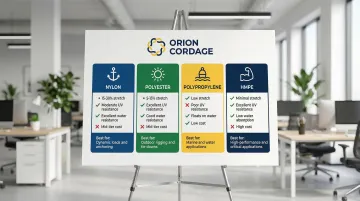
Key material considerations:
- Nylon works best when shock absorption is critical—its high elongation handles dynamic loads but sacrifices precise control
- Polyester balances UV resistance, strength, and moderate stretch, making it the workhorse of permanent moorings where dimensional stability matters
- Polypropylene offers the lowest cost and floats, ideal for pot warps where buoyancy prevents bottom contact (though UV degradation requires frequent replacement)
- HMPE delivers unmatched performance at premium cost—its strength-to-weight ratio makes it ideal for trawl warps where reduced drag translates directly to fuel savings
Regulatory Compliance and Safety Standards
Commercial fishing operations must comply with Coast Guard regulations, vessel classification society requirements, and fishery-specific gear regulations.
U.S. Coast Guard 46 CFR Part 28 mandates that vessels be fitted with anchors, chains, cables, or ropes appropriate for vessel size and intended waters.
Vessels built or converted after July 27, 1990, must be classed by the American Bureau of Shipping or similarly qualified organization.
NOAA Fisheries imposes specific gear regulations to protect marine mammals. Northeast lobster and Jonah crab trap/pot fisheries must use "weak rope" with 1,700 lbs breaking strength or less (with 10% tolerance) to reduce entanglement risk for North Atlantic right whales. This can be achieved using fully formed weak rope or engineered weak inserts.
Using rope that meets or exceeds regulatory standards reduces liability and insurance costs while ensuring compliance during inspections.
Supplier Reliability and Supply Chain Considerations
Consistent rope availability is critical for operations with tight fishing windows or quota deadlines. Domestic manufacturing provides supply chain advantages that imported rope can't match: shorter lead times, better communication, easier quality verification, and reduced import disruptions.
Orion Cordage's domestic manufacturing facilities in the USA and Canada enable them to maintain tight lead times and integrate directly into customer supply chains. As one rigging distributor notes, "Orion has been a lifesaver for us. Our customers know they are getting very high quality domestic product, the prices are great, and their lead times are always tight."
Total Cost of Ownership vs. Initial Price
Rope cost should be evaluated over its service life, not just purchase price. Factor in replacement frequency, downtime costs, labor for re-rigging, and potential loss from equipment failure.
Simple ROI Framework:
- Initial Cost: Higher-quality rope costs 30-50% more upfront
- Service Life: Quality rope lasts 2-3x longer (24-36 months vs. 12-18 months)
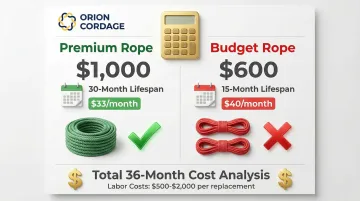
- Replacement Labor: Re-rigging costs $500-2,000 in labor and downtime per replacement
- Failure Risk: Equipment failure during operations can cost $5,000-50,000+ in lost catch, repairs, and downtime
Example: A $1,000 premium rope lasting 30 months costs $33/month. A $600 budget rope lasting 15 months costs $40/month.
The budget option also requires twice the replacement labor and double the failure risk. Premium rope delivers lower total cost despite higher upfront investment.
How Orion Cordage Can Help
Orion Cordage brings 168+ years of manufacturing experience and deep understanding of marine applications to help commercial fishing operations select and source the right rope for their specific needs.
Since 1856, Orion has built a reputation as one of North America's most trusted industrial cordage manufacturers.
Their specialized commercial fishing products are designed specifically for the demands of marine operations:
Specialized Commercial Fishing Products:
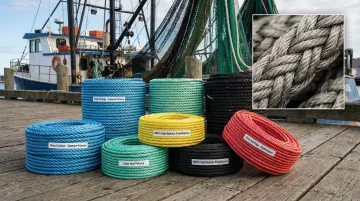
- Custom/OEM rope with composite yarn construction (polyester over polypropylene core) offering low hauler noise, excellent handling, and superior abrasion resistance
- Superpro® Potwarp with 286,683 lbs maximum break force for heavy-duty fishing operations
- Super Haul® Potwarp combining polyester and co-polymer materials with 154,105 lbs break force
- Polypropylene Potwarp providing buoyant characteristics with 135,073 lbs break force
- HMPE options for high-performance trawl warps and longlines
Key Advantages:
- Thousands of SKUs designed, manufactured, and tested at domestic factories in Canada and the USA
- Tight lead times and consistent product availability
- Domestic manufacturing provides supply chain reliability and eliminates import uncertainties
- Technical support to match rope specifications to specific fishing methods and vessel requirements
- Custom lengths, put-ups, colors, and finishes available for all products
Orion's commitment to quality is non-negotiable, and their problem-solving approach ensures fishing operations get rope that performs consistently in demanding conditions.
As one marine supply company owner puts it: "Customers who move away from Orion rope always end up coming back—they want the good stuff!"
Conclusion
Rope selection directly impacts safety, efficiency, and profitability in commercial fishing operations. Your goal isn't to find the strongest or cheapest option—it's matching rope specifications to your specific fishing method, environmental conditions, and operational priorities.
Quality rope from reliable domestic manufacturers reduces replacement frequency, minimizes downtime, and most importantly, protects crew safety in one of the most dangerous occupations in North America.
Monitor rope performance regularly, inspect for wear according to established criteria, and replace proactively rather than reactively.
Beyond equipment maintenance, building a relationship with an established North American manufacturer ensures long-term operational success through consistent product availability, technical support, and supply chain integration that keeps your vessel fishing when it matters most.
Frequently Asked Questions
What is the best rope for commercial fishing?
It depends on your application. Commercial operations typically use nylon for mooring/anchoring (shock absorption), polyester or HMPE for trawling (low stretch, high strength), and polypropylene for pot warps (buoyancy). Match material properties to your fishing method for optimal performance.
What are the different types of fishing rope?
The main types are nylon (high stretch, shock absorption), polyester (low stretch, UV resistance), polypropylene (floats, low cost), HMPE/Dyneema (high strength-to-weight, very low stretch), and blended ropes. Each offers distinct advantages for specific applications.
How often should commercial fishing rope be inspected and replaced?
Inspect visually before each trip and conduct detailed inspections monthly or after shock loads. Replace based on visible wear (25% abrasion for braided, 10% for 3-strand twisted, broken fibers, stiffness) rather than fixed timelines, as degradation varies by use intensity.
What's the difference between breaking strength and working load for fishing rope?
Breaking strength is the laboratory-tested failure point of new rope. Working load (typically 20-25% of breaking strength) is the safe maximum load accounting for real-world degradation from UV, abrasion, saltwater, and age.
Does rope diameter matter as much as strength rating?
Yes. Diameter affects winch/pulley compatibility, handling characteristics, and abrasion resistance. A rope might have adequate strength but be incompatible with your equipment. Balance strength requirements with equipment specifications for safe operations.
How should commercial fishing rope be stored to maximize lifespan?
Store in cool, dry, dark locations away from chemicals and UV. Coil properly to prevent kinking. Wash salt and grit from rope with fresh water before storage, as contaminants weaken fibers from inside. Inspect thoroughly before re-deployment.