Introduction: Why Rope Specifications Matter for Boat Dealers
Many boat dealers face a frustrating cycle of customer returns and complaints when anchor kits include rope that's undersized, the wrong material, or poor quality for the customer's boat type and usage. A 20-foot sailboat owner who receives 3/8" polypropylene rope instead of nylon discovers the hard way that their anchor system fails when they need it most.
These mismatches don't just create customer service headaches. They damage dealer reputation and eat into profit margins through returns and warranty claims.
Behind these problems is a common oversight: many dealers stock anchor rope based on price alone. They overlook the technical specifications that determine whether a rope will perform safely for a given boat size and anchoring condition. This guide covers the essential rope specifications dealers need to know, how to match rope to different boat sizes and conditions, and how to build a profitable anchor kit inventory that minimizes returns while maximizing customer satisfaction.
TLDR: Essential Rope Specs for Stocking Anchor Kits
- Stock 3/8", 1/2", and 5/8" diameters to cover the 20-40+ foot recreational boat market
- Three-strand nylon delivers the shock absorption essential for anchoring applications
- Most recreational anchoring needs require 150-foot and 200-foot lengths (based on 7:1 scope standard)
- Pre-packaged kits accelerate checkout while bulk spools enable custom lengths
- Domestic manufacturers provide consistent stock availability and technical support
Core Rope Specifications for Anchor Kits
Diameter (Thickness)
Rope diameter must match both the anchor weight and the boat size. Undersized rope creates a dangerous weak point in the anchoring system, while oversized rope unnecessarily increases cost and storage requirements.
Recommended Minimum Diameters by Boat Length:
| Boat Length | Minimum Diameter | Typical Anchor Weight |
|---|---|---|
| 20-30 feet | 3/8" | 8-15 lbs |
| 31-40 feet | 1/2" | 15-25 lbs |
| 41-45 feet | 5/8" | 25-45 lbs |
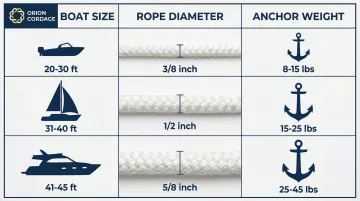
The industry uses a rule of thumb: 1/8" of rope diameter for every 9 feet of boat length for normal displacement vessels. Adjust based on boat characteristics:
- Heavy boats with high windage (trawlers, catamarans): Step up one diameter size
- Lightweight boats: May use one size smaller
Thicker rope provides higher breaking strength but comes with trade-offs. A 5/8" nylon rope costs significantly more than 3/8" and occupies roughly three times the storage space.
Train your sales staff to ask about boat type and displacement, not just length.
Breaking Strength and Working Load Limit
Diameter determines the rope's performance limits. Breaking strength is the maximum load before rope failure, while Working Load Limit (WLL) represents the safe working capacity—typically 10-15% of breaking strength for anchoring applications, accounting for knots, splices, age, and shock loads.
Typical Breaking Strengths for Three-Strand Nylon:
| Diameter | Breaking Strength Range |
|---|---|
| 3/8" | 3,340-4,250 lbs |
| 1/2" | 5,750-7,500 lbs |
| 5/8" | 9,350-11,650 lbs |
Dealers must know these specifications for two critical reasons:
- Experienced boaters will ask about ground tackle requirements
- Liability concerns require matching rope strength to boat size
Industry guidelines recommend design factors between 8:1 and 12:1 for anchoring applications. A boat experiencing 500 lbs of load should use rope with at least 4,000-6,000 lbs breaking strength.
Label your inventory with both breaking strength and recommended WLL (approximately 15% of breaking strength). This helps customers make informed decisions and protects your business from liability issues.
Length Requirements
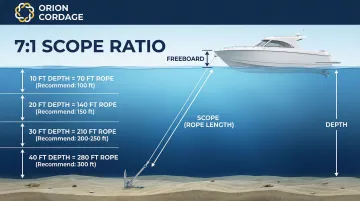
Beyond diameter and strength, length requirements follow the universal 7:1 scope ratio—7 feet of rode for every 1 foot of water depth plus freeboard (the height from waterline to deck). This mathematical reality drives your length inventory decisions.
Required Rope Lengths by Water Depth (7:1 Scope):
- 10 feet depth → 70 feet required → Stock 100-foot lengths
- 20 feet depth → 140 feet required → Stock 150-foot lengths
- 30 feet depth → 210 feet required → Stock 200-250 foot lengths
- 40 feet depth → 280 feet required → Stock 300-foot lengths
The 7:1 scope is recommended by the US Coast Guard, BoatUS, and ABYC for normal conditions. Calm conditions may allow 5:1, while storm conditions require 10:1 or more.
Regional considerations matter:
- Shallow-water markets (lakes, bays, rivers): Prioritize 100-150 foot lengths
- Coastal markets (deeper anchorages): Stock more 200-250 foot lengths
- Offshore/deep-water markets: Consider 300+ foot options for larger vessels
Stock 150-foot and 200-foot lengths as your core inventory—these cover the most common recreational anchoring depths while maintaining proper safety margins.
Material Selection: Nylon, Polyester, or Polypropylene?
Nylon: The Industry Standard for Anchoring
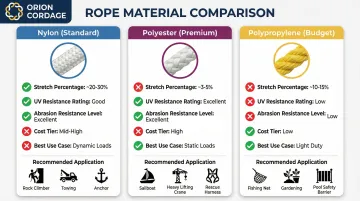
Nylon dominates anchoring applications because it stretches approximately 20% at 50% of its breaking load, providing critical shock absorption when waves and wind create sudden loads.
This elasticity prevents the violent jerking that can break the anchor free or damage deck hardware.
Dealers benefit from nylon's practical advantages:
- High strength-to-weight ratio makes it easy for customers to handle
- Excellent abrasion resistance against seabeds and chocks
- Good UV resistance ensures long service life
- Cost-effective compared to premium materials
Nylon comes in two constructions. Three-strand twisted is more popular for anchoring because it's easier to splice (customers can add thimbles or repair damage), costs less, and provides excellent stretch characteristics.
Double-braid offers 10-20% higher strength and easier handling but costs more and requires specialized splicing tools.
Stock three-strand nylon as your primary volume product—it covers 70% of recreational anchoring needs. Reserve double-braid for customers specifically requesting premium handling characteristics.
Polyester: Premium Option for Specific Conditions
While nylon dominates general anchoring, polyester serves specific needs. It offers minimal stretch (2-4% elongation at 50% load versus nylon's 20%) and superior UV resistance, making it suitable for permanent moorings where minimal movement is desired.
Recommend polyester for:
- Permanent mooring installations (not temporary anchoring)
- High-UV environments where rope remains deployed year-round
- Customers who need minimal stretch for specific boat setups
Polyester typically commands 20-30% higher retail prices than equivalent nylon. Stock it as a specialty item for customers with specific requirements, not as your primary anchor rope inventory.
Polypropylene: Budget Option with Critical Limitations
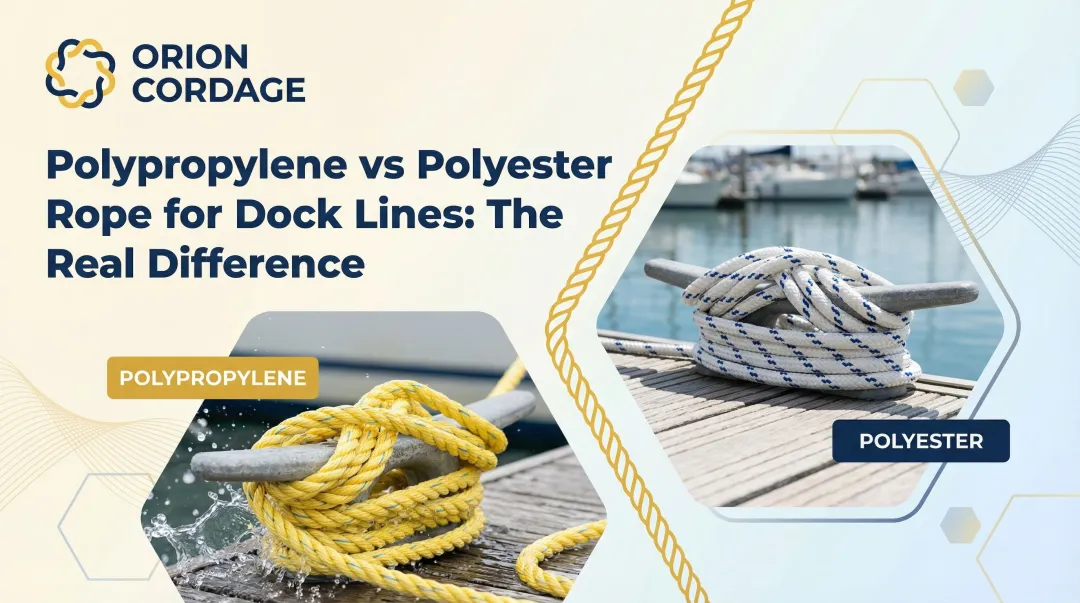
Polypropylene offers the lowest cost and floats (specific gravity 0.91), but comes with significant limitations for anchoring applications.
The advantages are straightforward:
- Most economical material
- Floats (can be useful for temporary anchoring)
- Good chemical resistance
Limitations Dealers Must Communicate
- Poor UV resistance—can lose up to 70% strength after just 6 days of high-intensity sun exposure without treatment
- Lower abrasion resistance than nylon
- Minimal shock absorption (defeats the purpose of rope in an anchor system)
- Floating characteristic can foul propellers
Stock polypropylene only for budget-conscious customers or specific use cases like temporary freshwater anchoring. Never recommend it as a primary anchor rode for boats 20+ feet—the safety compromises outweigh the cost savings.
Sizing Your Inventory: Rope Diameter and Length by Boat Class
Small Boats (Under 20 feet)
Recommended specifications:
- Diameter: 3/8" minimum
- Length: 100-150 feet most common
- Typical anchor weight: 8-15 lbs
This segment typically prefers pre-packaged anchor kits for convenience and lower price points. Stock complete kits with 3/8" three-strand nylon, 100-foot length, and appropriate anchor (8-10 lbs).
These move quickly during spring commissioning season and appeal to first-time boat owners.
Mid-Size Boats (20-30 feet)
This is your highest-volume segment—plan for 50% of your anchor rope inventory to serve this boat class.
Specifications for this range:
- Diameter: 1/2" (the sweet spot for this class)
- Length: 150-200 feet covering most use cases
- Typical anchor weight: 15-25 lbs
Stock depth matters here. Customers in this range often want options: different colours, pre-spliced versus by-the-foot, and choice between three-strand and double-braid.
Offer both pre-packaged kits (convenience) and bulk rope sold by the foot (customisation). Many customers in this segment already own anchors and just need replacement rode.
Large Recreational Boats (30-40 feet)
Recommended specifications:
- Diameter: 5/8" minimum
- Length: 200-250 feet standard
- Typical anchor weight: 25-45 lbs
This segment has higher expectations for quality and often prefers premium materials. Stock both three-strand nylon and double-braid options. Some customers will specify polyester for permanent moorings or specific performance characteristics.
Larger boats often carry multiple anchors (primary, storm, lunch hook), creating opportunities for multiple rope sales per customer. Train staff to ask about the customer's complete ground tackle system.
Inventory Mix Strategy
With these boat-specific requirements in mind, structure your inventory to match real-world demand patterns.
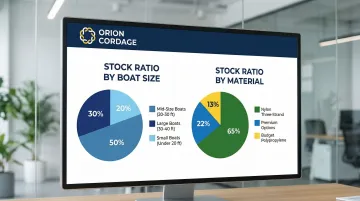
Recommended stock ratio by boat size:
- 20% small boat rope (under 20 feet)
- 50% mid-size boat rope (20-30 feet)
- 30% large boat rope (30-40 feet)
Recommended stock ratio by material:
- 60-70% nylon three-strand (your workhorse)
- 20-25% premium options (double-braid nylon or polyester)
- 10-15% budget polypropylene (if you stock it at all)
Seasonal considerations:
- Spring/summer: Stock up on lighter diameters (3/8", 1/2") and shorter lengths (100-150 feet)
- Fall/storm season: Increase inventory of heavier specs (5/8") and longer lengths (200-250 feet)
- Winter: Reduce overall inventory but maintain service stock for emergency replacements
Adjust these ratios based on your local market. A dealer near shallow inland lakes needs more 100-150 foot lengths, while a coastal dealer serving offshore boaters needs deeper stock of 200-250 foot options.
Packaging and Kit Configuration Options
Dealers face a strategic choice: pre-packaged anchor kits versus selling rope by the foot with separate anchor selection.
Pre-packaged kits offer clear advantages:
- Faster turnover (customers grab and go)
- Higher perceived value (complete solution)
- Easier for inexperienced boaters
- Lower margins (more competition on packaged goods)
- Limited customization
Selling rope by the foot provides different benefits:
- Higher margins (less price comparison)
- Complete customization for customer needs
- Serves customers who already own anchors
- Requires more staff knowledge and customer education
- Slower transaction time
Stock both options to maximize sales opportunities. Pre-packaged kits capture convenience-focused customers and first-time boat owners, while bulk rope serves experienced boaters and those with specific requirements.
When offering pre-packaged kits, packaging quality directly impacts sales and returns.
Essential packaging elements include:
- UV-resistant bags or boxes (prevent degradation in inventory)
- Clear specification labels: diameter, length, material, breaking strength
- Basic usage instructions: scope ratios, splicing tips, inspection guidelines
- Visible branding that communicates quality
Customers can't evaluate rope quality by looking at it through packaging. Clear labeling builds confidence and reduces returns from customers who bought the wrong specification.
Working with Rope Suppliers: What Dealers Should Expect
Key Supplier Criteria
Consistent product availability: Stockouts during peak season (April-June) damage customer relationships and send business to competitors. Look for suppliers who maintain deep inventory or have short production lead times.
Reasonable minimum order quantities: Small dealers can't commit to pallet quantities of every SKU. Look for suppliers who accommodate smaller initial orders while offering volume discounts as your business grows.
Technical support: Your staff will field questions about diameter selection, material trade-offs, and application-specific recommendations. Reliable partners provide technical resources, specification sheets, and direct access to knowledgeable representatives.
Domestic Manufacturing Advantages
Suppliers with domestic manufacturing facilities offer significant advantages for dealers:
- Faster lead times (days instead of weeks)
- Supply chain reliability (no overseas shipping delays)
- Quality consistency (single-source production standards)
- Responsive customer service (same time zones, direct communication)
Orion Cordage manufactures thousands of rope SKUs at facilities in the USA and Canada. Their domestic production means dealers can restock quickly during peak season without carrying excessive inventory.
The company's technical team helps dealers build anchor kit inventory matched to local market needs, providing specification guidance and application recommendations.
Building Supplier Relationships
The best supplier relationships go beyond transactional ordering:
- Inventory planning support: Suppliers should help forecast seasonal demand
- Product training: Staff education on specifications and applications
- Marketing materials: Point-of-sale displays, specification guides, comparison charts
- Flexible terms: Payment terms and return policies that support your business
Treat your rope supplier as a partner in serving your customers, not just a vendor. Suppliers with long-term relationships understand your market and can provide valuable insights on inventory mix and emerging customer needs.
Quality Standards and Compliance Requirements
Cordage Institute Standards
The Cordage Institute publishes definitive standards for fibre rope, including:
- CI 1303: Specific standard for Nylon (Polyamide) 3-Strand construction
- CI 1500: Test methods for determining breaking strength
- CI 1401: Guidelines for safer use of fibre rope, including WLL calculations
Verify that your supplier's rope meets these standards. Quality manufacturers provide certification documentation—a sign of reliable sourcing.
These standards form the foundation for compliance. Beyond manufacturing specs, installation guidelines matter too.
ABYC Guidelines
The American Boat and Yacht Council's H-40 standard covers "Anchoring, Mooring, and Strong Points." It provides engineering basis for anchor rode selection and design loads for recreational boats. ABYC compliance demonstrates commitment to safety standards recognized by marine surveyors and insurance companies.
Labeling Requirements
Proper labeling protects dealers from liability and builds customer confidence. Clear documentation proves you sold appropriate specifications.
Required information:
- Fibre content (e.g., "100% Nylon")
- Country of origin
- Minimum breaking strength
- Recommended working load limit
Best practice additions:
- Diameter and length
- Construction type (3-strand, double-braid)
- Manufacturer name and contact information
- Basic usage guidelines
Keep certification records on file. If a customer questions rope quality after an anchoring failure, documentation proves you met industry standards.
Liability Protection
Undersized rope creates liability risk. Protect your business with these practices:
- Maintain clear specification documentation for all inventory
- Train staff to ask qualifying questions (boat size, typical anchoring depths, usage patterns)
- Provide written recommendations when customers request advice
- Never recommend polypropylene as a primary anchor rode for boats 20+ feet
- Keep records showing rope meets Cordage Institute standards
Frequently Asked Questions
What's the minimum rope diameter dealers should stock for different boat sizes?
Stock 3/8" for boats under 30 feet, 1/2" for 30-40 foot boats, and 5/8" for 40+ foot boats based on industry-standard sizing guidelines. Heavy displacement boats may require stepping up one diameter size.
How much rope length should be included in a complete anchor kit?
Stock 100-foot, 150-foot, 200-foot, and 250-foot options—150 feet is most versatile for recreational boating, covering 20-foot depths at the standard 7:1 scope ratio. Coastal dealers should emphasize longer lengths, while inland dealers can focus on 100-150 foot inventory.
What's the difference between twisted and braided anchor rope for retail customers?
Three-strand twisted is traditional, easier to splice, less expensive, and preferred by most recreational boaters. Double-braid is 10-20% stronger and more abrasion-resistant, but costs more and requires specialized splicing tools.
Should dealers stock pre-spliced anchor rope or sell it by the foot?
Stock both—pre-spliced kits for convenience-focused customers and first-time boat owners, and rope by the foot for custom lengths and higher margins. Plan for roughly 60% pre-spliced kits and 40% bulk rope in your inventory mix.
What certifications or standards should anchor rope meet for retail sale?
While no federal law mandates specific certifications, rope should meet Cordage Institute standards and dealers should provide breaking strength documentation upon request. Quality manufacturers will supply CI compliance documentation and ABYC guideline conformance. This protects dealers from liability and provides customer confidence.
How long does marine anchor rope last in inventory before degrading?
Properly stored rope (cool, dry, out of direct sunlight) can remain in inventory for 2-3 years without significant degradation. Store away from windows, rotate stock using first-in-first-out principles, and protect from UV exposure—the primary degradation factor.