Introduction
UV exposure degrades rope strength over time, making material selection critical for outdoor and industrial applications. Choosing the wrong rope can lead to premature failure, safety risks, increased replacement costs, and operational downtime.
The financial and safety stakes are significant.
Untreated polypropylene can lose over 20% of its tensile strength after just 600 hours of UV exposure—roughly 6 months outdoors. High-quality polyester, by contrast, maintains 95% of its strength after 1,000 hours. This difference directly impacts both safety and total cost of ownership.
TLDR
- Polyester offers superior UV resistance, retaining 95% strength after 1,000+ hours of sun exposure
- Nylon provides excellent UV performance (85%+ retention at 500 hours) but loses 10-15% strength when wet
- HALS-treated polypropylene achieves 90% strength retention after 2,000 hours of UV exposure
- Match material to your application: high-load marine use favors polyester, while cost-sensitive temporary rigging works with treated polypropylene
- Orion Cordage manufactures UV-resistant ropes across all major materials at USA and Canada facilities
What is UV Resistant Rope?
UV resistant rope is cordage engineered to withstand ultraviolet radiation from sunlight without significant degradation in tensile strength, flexibility, or structural integrity. Standard rope weakens rapidly outdoors. UV-resistant types maintain their performance characteristics through extended sun exposure.
The UV Degradation Process
UV photons break polymer chains through photo-oxidation—a chemical reaction where high-energy radiation creates free radicals that react with oxygen.
This process cleaves the long molecular chains that give synthetic fibers their strength, causing brittleness, color fading, surface powdering, and progressive strength loss.
Degradation is primarily a surface phenomenon. The outer fibers absorb UV energy and act as a sacrificial shield, protecting the rope's core.
In twisted constructions, fibers constantly rotate to the surface. This exposes more of the total fiber mass over time.
UV resistance is achieved through:
- Material selection - Choosing polymers with inherent UV stability
- UV-stabilizer additives - HALS (Hindered Amine Light Stabilizers) that neutralize free radicals
- Protective pigments - Carbon black and other UV-blocking colorants
- Construction methods - Double braid and kernmantle designs that shield core fibers

Comparing UV Resistance Across Rope Materials
Not all rope materials perform equally under UV exposure. Understanding these differences helps you match the right material to your application's demands.
Polyester Rope
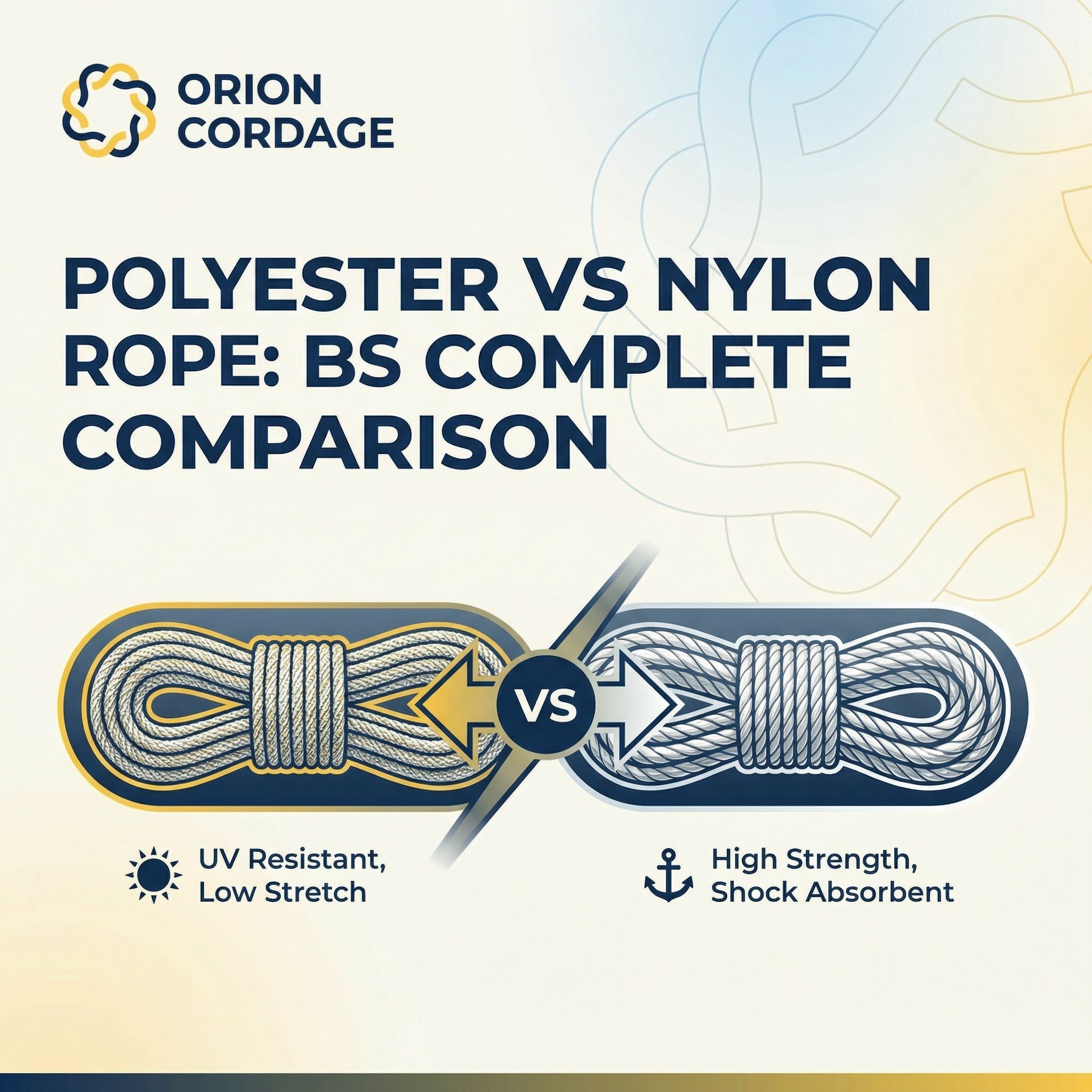
Polyester stands as the benchmark for UV resistance among common synthetic fibres. Its molecular structure provides inherent protection against UV degradation.
Performance data: Polyester retains 95% of its tensile strength after 1,000 hours of accelerated UV testing, equivalent to approximately 3 years of continuous outdoor exposure.
Additional benefits include:
- Low stretch (3-5% under load) for dimensional stability
- High abrasion resistance for extended service life
- Complete resistance to rot and mildew
- Zero water absorption, maintaining strength when wet
- Chemical resistance to most industrial substances
Polyester excels in marine rigging, static lines, mast stays, and industrial applications where UV exposure is constant and low stretch is critical.
Nylon Rope
Nylon provides excellent UV resistance combined with superior strength-to-weight ratio and shock absorption capabilities. Its hygroscopic nature, however, creates performance trade-offs in wet conditions.
UV performance: Nylon retains over 85% of its strength after 500 hours of UV exposure, making it suitable for most outdoor applications.
Moisture impact: Nylon absorbs 3-6% water by weight, causing a 10-15% reduction in tensile strength when wet. This characteristic requires consideration in marine and high-humidity environments.
Ideal applications include:
- Towing lines where shock absorption prevents sudden loads
- Anchor lines that benefit from elastic stretch
- Fall protection systems requiring energy absorption
- Dynamic load applications where elasticity is beneficial
Orion Cordage's Superior 3-Strand Nylon combines high tensile strength with UV resistance for marine and utility applications requiring weather protection and durability.
Polypropylene Rope
Polypropylene presents a cost-effective option with significant performance differences between treated and untreated versions.
Untreated polypropylene: Loses 20-30% strength within 600 hours (approximately 6 months), making it unsuitable for long-term outdoor use without stabilisation.
UV-stabilised polypropylene: With proper UV-stabiliser additives, treated polypropylene can retain approximately 90% strength after 2,000 hours of exposure, dramatically extending its outdoor lifespan.
Key advantages:
- Floats on water (ideal for marine safety lines and buoys)
- Lightweight (easiest to handle among synthetic fibres)
- Dielectric properties (safe for electrical utility work)
- Cost-effective when UV-stabilised
- Chemical resistance to acids and alkalis
Suitable applications include swimming lane markers, marine buoys, utility pulling lines, and temporary outdoor installations when UV-stabilised formulations are specified. Orion's Unmanila 3-Strand Polypropylene offers moisture and UV resistance for marine, industrial, and recreational applications.

Manila and Natural Fibre Ropes
Natural fibre ropes including manila, sisal, and jute have poor UV resistance and are susceptible to biological degradation.
Performance: Manila can lose 30% of its strength after 12 months in high-UV environments, with additional degradation from rot, mildew, and moisture absorption.
Limited use cases:
- Decorative applications where aesthetics matter
- Short-term projects with minimal safety requirements
- Indoor rigging where UV exposure is negligible
- Historical restoration requiring authentic materials
Natural fibres should not be specified for safety-critical or long-term outdoor applications.
What to Consider When Choosing UV Resistant Rope
Selecting the right UV-resistant rope requires balancing technical performance, environmental conditions, application requirements, and total cost of ownership. These six factors guide informed material selection.
UV Exposure Intensity and Duration
Geographic location dramatically affects UV degradation rates. Tropical and equatorial regions with UV Index ratings above 8 accelerate rope material breakdown.
Temperate climates with seasonal variation provide periodic relief from intense radiation.
Daily sun hours matter: Rope in continuous sun exposure (rooftop installations, open water moorings) degrades faster than rope with partial shade or nighttime storage.
Material matching guidance:
- High-intensity continuous exposure (UV Index 8+): Specify polyester or HALS-treated polypropylene with at least 2% stabilizer loading
- Moderate exposure (UV Index 4-7): Nylon or UV-treated polypropylene performs adequately
- Intermittent exposure: Standard synthetic ropes with basic UV resistance suffice
Application Type and Load Requirements
Different applications demand specific performance characteristics beyond UV resistance.
Static load applications (guy lines, rigging, tie-downs) require low-stretch materials like polyester that maintain dimensional stability under constant tension. Dynamic load applications (towing lines, fall protection, anchor lines) benefit from nylon's elasticity and shock absorption capabilities.
Floating applications (marine safety lines, swimming pool markers) require polypropylene's buoyancy characteristics. Electrical utility work demands polypropylene's dielectric properties for safety around power lines.
Match your rope's stretch, strength, and handling characteristics to your specific load profile and operational requirements.
Environmental Conditions Beyond UV
Outdoor ropes face multiple simultaneous stressors that interact with UV degradation. Consider these environmental factors:
- Saltwater environments require materials resistant to both UV and salt crystallization. Salt crystals work into fibers and act like microscopic knives during flexing. Polyester's zero water absorption makes it superior for marine applications.
- Chemical exposure from acids, solvents, or alkalis needs chemically resistant materials. Polypropylene offers excellent acid resistance, while polyester handles most industrial chemicals.
- Abrasion in high-traffic areas or rough surfaces demands abrasion-resistant materials. Polyester and nylon outperform polypropylene in abrasion testing.
- Temperature extremes affect material performance across your operating range. Nylon loses strength in high heat, while polypropylene becomes brittle in extreme cold.
Combined exposure factors create accelerated degradation. A marine mooring line faces UV, saltwater, abrasion, and dynamic loads simultaneously, requiring premium UV-resistant polyester for reliable long-term performance.

Expected Lifespan and Replacement Cycle
Premium UV-resistant materials cost more upfront but deliver lower total cost of ownership through extended service life. The initial investment pays off through reduced replacement frequency and lower labor costs.
Cost-benefit analysis:
| Material Type | Outdoor Lifespan | Replacement Frequency |
|---|---|---|
| Polyester/HALS-treated PP | 3-5 years | Every 3-5 years |
| Standard nylon | 2-3 years | Every 2-3 years |
| Untreated polypropylene | 6-12 months | Annual replacement |
Calculate total cost of ownership:
- Material cost per replacement cycle
- Labor cost for rope replacement
- Operational downtime during replacement
- Safety risk and liability exposure
- Inspection and maintenance requirements
IRopes' analysis of a 10km rope fleet showed UV-stabilized ropes saved approximately $300,000 over three years compared to standard polypropylene due to reduced replacement frequency and lower labor costs.
For projects lasting longer than 12 months, investing in premium UV-resistant materials delivers positive ROI within the first replacement cycle.
Color and Construction Impact on UV Performance
Rope color significantly affects UV resistance. Dark colors containing carbon black additives provide superior UV protection by absorbing radiation before it penetrates fiber cores. Renco Nets' UV testing shows black polypropylene ropes lost only 12% strength after 600 hours, compared to 30% loss for white ropes.
Color selection guidelines:
- Black or dark colors: Maximum UV protection, ideal for long-term outdoor use
- Bright colors (yellow, orange): Enhanced visibility for safety applications, require UV inhibitor additives to maintain performance
- White or light colors: Fastest fading and degradation unless formulated with specialized UV stabilizers
Construction type influences UV exposure:
- Twisted (3-strand) ropes: Fibers constantly spiral to the surface, exposing more material to UV over time. Can suffer 25% greater strength loss than protected constructions.
- Double braid ropes: Feature a sacrificial outer cover that shields the load-bearing core, significantly extending UV life
- Kernmantle construction: Provides maximum core protection with a dedicated UV-resistant sheath
For critical outdoor applications, specify double braid or kernmantle construction with dark-colored covers to maximize UV protection.

Regulatory and Safety Standards
Safety-critical applications must comply with industry-specific standards that may specify UV resistance requirements.
Relevant standards include:
- ASTM G154: Standard practice for UV lamp apparatus testing of non-metallic materials
- ISO 2307: Methods for determining physical and mechanical properties of fiber ropes
- OSHA 1926.104(c): Requires lifelines to have minimum 5,400 lbs breaking strength, implying UV-resistant materials for outdoor safety rigging
Industry-specific requirements:
- Utilities: Power companies often specify UV-resistant rope for transmission line work
- Construction: Fall protection systems require certified UV-stable lifelines
- Marine: Coast Guard and classification societies specify UV resistance for safety equipment
Verify that your rope selection meets applicable regulatory requirements for your industry and application.
How Orion Cordage Can Help
Orion Cordage has manufactured durable, UV-resistant rope solutions since 1856, bringing over 165 years of expertise in material selection, custom formulations, and strict quality control.
Their domestic manufacturing facilities in the USA and Canada produce thousands of SKUs designed and tested for demanding outdoor conditions across diverse industries.
This commitment to quality ensures customers receive reliable UV-resistant cordage backed by decades of manufacturing excellence and real-world performance validation.
UV-Resistant Rope Capabilities:
- In-house design and testing - All products are engineered, manufactured, and tested at Orion's own facilities, ensuring quality control throughout production
- UV-stabilized formulations - Available across polyester, nylon, and polypropylene materials to match your specific application requirements
- Custom solutions - Tailored rope specifications for unique environmental conditions and performance demands
- High product availability - Thousands of SKUs with tight lead times and reliable supply chain integration
- 150+ years experience - Rope manufacturing since 1856 serving industrial, marine, utility, and rigging professionals
- Domestic manufacturing - USA and Canada production facilities with direct quality oversight
Orion serves six primary industries—Industrial, Fall Protection, Power Utility, Commercial Marine, Pleasure Marine, and Rigging—with UV-resistant rope solutions engineered for each sector's specific demands.
Conclusion
Choosing UV-resistant rope isn't about finding the most expensive option—it's about matching material properties to your specific exposure conditions, application requirements, and performance expectations. The right selection balances initial investment with total lifespan value, operational reliability, and safety performance.
Premium UV-resistant materials like polyester and HALS-treated polypropylene cost more upfront but typically deliver lower total cost of ownership through extended service life and reduced replacement frequency.
For safety-critical applications, the investment in proven UV-resistant materials provides essential protection against premature failure.
UV resistance should be verified through material specifications and testing standards like ASTM G154, not marketing claims alone. Domestically manufactured rope from established producers like Orion Cordage undergoes rigorous quality testing to ensure consistent UV performance across product lines.
Even the most UV-resistant ropes benefit from regular maintenance practices:
- Periodic inspection for surface powdering, color fading, and stiffness
- Proper storage out of direct sunlight when not in use
- Regular cleaning to remove contaminants that accelerate degradation
These simple practices extend rope life and ensure reliable performance regardless of material selection.
Frequently Asked Questions
What rope is most UV resistant?
Polyester offers the best UV resistance among common synthetic fibers, retaining over 95% tensile strength after 1,000 hours of UV exposure. It outperforms nylon slightly and maintains full strength when wet, making it ideal for marine and outdoor applications.
What UV-resistant coatings are used for rope?
The most common UV protections include HALS (Hindered Amine Light Stabilizers) additives, carbon black pigments that absorb UV radiation, and UV-blocking polymer coatings. Premium ropes often combine multiple protective treatments for maximum durability.
How long does UV-resistant rope last outdoors?
UV-resistant polyester or nylon rope typically lasts 3-5 years in continuous outdoor exposure, while UV-treated polypropylene lasts 2-3 years. Actual lifespan depends on sun intensity, maintenance practices, and exposure conditions.
Does rope color affect UV resistance?
Yes, darker colors offer superior UV protection due to carbon black content that absorbs UV radiation. Black ropes retain significantly more strength than white or bright-colored ropes after extended sun exposure, though bright colors can be formulated with UV inhibitors.
What are signs of UV damage in rope?
Key signs include color fading, chalky surface powdering, increased stiffness, surface fraying with fiber "whiskers," and reduced flexibility. Retire any rope showing powdering or significant stiffness immediately, as internal strength may be severely compromised.
Can you improve UV resistance of existing rope?
No, UV damage is cumulative and irreversible—once molecular chains break, they cannot be repaired. Choose UV-resistant materials upfront, store rope in shade when not in use, and replace at first signs of degradation.